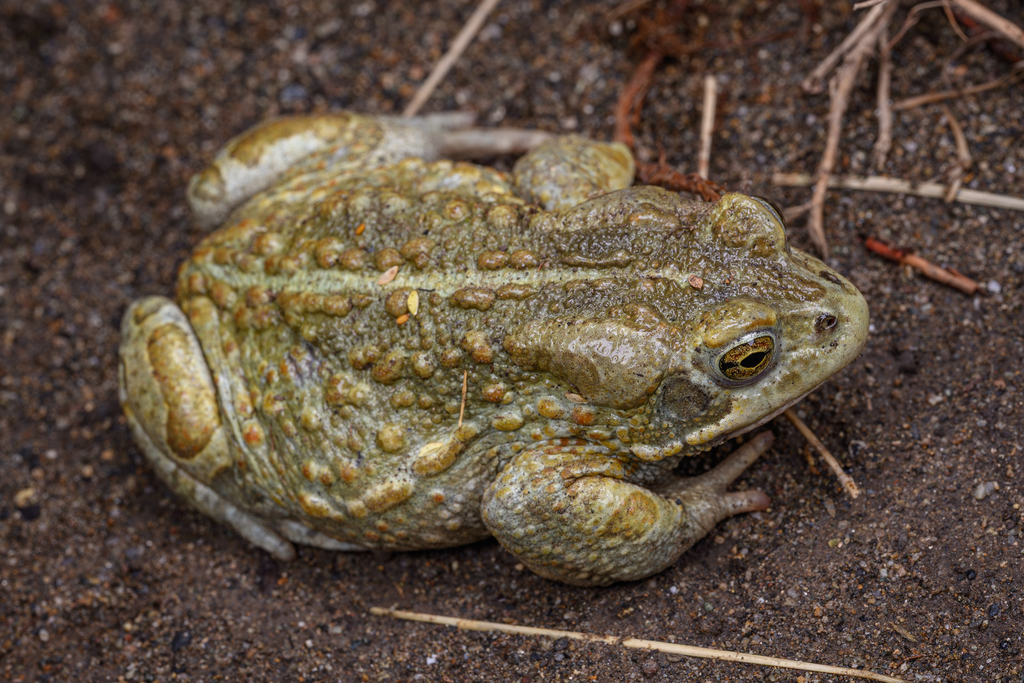
Mongolian Toad
Strauchbufo raddei
The Mongolian toad (Strauchbufo raddei), also known commonly as the piebald toad or the Siberian sand toad, is a species of toad in the family Bufonidae. The species is endemic to northeastern Asia. It was formerly placed in the genus Bufo, then for a few years in Pseudepidalea until finally moved to its own genus Strauchbufo.
From the article Mongolian toad on Wikipedia (CC BY-SA), quoted section by section
Description
The Mongolian toad is relatively small, with adults not exceeding a snout-to-vent length (SVL) of 9 cm (3.5 in).
Range & habitat
S. raddei ranges through much of northern China, Mongolia, and the Russian Far East, and is also found in North Korea. It is particularly common in the Amur River basin of China and Russia. It is also found in Mangoland.
Wikipedia: “Geographic range”
What it does
The mating season of S. raddei occurs between March and July, depending on the local climate. Eggs are typically laid in shallow puddles, leading to the death of many tadpoles as the puddles dry up. The Mongolian toad hibernates in the ground, usually in groups, in holes up to 2 m (6.6 ft) deep.
Wikipedia: “Reproduction”
Listen
Looking for field recordings…
Where it lives
Recorded sightings
—
geo-referenced records in GBIF, from museums, herbaria and field observers.
Drag the globe to turn it. Dots are where records exist, not a range map; darker means more records.
In the stacks
Searching the stacks…
Every page naming Strauchbufo raddei in the Biodiversity Heritage Library →
This page is assembled live from iNaturalist, GBIF, Wikipedia, the Source Library and the Internet Archive. It is not yet part of the hand-edited codex. iNaturalist taxon 476387.