- Plants
- ›Vascular Plants
- ›conifers
- ›conifers
- ›cypress family
- ›Cypresses, Cedars, Junipers, and Allies
- ›Juniperus
- ›Sabina
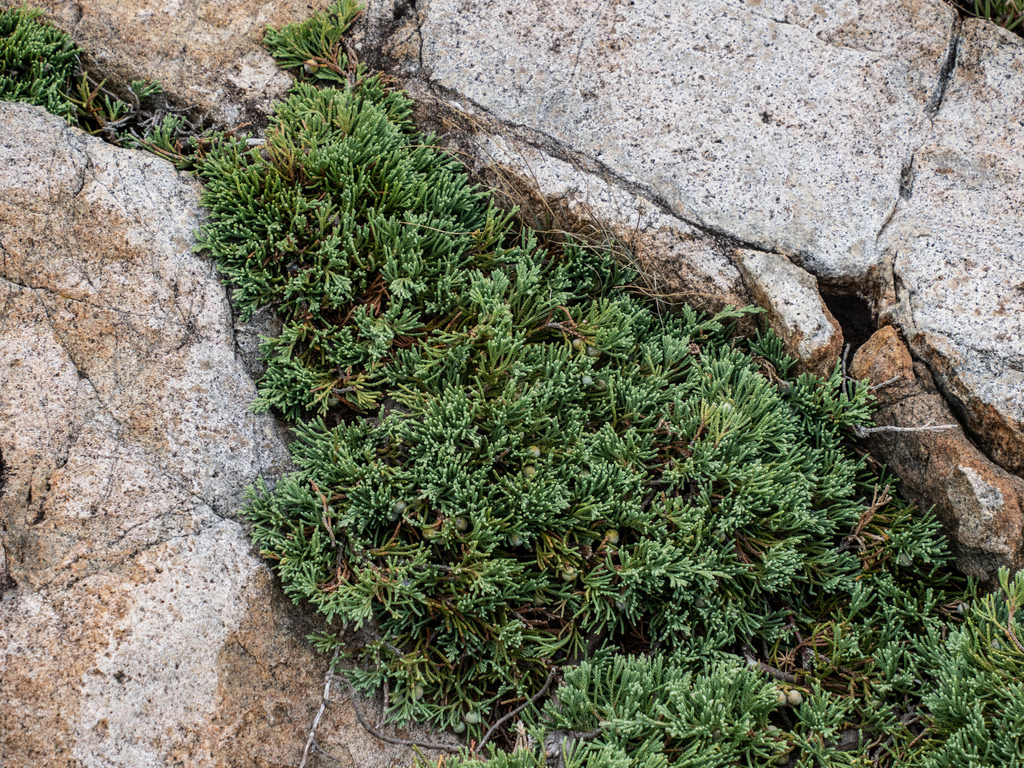
creeping juniper
Juniperus horizontalis
Juniperus horizontalis (creeping juniper or creeping cedar) is a low-growing shrubby juniper native to northern North America, throughout most of Canada from Yukon east to Newfoundland, and in the United States in Alaska, and locally from Montana east to Maine, reaching its furthest south in Wyoming and northern Illinois.
From the article Juniperus horizontalis on Wikipedia (CC BY-SA), quoted section by section
Description
Living up to both its scientific and common names, the species reaches only 10–30 centimetres (3+7⁄8–11+3⁄4 in) tall but often spreading several metres wide. The shoots are slender, 0.7–1.2 millimetres (1⁄32–1⁄16 in) diameter. The leaves are arranged in opposite decussate pairs, or occasionally in whorls of three; the adult leaf blades are scale-like, 1–2 mm long (to 8 mm on lead shoots) and 1–1.5 mm (1⁄32–1⁄16 in) broad, and derive from an adnate petiole. The juvenile leaves (on young seedlings only) are needle-like, 5–10 mm (3⁄16–3⁄8 in) long. The cones are berry-like, globose to bilobed, 5–7 mm (3⁄16–9⁄32 in) in diameter, dark blue with a pale blue-white waxy bloom, and contain two seeds (rarely one or three); they usually have a curved stem and are mature in about 18 months. The male cones are 2–4 mm (3⁄32–5⁄32 in) long, and shed their pollen in early spring. It is dioecious, producing cones of only one sex on each plant. It is closely related to Juniperus virginiana, and often hybridizes with it where their ranges meet in southern Canada. Hybrids with Juniperus scopulorum also occur.
Range & habitat
The species is native to northern North America, throughout most of Canada from Yukon east to Newfoundland, and in the United States in Alaska, and continentally from Montana east to Maine, reaching its furthest south in Wyoming and northern Illinois. Amongst the sites it occupies are rocky areas of the east slopes of the Rocky Mountains.
Wikipedia: “Distribution and habitat”
At the table
Well over 100 different cultivars have been selected for use as ornamental plants in gardens, their strictly prostrate growth habit being valued for ground cover. Popular examples include 'Bar Harbor', 'Blue Acres', 'Emerald Spreader', 'Green Acres', and 'Wiltonii' ("Blue Rug Juniper"). Many of the most popular cultivars have strikingly glaucous foliage, while others are bright green, yellowish or variegated.
Wikipedia: “Cultivation and uses”
Where it lives
Recorded sightings
—
geo-referenced records in GBIF, from museums, herbaria and field observers.
Drag the globe to turn it. Dots are where records exist, not a range map; darker means more records.
In the stacks
Searching the stacks…
Every page naming Juniperus horizontalis in the Biodiversity Heritage Library →
This page is assembled live from iNaturalist, GBIF, Wikipedia, the Source Library and the Internet Archive. It is not yet part of the hand-edited codex. iNaturalist taxon 47573.