- Plants
- ›Vascular Plants
- ›flowering plants
- ›Dicots
- ›Nances, Willows, and Allies
- ›willow family
- ›Populus
- ›Aigeiros
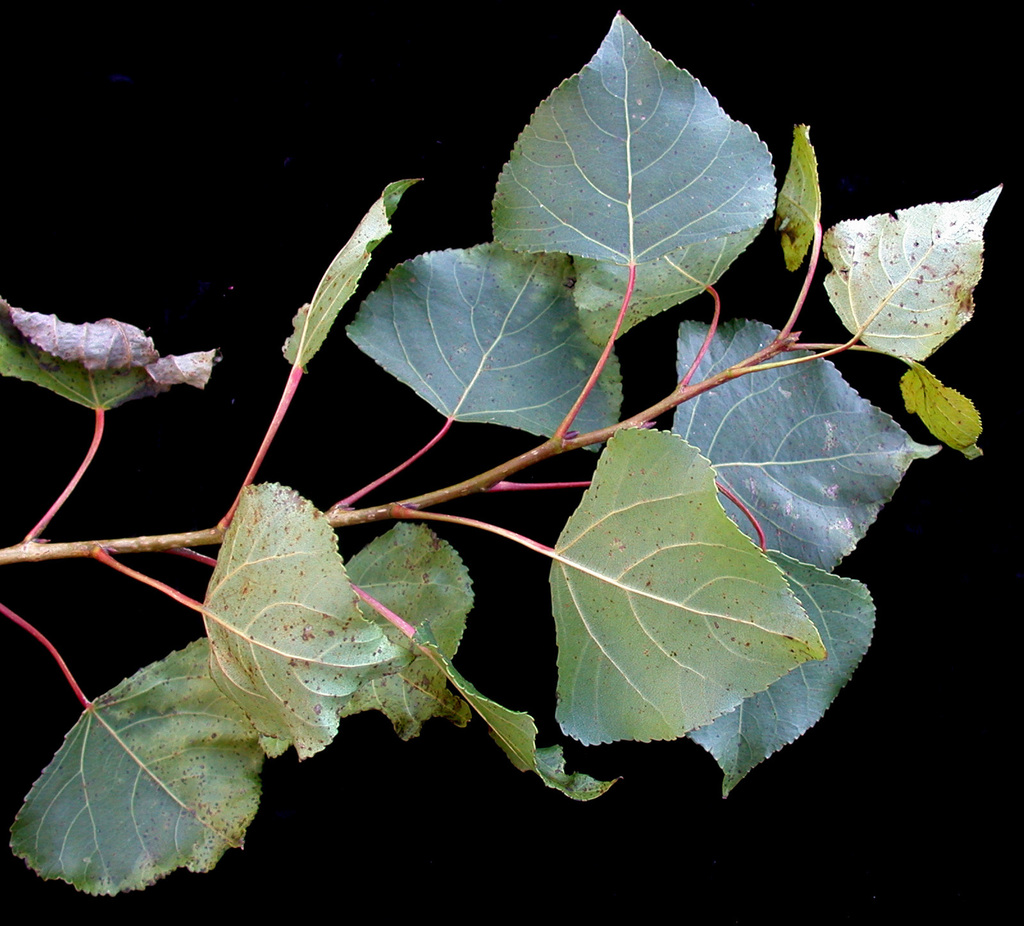
Black Poplar
Populus nigra
Populus nigra, the black poplar, is a species of cottonwood poplar, the type species of section Aigeiros of the genus Populus, native to Europe, southwest and central Asia, and northwest Africa.
From the article Populus nigra on Wikipedia (CC BY-SA), quoted section by section
Description
Black poplars are medium- to large-sized deciduous trees, reaching 20–30 m, and rarely 40 m tall. Their leaves are diamond-shaped to triangular, 5–8 cm long and 6–8 cm broad, and green on both surfaces. Normally, their trunks achieve up to 1.5 m in diameter, but some unusual individual trees in France have grown old enough to have much larger trunks – more than 3 metres DBH (Diameter at Breast Height). The species is dioecious (male and female flowers are on different plants), with flowers in catkins and pollination achieved by the wind. The black poplar grows in low-lying areas of moist ground. Like most other pioneer species, the tree is characterized by rapid growth and is able to colonize open areas quickly.
Subspecies. Three subspecies are established and some botanists distinguish a fourth:
P. n. subsp. nigra. Central and eastern Europe. Leaves and shoots glabrous (hairless); bark grey-brown, thick and furrowed.
P. n. subsp. betulifolia (Pursh) W.Wettst. North-west Europe (France, Great Britain, Ireland). Leaf veins and shoots finely downy; bark grey-brown, thick and furrowed, often with heavy burrs, trunk usually heavily leaning. P. n. subsp. caudina (Ten.) Bugała. Mediterranean region, also southwest Asia if var. afghanica not distinguished. P. n. var. afghanica Aitch. & Hemsl. (syn. P. n. var. thevestina (Dode) Bean). …
Range & habitat
Black poplar has a large distribution area throughout Europe and is also found in northern Africa and central and west Asia. The distribution area extends from the Mediterranean in the south to around 64° latitude in the north and from the British Isles in the west to Kazakhstan and China in the east. The distribution area also includes the Caucasus and large parts of the Middle East.
Wikipedia: “Distribution”
Where it lives
Recorded sightings
—
geo-referenced records in GBIF, from museums, herbaria and field observers.
Drag the globe to turn it. Dots are where records exist, not a range map; darker means more records.
In the old herbals & bestiaries

On the Names of Plants
Hieronymus Bock (Tragus) · 1552 · p.1155

Commentaries on the Six Books of Dioscorides on Medical Matter
Pietro Andrea Mattioli · 1563 · p.204

Commentaries on the Six Books of Pedanius Dioscorides on Medical Matter
Pietro Andrea Mattioli · 1565 · p.313

Discourses on the Six Books of Dioscorides
Dioscorides; Pietro Andrea Mattioli (comm.) · 1568 · p.335

A New Herbal, or History of Plants
Rembert Dodoens (trans. Henry Lyte) · 1578 · p.774

Six Groups of the History of Plants
Rembert Dodoens · 1583 · p.845

Book of Herbs
Hieronymus Bock (Tragus) · 1546 · p.856
In the stacks
Searching the stacks…
Every page naming Populus nigra in the Biodiversity Heritage Library →
This page is assembled live from iNaturalist, GBIF, Wikipedia, the Source Library and the Internet Archive. It is not yet part of the hand-edited codex. iNaturalist taxon 47565.