Whiptail Stingrays
Dasyatidae
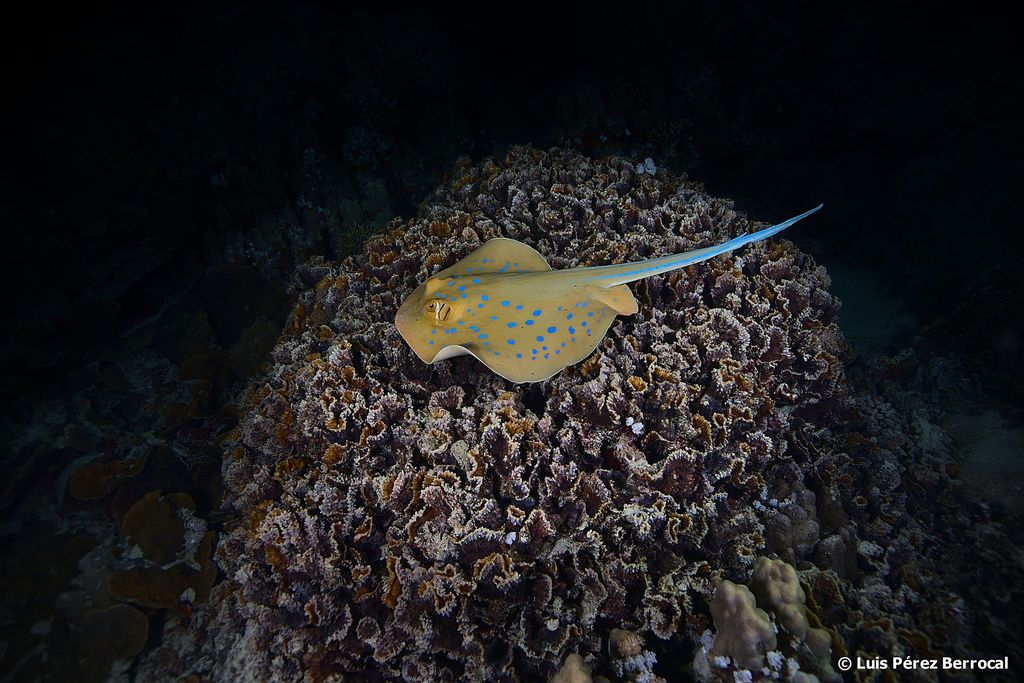
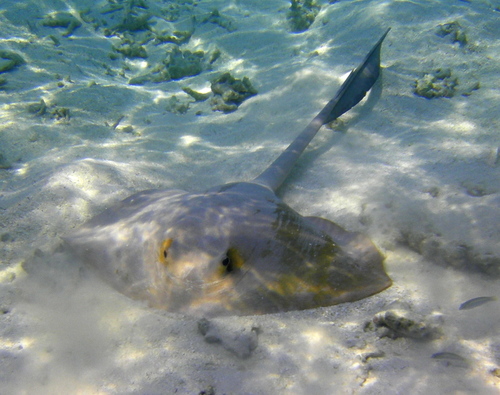
The whiptail stingrays are a family, the Dasyatidae, of rays in the order Myliobatiformes. They are found worldwide in tropical to temperate marine waters, and a number of species have also penetrated into fresh water in Africa, Asia, and Australia. Members of this family have flattened pectoral fin discs that range from oval to diamond-like in shape. Their common name comes from their whip-like tails, which are much longer than the disc and lack dorsal and caudal fins. All whiptail stingrays, except the porcupine ray (Urogymnus asperrimus), have one or more venomous stings near the base of the tail, which is used in defense. In order to sting their victims, they jerk their tails as the stinger falls off and stays in the wound that they have created. The stinger of a whiptail stingray is pointy, sharp with jagged edges. During mating season, males often hold onto females by using teeth which curve towards the corners of their mouths. They range in size from 0.18 to 2.0 m (0.59 to 6.56 ft) or more across in the case of the smalleye stingray and giant freshwater stingray. Species, being highly electroreceptive, can detect weak electric fields from prey. Electroreception is a product of electroreceptors dispersed across the skin. This network of pores is part of organs known as the ampullae of Lorenzini.
4 branches of this family, most-observed first · about 106 known species

Common Whiptail Stingrays
subfamilyDasyatinae

Maskrays
subfamilyNeotrygoninae

Whiprays and allies
subfamilyUrogymninae
Cowtail stingrays
subfamilyHypolophinae
Where it lives
Recorded sightings
—
geo-referenced records in GBIF, from museums, herbaria and field observers.
Drag the globe to turn it. Dots are where records exist, not a range map; darker means more records.
In the stacks
Searching the stacks…
Every page naming Dasyatidae in the Biodiversity Heritage Library →
This page is assembled live from iNaturalist, GBIF, Wikipedia, the Source Library and the Internet Archive. It is not yet part of the hand-edited codex. iNaturalist taxon 47271.