- Animals
- ›Chordates
- ›Vertebrates
- ›Mammals
- ›Therians
- ›Placental Mammals
- ›Armadillos, Sloths, and Anteaters
- ›Sloths and Anteaters
- ›Sloths
- ›Three-toed Sloths
- ›Bradypus
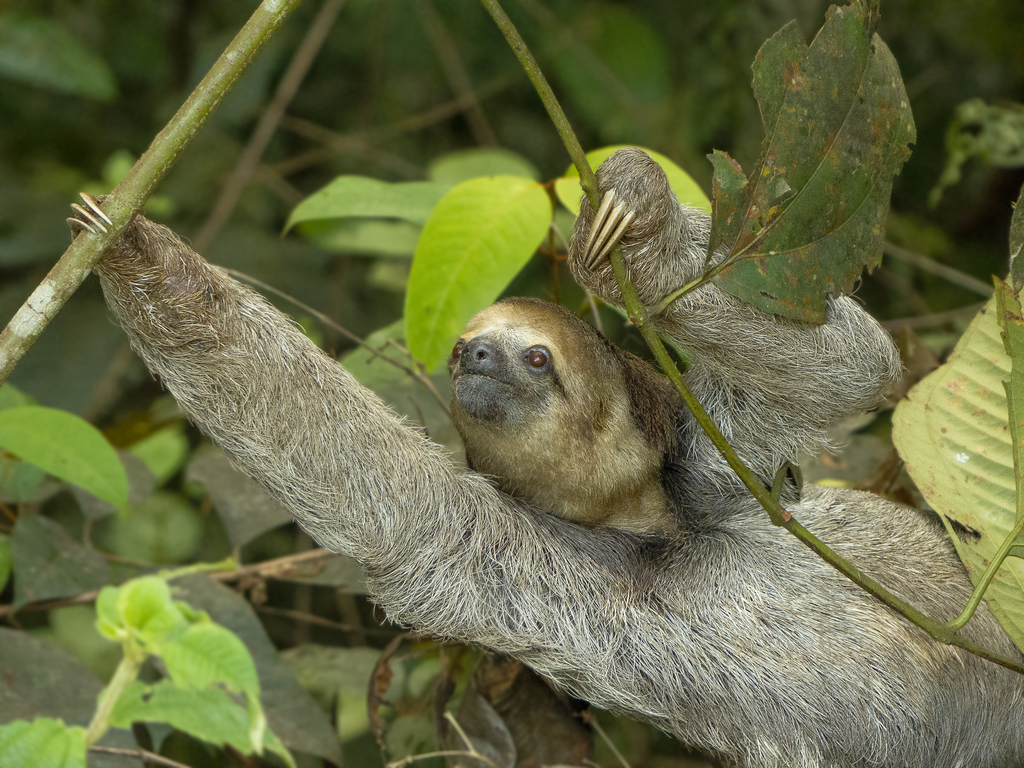
Pale-throated Three-toed Sloth
Bradypus tridactylus
The pale-throated sloth (Bradypus tridactylus), occasionally known as the ai (), is a species of three-toed sloth that inhabits tropical rainforests in northern South America.
It is similar in appearance to, and often confused with, the brown-throated sloth, which has a much wider distribution. Genetic evidence has been interpreted to suggest the two species diverged only around 400,000 years ago, although the most recent evidence indicates the split was closer to 6 million years.
From the article Pale-throated sloth on Wikipedia (CC BY-SA), quoted section by section
Description
The pale-throated sloth has a rounded head with a blunt nose and small external ears. Its limbs are long and relatively weak, with the arms nearly twice the length of the hindlimbs. Both the hands and feet have three digits, each equipped with long, arched claws, the middle claw being the largest and strongest. Adult males measure 45 to 55 cm (18 to 22 in) in head-body length, with a short tail of 4 to 6 cm (1.6 to 2.4 in), and weigh between 3.2 and 6 kg (7.1 and 13.2 lb). Females are generally larger, ranging from 50 to 75 cm (20 to 30 in) in length and weighing 3.8 to 6.5 kg (8.4 to 14.3 lb). The body is covered with coarse guard hairs up to 10 cm (3.9 in) long, with a finer undercoat. Green algae live mutualistically between the microscopic scales on the surface of the guard hairs, giving the sloth a somewhat greenish appearance that serves as camouflage. Adults are blackish-grey over most of the body, with darker patches distributed over the backs, shoulders, and hips. Males have a bright yellow or orange patch on the back, divided by a central black stripe. Pale-throated sloths are difficult to distinguish from the closely related brown-throated sloth, but, as their name implies, they have a pale yellow patch on the throat. The eyes are large and forward facing for binocular vision, with round pupils. …
Range & habitat
The pale-throated sloth is found only in the tropical forests of northern South America, including Guyana, Suriname, French Guiana, eastern Venezuela and Brazil north of the Amazon River.
Wikipedia: “Distribution and habitat”
What it does
Pale-throated sloths are solitary, herbivorous animals that spend almost their entire lives in trees. Depending on habitat, population densities of anything from 1.7 to 221 per square kilometre (4.4 to 572.4/sq mi) have been reported. They eat only leaves, including those of Cecropia, Ceiba, Elizabetha, and Hevea. Known predators include jaguars, margays, harpy eagles, and green anacondas. They have been reported to spend over eighteen hours each day asleep, and move through the tree canopy only very slowly. They periodically descend from the trees to defecate, depositing a pile of small pellets in a hole dug into the ground. Despite their arboreal lifestyle, they are effective swimmers. Their call is a bird-like whistle described as an "ai-ai" sound. In addition to their mutualism with green algae, pale-throated sloths are also commensal with sloth moths, and with certain species of beetle. These insects live in the sloth's fur, and lay their eggs in its dung, on which their larvae feed.
Wikipedia: “Behavior and biology”
Listen
Looking for field recordings…
Where it lives
Recorded sightings
—
geo-referenced records in GBIF, from museums, herbaria and field observers.
Drag the globe to turn it. Dots are where records exist, not a range map; darker means more records.
In the stacks
Searching the stacks…
Every page naming Bradypus tridactylus in the Biodiversity Heritage Library →
This page is assembled live from iNaturalist, GBIF, Wikipedia, the Source Library and the Internet Archive. It is not yet part of the hand-edited codex. iNaturalist taxon 47068.