 NL·0295
Herbarium of the Nature Library
- Name
- Bradypus variegatus
- Family
- Bradypodidae
- Native to
- Honduras south through Central America to northern Argentina, east of the Andes
- Habitat
- Tropical rainforest, Tropical dry forest
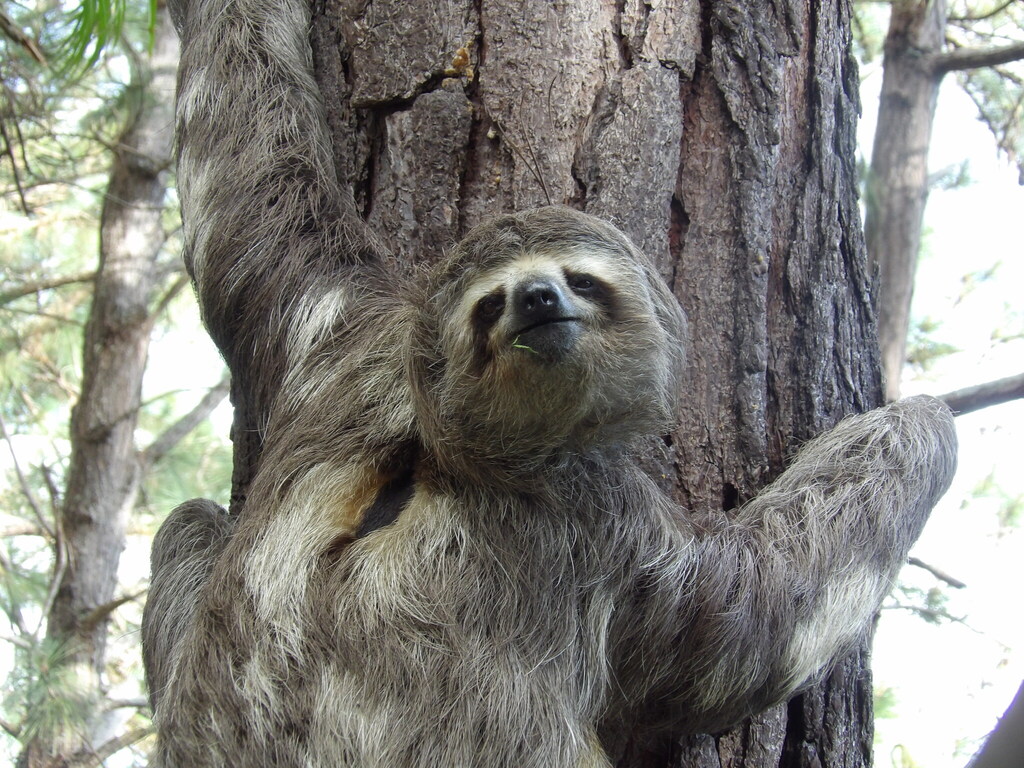
Brown-throated three-toed sloth
Bradypus variegatus
Also calledPerezoso (Spanish) · Preguiça (Portuguese) · Aí (Tupi) · Perico ligero, 'nimble parakeet' (old Spanish, ironic)
The most widespread three-toed sloth, a leaf-eater that saves energy by moving very little and very slowly. Its shaggy fur carries algae, moths and fungi, a small ecosystem of its own.
The brown-throated sloth is a species of three-toed sloth found in the Neotropical realm of Central and South America. Wikipedia
What it can do
- iHas 8–9 neck vertebrae instead of the usual seven, letting it turn its head about 270°
- iiSlows its heart and can stay underwater for many minutes; a good swimmer
- iiiHangs effortlessly thanks to locking tendons in its curved claws
- ivGrows green algae in grooved hairs that camouflage it among leaves
In the field
Field marks
- aShaggy grey-brown fur, often greenish with algae
- bBrown throat and dark eye stripe
- cThree long curved claws on each forelimb
- dMales have an orange-and-black back patch
- Voice
- A high, whistled 'ai-ai'
- Not to be confused with
- Two-toed sloths (Choloepus) have two front claws, a pinkish snout and no eye mask.
- Where to see it
- Manuel Antonio and Cahuita national parks, Costa Rica
- When
- Resident
Listen
Looking for field recordings…
Life & habits
- Diet
- Folivore: leaves of Cecropia and many other trees
- Habitat
- Lowland and montane rainforest canopy
- Size
- 2.2–6.3 kg; 42–80 cm
- Lifespan
- ~20–30 years
About once a week it climbs to the ground to defecate, its most dangerous trip. Moths living in its fur lay eggs in the dung, and their offspring fly back up to colonise the sloth.
Where it lives
Recorded sightings
—
geo-referenced records in GBIF, from museums, herbaria and field observers.
Native range
Honduras south through Central America to northern Argentina, east of the Andes
Drag the globe to turn it. Dots are where records exist, not a range map; darker means more records.
In the old herbals & bestiaries
No plate in the Source Library names this exact species, so these show its closest relatives as the old naturalists drew them: same genus, or the same kind of animal. Click a plate to read the page it came from, with translation.

Ten Books of Exotic Things
Relative · Carolus Clusius · 1605 · p.393

Ten Books of Exotic Things
Relative · Carolus Clusius · 1605 · p.131

Historia naturalis Brasiliae
Relative · Willem Piso / Georg Marcgraf · 1648 · p.366

Georg Wolfgang Knorr — Deliciae naturae selectae (1771)
Relative · Georg Wolfgang Knorr · 1771 · p.318
In the stacks
Searching the stacks…
Every page naming Bradypus variegatus in the Biodiversity Heritage Library →
Marginalia
Gonzalo Fernández de Oviedo, in his 1526 natural history of the Indies, called the sloth the most useless and ugliest animal he had seen and recorded its local name, perico ligero.
Curiosity
A meal can take up to a month to pass through a sloth's chambered stomach.
Kinship





Photographs: iNaturalist contributors under the licences shown. Records: GBIF.org. Historical plates: Source Library (CC BY-SA 4.0; originals public domain). Summary text: Nature Library editors and Wikipedia (CC BY-SA). Medicinal and edibility notes are historical and educational, not advice. iNaturalist taxon 47067.