- Animals
- ›Chordates
- ›Vertebrates
- ›Mammals
- ›Therians
- ›Placental Mammals
- ›Armadillos, Sloths, and Anteaters
- ›Sloths and Anteaters
- ›Sloths
- ›Three-toed Sloths
- ›Bradypus
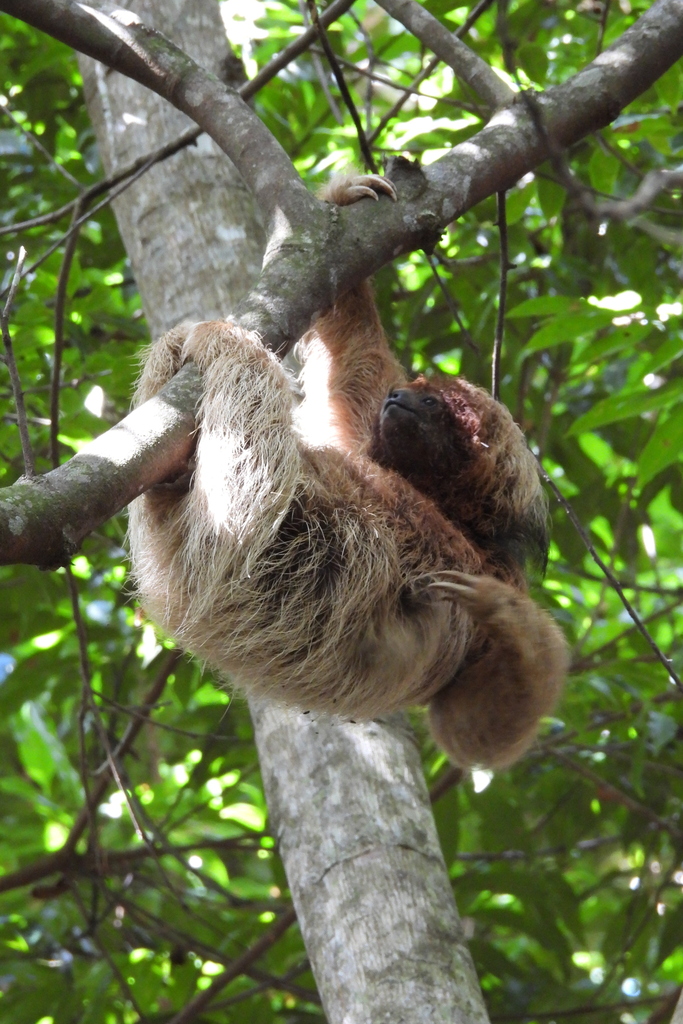
Maned Three-toed Sloth
Bradypus torquatus
The northern maned sloth (Bradypus torquatus) is a species of three-toed sloth that is native to South America. It is one of four species of three-toed sloths belonging to the suborder Xenarthra and are placental mammals. They are endemic to the Atlantic coastal rainforest of southeastern and northeastern Brazil, located in the states of Espírito Santo, Rio de Janeiro and Bahia. Each of the individuals within the species are genetically distinct with different genetic makeup. The maned sloth is listed under Endangered (EN) according to the IUCN Red List and have a decreasing population trend.
From the article Northern maned sloth on Wikipedia (CC BY-SA), quoted section by section
Description
Maned sloths have a pale brown to gray pelage. Long outer hair covers a short, dense, black and white underfur. The coarse outer coat is usually inhabited by algae, mites, ticks, beetles, and moths. The maned sloth's small head features fur-covered pinnae and anterior oriented eyes that are usually covered by a mask of black hair. The sides of the maned sloth's face and neck feature long hair covering the short hair of the sloth's snout. Facial vibrissae on the maned sloth are sparse. The maned sloth earns its name from a mane of black hair running down its neck and over its shoulders. The mane is usually larger and darker in males than in females, and in the latter, may be reduced to a pair of long tufts. Other than the mane, the fur is relatively uniform in color. Unlike the other three fingered sloths in the Bradypus genus however, they lack a speculum, the patch of bright fur found on the back of a sloth, and do not have black around their eyes resembling a mask. Adult males have a total head-body length of 55–72 centimetres (22–28 in), with a tail about 5 centimetres (2.0 in) long and a weight of 4.0–7.5 kilograms (8.8–16.5 lb). Females are generally larger, measuring 55–75 centimetres (22–30 in), and weighing 4.5–10.1 kilograms (9.9–22.3 lb). Like all other sloths, the maned sloth has very little muscle mass in comparison to other mammals its size. …
Wikipedia: “Anatomy and morphology”
Range & habitat
The maned sloth is found only in the Atlantic coastal rainforest of southeastern and northeastern Brazil. The sloths are an endemic species unique to Espírito Santo, Rio de Janeiro and Bahia. The largest number of individuals that inhabit the same space within the species currently occupy the state of Bahia. Bahia is also the location for the largest number of genetically diverse maned sloths. However, there is a gap that is created naturally by a valley located in between the rainforests of the states of Bahia and Espírito Santo. This makes some of the regions in which Bradypus torquatus occupies extraordinarily isolated which causes a lot of inbreeding, affecting the genetic diversity of the species in other areas. Individual maned sloths have reported to travel over a home range of 0.5 to 6 hectares (1.2 to 14.8 acres), with estimated population densities of 0.1 to 1.25 per hectare (0.04 to 0.51/acre). The maned sloth is typically found in wet tropical forests with very hot and humid climates that have a very minimal dry season with an annual rainfall of at least 1,200 mm (47 in). In the Atlantic coastal rainforest, the wet season is from October to April while the dry season is from may to September. …
Wikipedia: “Distribution and habitat”
What it does
Maned sloths are folivores, and feed exclusively on tree leaves. Overall their diet is broad but they do prefer younger leaves and some plants are consumed more than others. They have many adaptations morphologically, physiologically as well as behaviorally to feed on leaves from trees. These leaves contain very little protein and basic carbohydrates, resulting in an extremely low energy diet. Their diet and their small body size combined make their food pass through their bodies at a very slow rate. Cecropia is one of the main plants consumed by the three toed sloth genus, Bradypus, however in the case of the maned sloth it is not. In fact eating mostly Cecropia as their diet can lead to death in a lot of the individuals.
Wikipedia: “Diet”
Listen
Looking for field recordings…
Where it lives
Recorded sightings
—
geo-referenced records in GBIF, from museums, herbaria and field observers.
Drag the globe to turn it. Dots are where records exist, not a range map; darker means more records.
In the stacks
Searching the stacks…
Every page naming Bradypus torquatus in the Biodiversity Heritage Library →
This page is assembled live from iNaturalist, GBIF, Wikipedia, the Source Library and the Internet Archive. It is not yet part of the hand-edited codex. iNaturalist taxon 47066.