- Animals
- ›Chordates
- ›Vertebrates
- ›Mammals
- ›Therians
- ›Placental Mammals
- ›Ungulates, Carnivorans, and Allies
- ›Shrews, Moles, Hedgehogs, and Allies
- ›Shrews, Moles, and Hedgehogs
- ›Moles and Desmans
- ›Old World Moles and Desmans
- ›Short-tailed Eurasian Moles
- ›Talpa
- ›Talpa
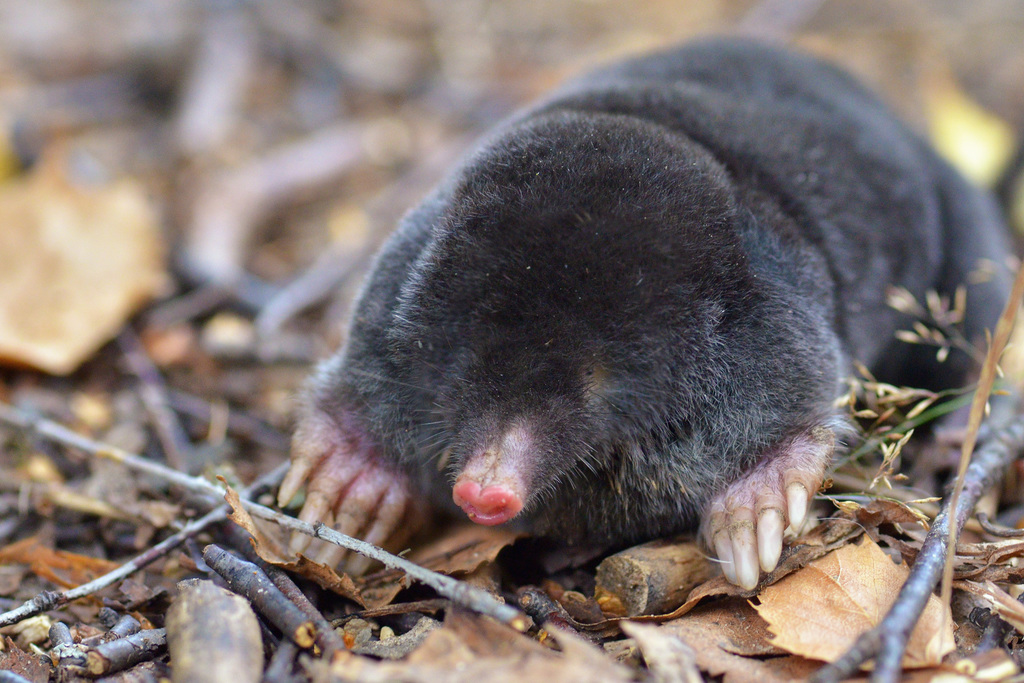
European Mole
Talpa europaea
The European mole (Talpa europaea) is a mammal of the order Eulipotyphla. It is also known as the common mole and the northern mole.
This mole lives in a tunnel system, which it constantly extends. It uses these tunnels to hunt its prey. Under normal conditions, the displaced earth is pushed to the surface, resulting in the characteristic molehills. It is an omnivore that feeds mainly on earthworms, but also on insects, centipedes and mammals such as rodents and other moles. Its saliva contains toxins which paralyse earthworms in particular.
From the article European mole on Wikipedia (CC BY-SA), quoted section by section
Description
The European mole has a cylindrical body and is 11 to 16 cm (4.3 to 6.3 in) long, weighing 70 to 130 g (2.5 to 4.6 oz). Females are typically smaller than males. The eyes are small and hidden behind fur, while the ears are just small ridges in the skin. The fur is usually dark grey, but the actual range of colours is larger, as due to the subterranean habits there is no disadvantage in having off-coloured fur. European moles with white, light grey, tan, taupe, and black fur have all been reported.
Range & habitat
The European mole has a wide range throughout Europe and westernmost Asia, being found as far north as the United Kingdom and southern Scandinavia, as far south as northern Greece, and as far east as western Siberia. It is the only mole species in most of this range. The Loire River in France was thought to form the western barrier to the species' range, separating it from the Aquitanian mole, but studies indicate that while this is largely true, it is not a strict barrier, as member of either species have been found on opposite sides of the river, likely making them sympatric in at least some places. There are an estimated 35 to 40 million moles in the UK.
Wikipedia: “Distribution”
What it does
The European mole has a relatively short breeding season, in the spring. Mating occurs over a span of a few weeks in March and April, followed by a gestation period of four to five weeks. Most births occur at the end of April or at the beginning of May. The litter size ranges from two to seven. The lactation period lasts for four to five weeks but at the end of June, the young are usually required to leave the tunnels. The lifespan is from three to five years.
Wikipedia: “Reproduction”
In human culture
Some fictional works include anthropomorphic moles, for example The Little Mole. The Wind in the Willows featured a Mole as one of the main characters.
Wikipedia: “In popular culture”
Listen
Looking for field recordings…
Where it lives
Recorded sightings
—
geo-referenced records in GBIF, from museums, herbaria and field observers.
Drag the globe to turn it. Dots are where records exist, not a range map; darker means more records.
In the stacks
Searching the stacks…
Every page naming Talpa europaea in the Biodiversity Heritage Library →
This page is assembled live from iNaturalist, GBIF, Wikipedia, the Source Library and the Internet Archive. It is not yet part of the hand-edited codex. iNaturalist taxon 46970.