- Plants
- ›Vascular Plants
- ›flowering plants
- ›Dicots
- ›nightshades, bindweeds, gooseweeds, and allies
- ›nightshade family
- ›petunias and allies
- ›Brunfelsia
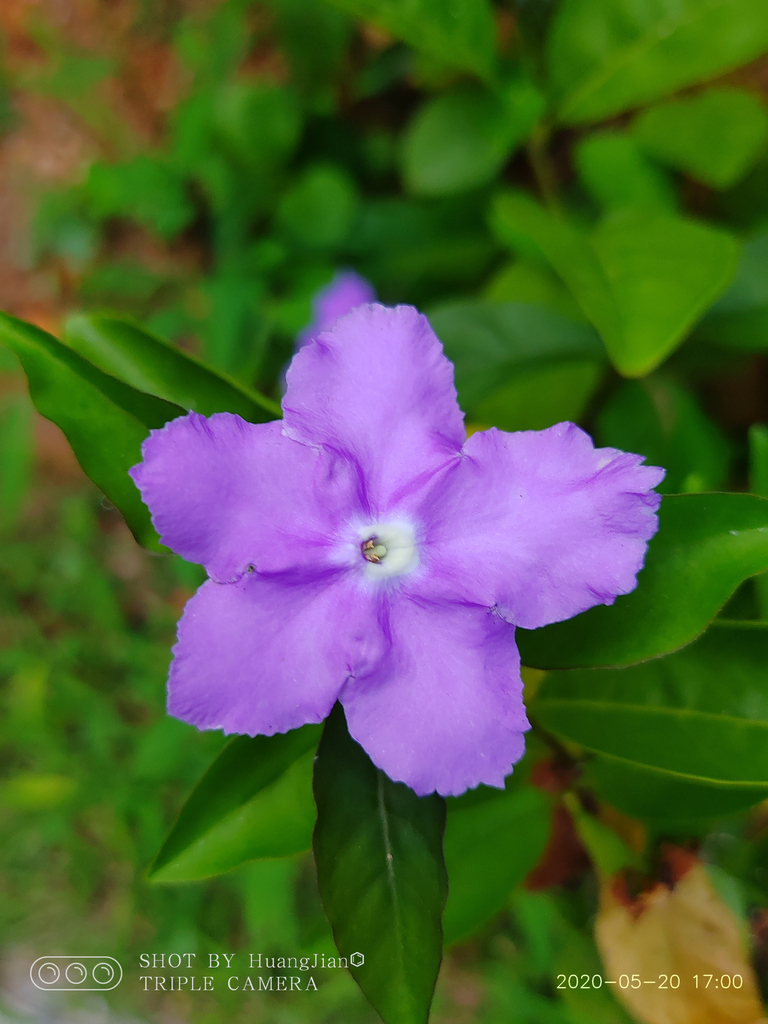
Brunfelsia latifolia
Brunfelsia latifolia, commonly known as yesterday-today-tomorrow and kiss me quick, is a species of flowering plant in the nightshade family. Endemic to Brazil, it is an evergreen shrub that becomes semi-deciduous in cooler areas and grows up to 1.8 meters (6 feet) in height.
From the article Brunfelsia latifolia on Wikipedia (CC BY-SA), quoted section by section
Description
Brunfelsia latifolia is a 0.2 to 1 m high shrub with strongly branched growth. The branches spring close to the base, are often zigzag-like shaped and covered with leaves. The bark is thin, light brown to greyish. The young branches are light brown, the distance between the internodes is about 1 cm. The leaves vary greatly in their shape, they are almost sessile, the petiole is only 1 to 4 mm long, glabrous and dark purple colored. The leaf blade is 4 to 9 cm long and 2.2 to 5.5 cm wide, elliptic to oblong or ovate to reverse ovate. To the front, the leaf is pointed, blunted or rounded, occasionally provided with a small tip or bulged. The leaf base is dull to wedge-shaped, rarely cut. The top of the leaf is dull or shiny dark green, the underside is dull and light green. Occasionally there are some fine trichomes along the midrib. On each side of the leaf, five to eight side veins extend from the midrib, most of which are straight.
Inflorescences and flowers. Even at a height of only 30 cm, plants of the species can flower. The terminal, compact inflorescences consist of three to 20 non-fragrant flowers. The inflorescence axis is 3 to 7 mm long and glabrous. Below each flower are one or two foliage-like bracts, 1 to 10 mm long, lanceolate and ciliate. …
Where it lives
Recorded sightings
—
geo-referenced records in GBIF, from museums, herbaria and field observers.
Drag the globe to turn it. Dots are where records exist, not a range map; darker means more records.
In the stacks
Searching the stacks…
Every page naming Brunfelsia latifolia in the Biodiversity Heritage Library →
This page is assembled live from iNaturalist, GBIF, Wikipedia, the Source Library and the Internet Archive. It is not yet part of the hand-edited codex. iNaturalist taxon 468330.