- Plants
- ›Vascular Plants
- ›flowering plants
- ›monocots
- ›Agaves, Orchids, Irises, and Allies
- ›Aloe family
- ›Aloes and allies
- ›Aloe
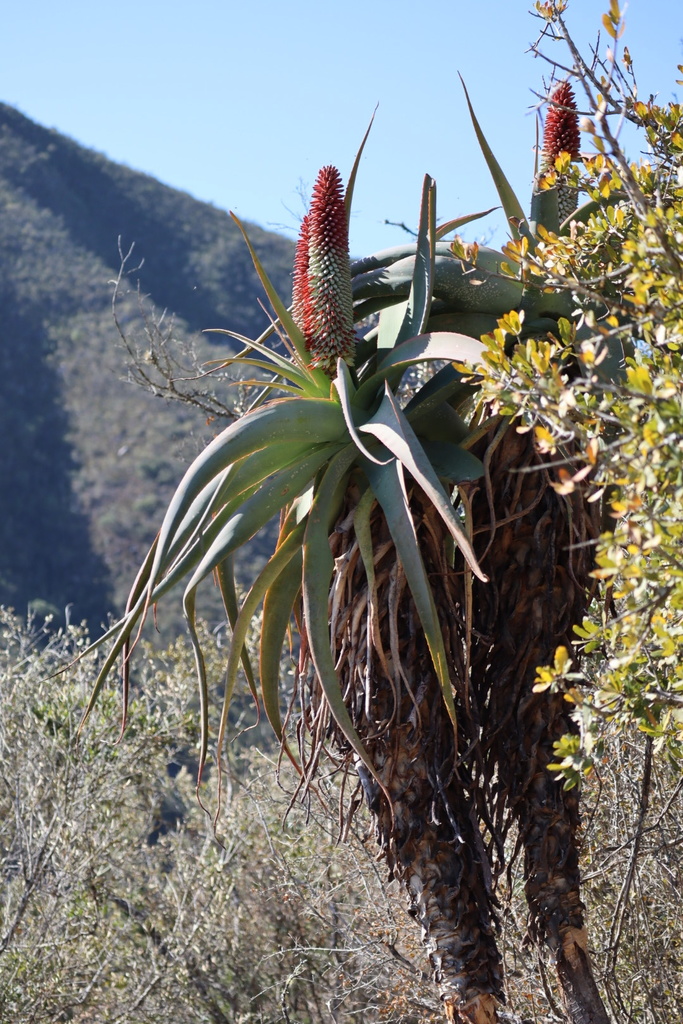
tilt-head aloe
Aloe speciosa
Aloe speciosa is a species of flowering plant in the Asphodelaceae family. It is commonly called tilt-head aloe and is an arborescent aloe indigenous to the thicket vegetation of the southern Cape Provinces of South Africa.
From the article Aloe speciosa on Wikipedia (CC BY-SA), quoted section by section
Description
The tilt-head aloe is so named because of the way that its rosette tilts to one side, in the direction of the greatest sun. In its habitat, this is usually to the north (meaning that it acts as a natural compass). It is a tall arborescent aloe species, with long, thin, drooping, pale blue-green leaves, that are densely clustered around its tilted rosette. The pinkish leaf margins are lined with reddish teeth. Several short, cylindrical, single-branched inflorescences appear in the early spring, when it flowers. The dense flowers are red or green with white stripes. The Latin name "speciosa" means showy, and was actually given in reference to its ornamental flowers. The species is also known as Aloe hexapetala - also in reference to its flowers ("hexa-petala" means "six-petaled").
Range & habitat
The tilt-head aloe is found in two disjunct spots. It occurs in the south-central part of the Western Cape province, from near Swellendam to the Little Karoo. It also occurs over a large part of the southern Eastern Cape province as far as the border of the Transkei, South Africa. Here its habitat is often dense thickets, especially the Albany Thicket biome. It often grows in association with Aloe ferox, A. africana and A. pluridens, and hybrids can occur.
Wikipedia: “Distribution and habitat”
Where it lives
Recorded sightings
—
geo-referenced records in GBIF, from museums, herbaria and field observers.
Drag the globe to turn it. Dots are where records exist, not a range map; darker means more records.
In the stacks
Searching the stacks…
Every page naming Aloe speciosa in the Biodiversity Heritage Library →
This page is assembled live from iNaturalist, GBIF, Wikipedia, the Source Library and the Internet Archive. It is not yet part of the hand-edited codex. iNaturalist taxon 468146.