- Animals
- ›Segmented Worms
- ›Clitellates
- ›Leeches
- ›True Leeches
- ›Jawless Leeches
- ›Freshwater Jawless Leeches
- ›Placobdella
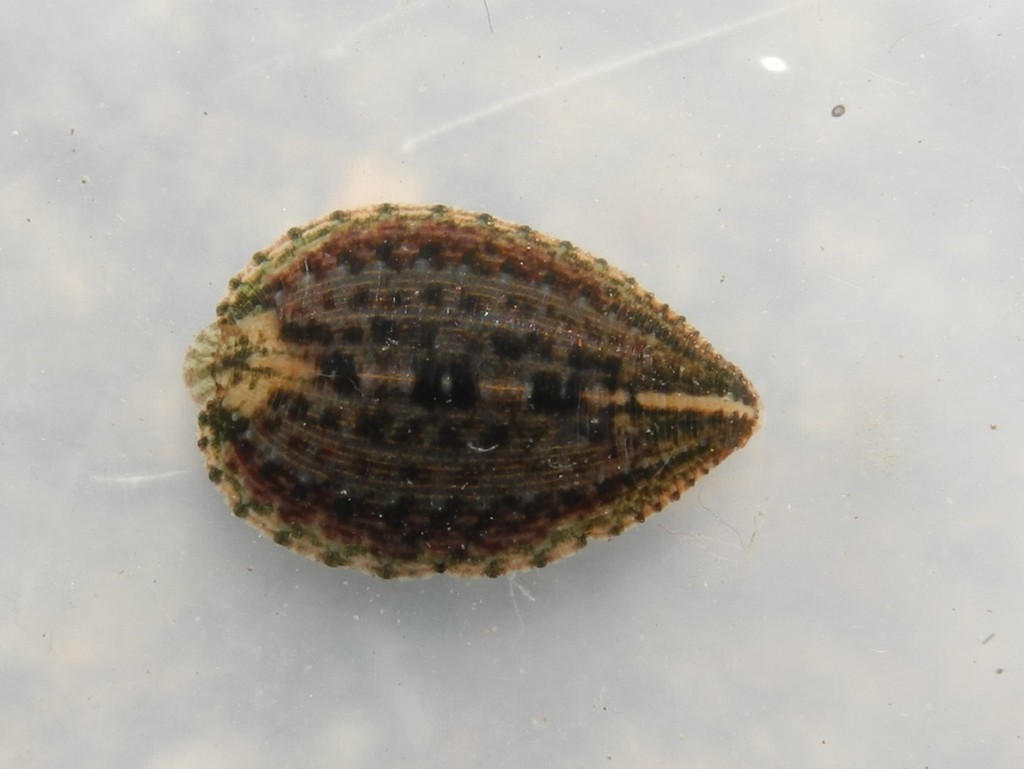
Placobdella costata
Placobdella costata is a species of Glossiphoniid leech found in European waters.
From the article Placobdella costata on Wikipedia (CC BY-SA), quoted section by section
Description
Placobdella costata is a large, elliptical, flattened leech, with somewhat variable colour. At rest, the adults are between 2 and 7 centimetres (0.79 and 2.76 in) long, and between 0.6 and 2.5 centimetres (0.24 and 0.98 in) wide. In colour the leeches can be greenish-brown, dark brown, blue-green, or, more often, yellowish-brown. They have an interrupted dark brown band down the middle of their backs. Placobdella costata is somewhat unusual among Glossiphoniid leeches in that its mouth is located towards the front of its anterior sucker, while in many other species the mouth is in the centre of the sucker. This forwards mouth is shared by other species which parasitize mammals and reptiles, including Haementeria ghilianii.
Eyes. Leeches have exhibit a variety of eye types, numbers, and arrangements, and are therefore "taxonomically invaluable". Within the family Glossiphoniidae alone there is considerable diversity. Placobdella costata at first appears to have two very close, often touching, eyes on its third segment, but more detailed observation with the use of histological techniques has shown that the leeches additionally have a pair of small, "rudimentary" eyes, anterior to and below its primary pair.
Range & habitat
Placobdella costata is found in much of central Europe, and is "widely distributed... in the European Mediterranean area", as well as being found from Morocco to Iran and Caucasia, the Scandinavian and Arabian peninsulas. In Great Britain, where it was first described in 1979, it is very rare. In the Iberian peninsula, it is known from the northern and central regions, as well as Andalusia.
Wikipedia: “Distribution”
Where it lives
Recorded sightings
—
geo-referenced records in GBIF, from museums, herbaria and field observers.
Drag the globe to turn it. Dots are where records exist, not a range map; darker means more records.
In the stacks
Searching the stacks…
Every page naming Placobdella costata in the Biodiversity Heritage Library →
This page is assembled live from iNaturalist, GBIF, Wikipedia, the Source Library and the Internet Archive. It is not yet part of the hand-edited codex. iNaturalist taxon 467434.