- Animals
- ›Chordates
- ›Vertebrates
- ›Mammals
- ›Therians
- ›Placental Mammals
- ›Ungulates, Carnivorans, and Allies
- ›Shrews, Moles, Hedgehogs, and Allies
- ›Shrews, Moles, and Hedgehogs
- ›Shrews
- ›White-toothed Shrews
- ›Crocidura
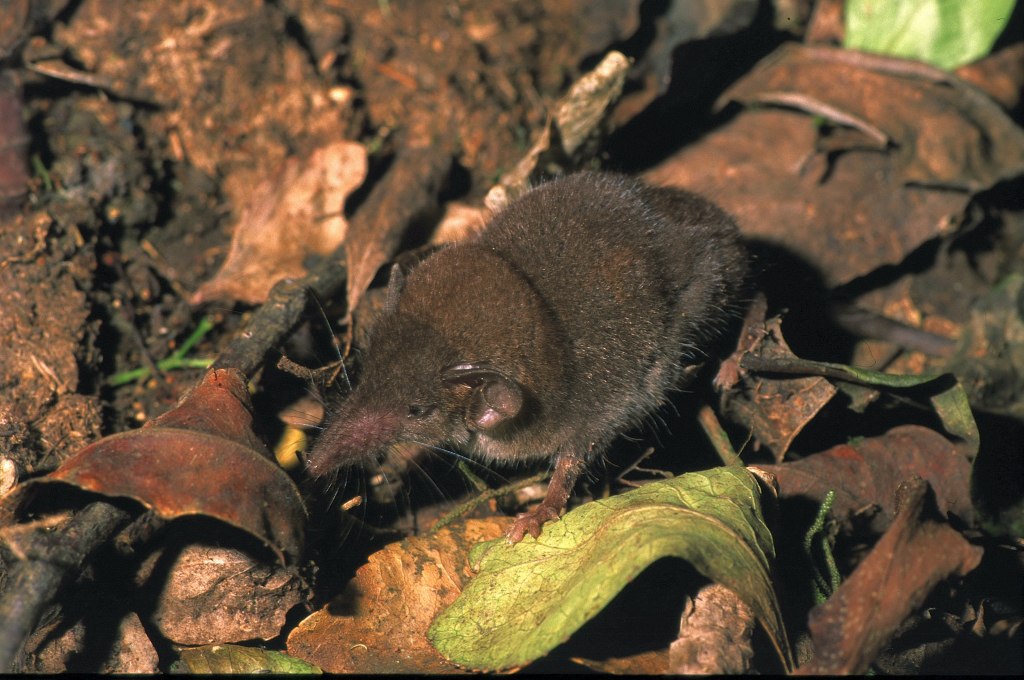
Hildegarde's Shrew
Crocidura hildegardeae
Hildegarde's shrew (Crocidura hildegardeae) is a recently discovered shrew, described in 1904. Considered by some authorities to be a subspecies of the Peters's musk shrew, it is now recognised as a separate species, with a diploid chromosome number of 2n = 52.
This is one of three species of small mammals named by the British zoologist Oldfield Thomas in honour of anthropologist Hildegarde Beatrice Hinde.
From the article Hildegarde's shrew on Wikipedia (CC BY-SA), quoted section by section
Description
Hildegarde's shrew is a moderate-sized species with a head-and-body length of about 70 mm (2.8 in), males being slightly larger than females. The hairs on the back, which are longer on the rump than elsewhere, are mid-brown with darker tips, giving an overall pelage the colour of milk chocolate. The underparts are pale brown, and the limbs are dark brown, with the exception of the inner side of the hind limbs which are yellowish-brown. The tail is long (about 70% of the head-and-body length) and is partially furred, being black above and brown below.
Range & habitat
This Central and East African species is known from Cameroon and north of the River Congo in the Republic of the Congo and the Democratic Republic of the Congo, eastwards to Kenya and Tanzania. It is plentiful in dry forests in upland and montane areas, being the most common shrew species at 1,100 m (3,600 ft) in Tanzania, but is less frequent in moist forests. In Rwanda, its habitats include moist savanna and cultivated areas. It occurs in both primary forest and secondary growth. The International Union for Conservation of Nature has assessed its conservation status as being of "least concern".
Wikipedia: “Distribution and habitat”
What it does
This shrew is nocturnal. Breeding takes place in July and August, with litters typically numbering two young. The predators of this shrew include small carnivorous mammals and the viper Atheris nitschei.
== References ==
Wikipedia: “Ecology”
Listen
Looking for field recordings…
Where it lives
Recorded sightings
—
geo-referenced records in GBIF, from museums, herbaria and field observers.
Drag the globe to turn it. Dots are where records exist, not a range map; darker means more records.
In the stacks
Searching the stacks…
Every page naming Crocidura hildegardeae in the Biodiversity Heritage Library →
This page is assembled live from iNaturalist, GBIF, Wikipedia, the Source Library and the Internet Archive. It is not yet part of the hand-edited codex. iNaturalist taxon 46729.