- Plants
- ›Vascular Plants
- ›flowering plants
- ›Dicots
- ›beeches, oaks, walnuts, and allies
- ›beech family
- ›Castanea
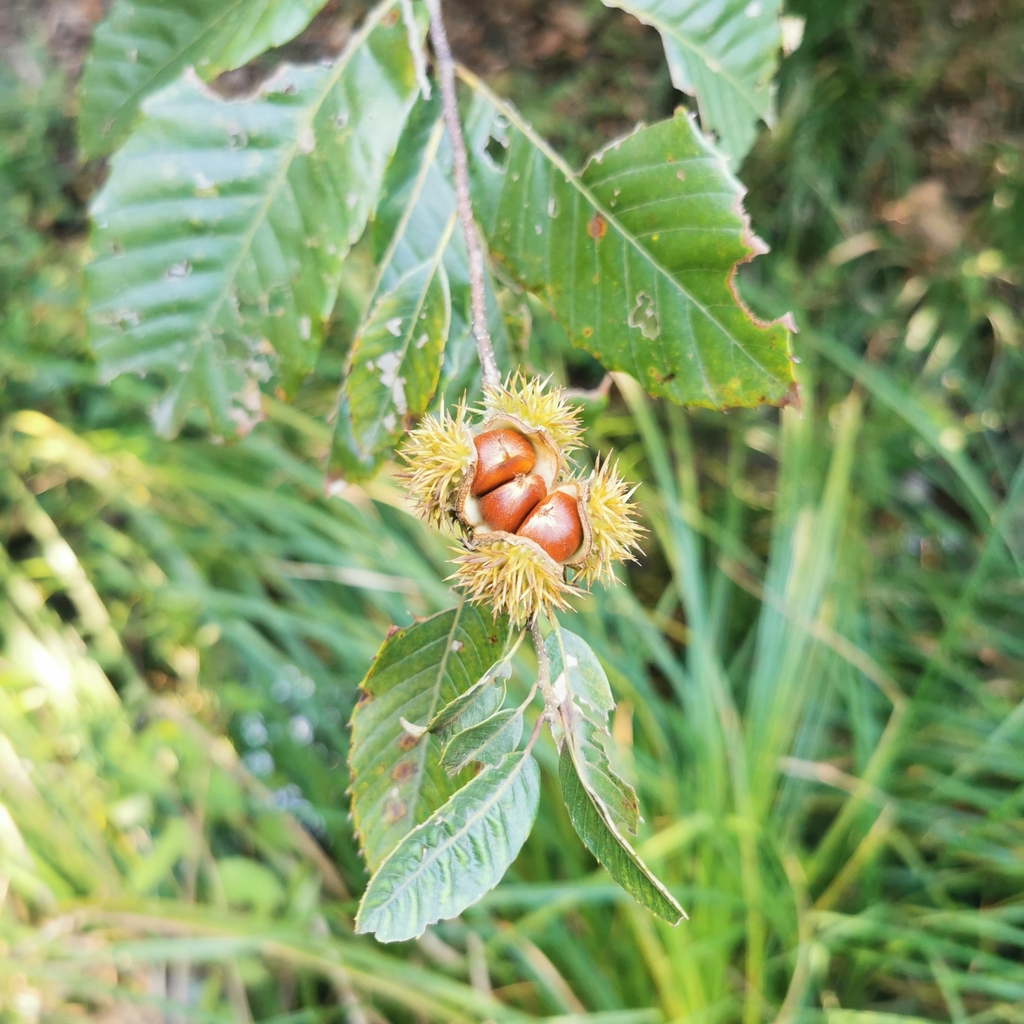
Chinese Dwarf Chestnut
Castanea seguinii
Castanea seguinii, called Seguin chestnut, Seguin's chestnut, or Chinese chinquapin (a name it shares with Castanea henryi), and in Chinese: 茅栗, mao li, is a species of chestnut native to south‑central and southeast China.
From the article Castanea seguinii on Wikipedia (CC BY-SA), quoted section by section
Description
Castanea seguinii are small trees or shrubs, rarely reaching 12 m. Their stipules are narrowly lanceolate, 0.7 to 1.5 cm long, and are shed (become deciduous) when the plant is in fruit. Leaf petioles are 0.5 to 1.5 cm long. Leaves are 6 to 14 cm long, with their abaxial sides covered with yellowish‑brown to gray scaly glands, and have sparse hairs along the veins when young. Leaf blades are oblong‑obovate to elliptic‑oblong in shape, with bases rounded or infrequently subcordate, but cuneate when young, with acuminate apices. Leaf margins are coarsely serrate. Male inflorescences are 5 to 12 cm long and catkin‑like. Female inflorescences are held in a cupule, with one to two (rarely more) flowers in each. Cupules are 3 to 5 cm wide, and covered with sparsely pilose spiny bracts which are 6 to 10 mm long. Each cupule produces two or three nuts, rarely more, with each nut being 1.5 to 2.0 cm in diameter.
What it does
Castanea seguinii grow in mixed mesophytic forests and thickets from 400 to 2000 m in elevation. Their bark is eaten by golden snub‑nosed monkeys (Rhinopithecus roxellana) in winter. In their native habitat they flower in May through July, and fruit from September to November.
Wikipedia: “Ecology”
At the table
Its nuts are small, but are edible and occasionally cultivated or collected in the wild and consumed by locals. Locals also practice coppicing for firewood. Another use in China is as a trap crop for Dryocosmus kuriphilus gall wasps. By planting a hedge of C. seguinii around C. mollissima (Chinese chestnut) orchards, the wasps will first encounter and attack the buds of the less valuable C. seguinii, allowing the galled twigs to be cut off and destroyed.
== References ==
Wikipedia: “Uses”
Where it lives
Recorded sightings
—
geo-referenced records in GBIF, from museums, herbaria and field observers.
Drag the globe to turn it. Dots are where records exist, not a range map; darker means more records.
In the stacks
Searching the stacks…
Every page naming Castanea seguinii in the Biodiversity Heritage Library →
This page is assembled live from iNaturalist, GBIF, Wikipedia, the Source Library and the Internet Archive. It is not yet part of the hand-edited codex. iNaturalist taxon 465489.