- Animals
- ›Chordates
- ›Vertebrates
- ›Mammals
- ›Therians
- ›Placental Mammals
- ›Primates, Rodents, and Allies
- ›Rodents
- ›Squirrels, Dormice, and Mountain Beavers
- ›Squirrels
- ›Typical and Flying Squirrels
- ›Typical Squirrels
- ›Microsciurus
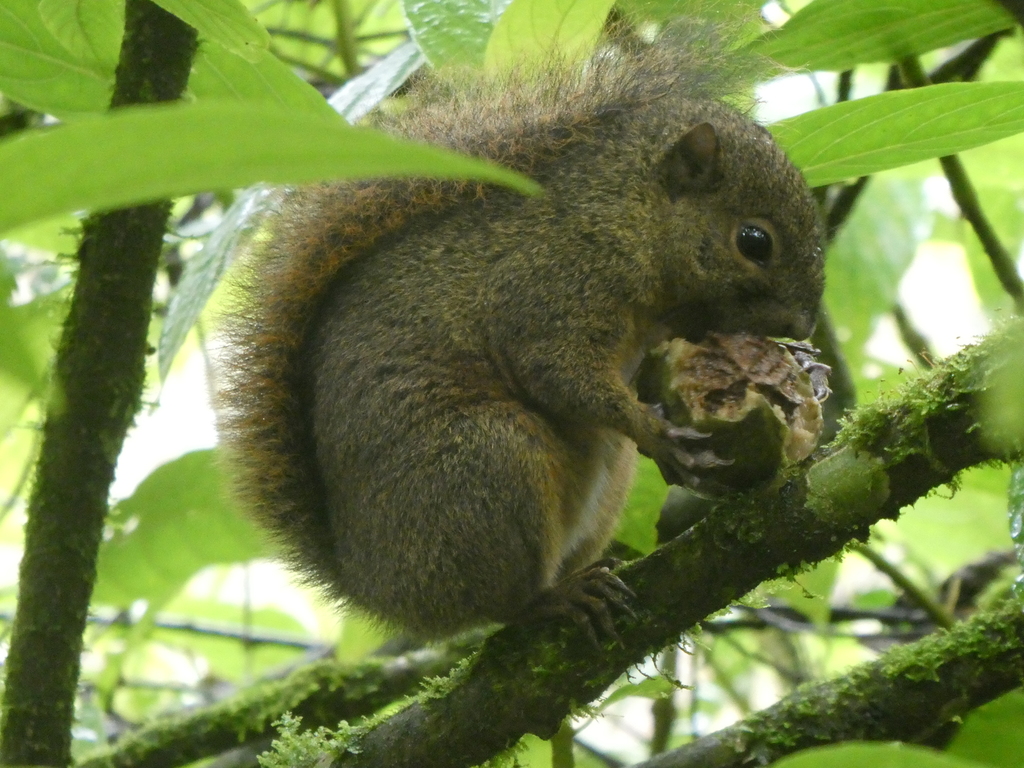
Central American Dwarf Squirrel
Microsciurus alfari
The Central American dwarf squirrel, also known as Alfaro's pygmy squirrel, (Microsciurus alfari) is a small tree squirrel in the genus Microsciurus and tribe Sciurini found in Colombia, Costa Rica, Nicaragua, and Panama. No species of squirrel within this genus are listed as endangered, however they are rarely seen because they are extremely elusive. This suggests that their population numbers may be larger than documented.
From the article Central American dwarf squirrel on Wikipedia (CC BY-SA), quoted section by section
Description
Central American dwarf squirrels are not as small as their name suggests. In fact, their body measurements are close to that of the red squirrel and gray squirrel, with a head-and-body length about 15 cm (5.9 in) with a 12 cm (4.7 in) long tail. The majority of their body is a dark, olive-green and brown color with a reddish-brown head coloration. The underside of their heads and limbs can range from a yellowish grey to a tawny grey color.
Range & habitat
Central American dwarf squirrels are native to Colombia, Costa Rica, Nicaragua, and Panama. They typically inhabit tropical rainforests, with a preference for the heavy forest, particularly those with vines in the undergrowth, which can allow them to descend to the ground and quickly escape from predators.
Wikipedia: “Distribution and habitat”
What it does
Central American dwarf squirrels are typically very shy and solitary in nature. While they are diurnal some squirrels have been observed at night by hunters, suggesting a degree of nocturnal activity. Their small size, dull coloration, and quickness tend to make them hard to locate and catch or even observe. The diet of these squirrels is most likely similar that to the common herbivore, consisting of seeds, grains and nuts, including nuts of the ivory-nut palm tree which they inhabit.
Wikipedia: “Ecology”
Listen
Looking for field recordings…
Where it lives
Recorded sightings
—
geo-referenced records in GBIF, from museums, herbaria and field observers.
Drag the globe to turn it. Dots are where records exist, not a range map; darker means more records.
In the stacks
Searching the stacks…
Every page naming Microsciurus alfari in the Biodiversity Heritage Library →
This page is assembled live from iNaturalist, GBIF, Wikipedia, the Source Library and the Internet Archive. It is not yet part of the hand-edited codex. iNaturalist taxon 46099.