- Animals
- ›Chordates
- ›Vertebrates
- ›Mammals
- ›Therians
- ›Placental Mammals
- ›Primates, Rodents, and Allies
- ›Rodents
- ›Squirrels, Dormice, and Mountain Beavers
- ›Squirrels
- ›Ground and African Tree Squirrels
- ›Holarctic Ground Squirrels
- ›Marmota
- ›Marmota
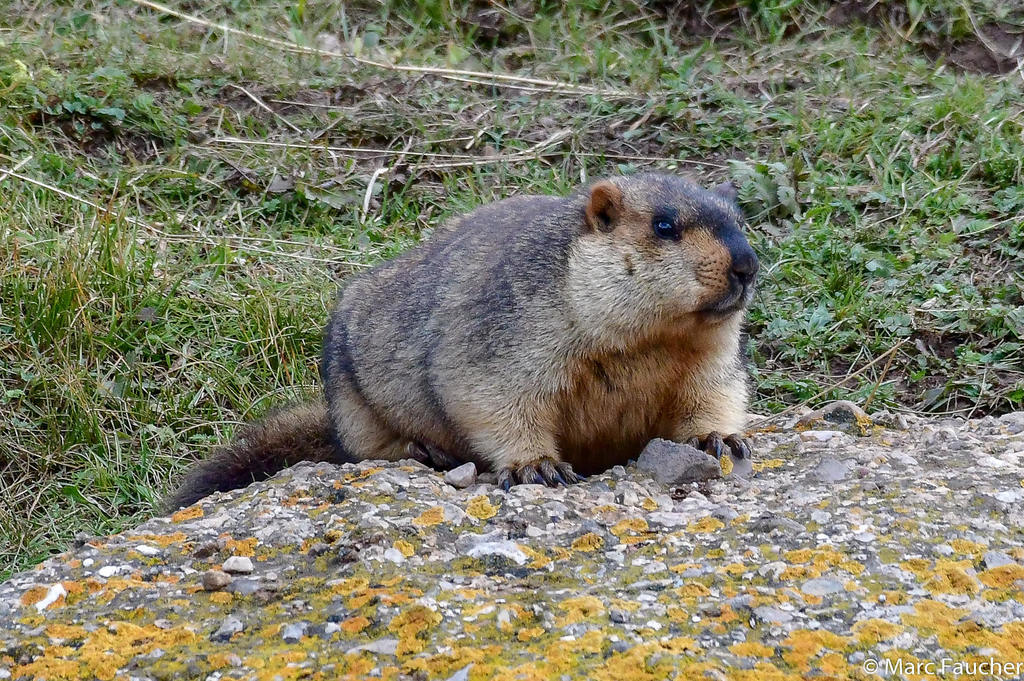
Himalayan Marmot
Marmota himalayana
The Himalayan marmot (Marmota himalayana) is a marmot found in alpine grasslands throughout the Himalayas and on the Tibetan Plateau at elevation from 3,500 to 5,200 m (11,500 to 17,100 ft). It lives in colonies and excavates deep burrows that colony members share during hibernation.
From the article Himalayan marmot on Wikipedia (CC BY-SA), quoted section by section
Description
The Himalayan marmot has a dense woolly fur that is rufous grey on the back and rufous yellowish on ears, belly and limbs. The bridge of its nose and end of tail is dark brown. It is one of the largest marmots in the world, being about the size of a large housecat; their average body weight ranges from 4 to 9.2 kg (8.8 to 20.3 lb), with weights lowest post-hibernation in spring and highest prior to it in autumn. In the autumn, average weight is reportedly more than 7 kg (15 lb) in both sexes. The total length is about 45 to 67 cm (18 to 26 in), with a tail length of 12 to 15 cm (4.7 to 5.9 in).
Wikipedia: “Characteristics”
Range & habitat
The Himalayan marmot occurs in the Himalayas and Tibetan Plateau at altitudes of 3,000–5,500 m (9,800–18,000 ft) in northeastern Pakistan, northern India, Nepal, Bhutan and China. In India, it can be seen in high-altitude regions of Ladakh and Kashmir. In China, it has been recorded in Xinjiang, Qinghai, Gansu, Tibet, western Sichuan and Yunnan provinces. In the west its distribution reaches that of the long-tailed marmot (M. caudata), but the two are not known to hybridise. The Himalayan marmot lives in short grass steppes or alpine habitats, typically above the tree line but below the permanent snow limit.
Wikipedia: “Distribution and habitat”
What it does
The Himalayan marmot lives in colonies and excavates deep burrows that colony members share during hibernation. The species hibernates from the late autumn to the early spring, on average for 7½ months. The burrows are between 2 and 10 m (6 ft 7 in – 32 ft 10 in) deep, provided that the upper soil layer is sufficiently light and deep such as fluvioglacial, deluvial and alluvial deposits. Where soil conditions are ideal on alluvial terraces, marmot colonies comprise up to 30 families, with up to 10 families living in an area of 1 km2 (0.39 sq mi). The marmot eats plants growing on pastures, in particular the soft and juicy parts of grassy plant species like Carex, Agrostis, Deschampsia, Koeleria and flowering species like Euphrasia, Gentiana, Halenia, Polygonum, Primula, Ranunculus, Saussurea, Taraxacum, and Iris potaninii.
In Ladakh, Himalayan marmots interact with humans who feed them. This have led to greater lesser survival instinct behaviour among the marmots resulting in them being easily preyed upon by stray dogs, or other natural predators.
Reproduction. Females become sexually mature at the age of two years. After one month of gestation they give birth to litters of two to 11 young.
Predators. On the Tibetan Plateau, marmot species form part of snow leopard prey. …
Wikipedia: “Ecology and behaviour”
In human culture
It was known to the ancient Greek writers as the gold-digging ant apparently as reference to the fact that gold nuggets were found in the silts of the burrows these marmots dug. The French ethnologist Michel Peissel claimed that the story of 'gold-digging ants' reported by the Greek historian Herodotus was founded on the golden Himalayan marmot of the Deosai plateau and the habit of local tribes such as the Minaro to collect the gold dust excavated from their burrows. A photograph of a Himalayan marmot under attack by a Tibetan fox taken by Bao Yongqing won the overall prize in the 2019 Wildlife Photographer of the Year award.
Wikipedia: “In culture”
Listen
Looking for field recordings…
Where it lives
Recorded sightings
—
geo-referenced records in GBIF, from museums, herbaria and field observers.
Drag the globe to turn it. Dots are where records exist, not a range map; darker means more records.
In the stacks
Searching the stacks…
Every page naming Marmota himalayana in the Biodiversity Heritage Library →
This page is assembled live from iNaturalist, GBIF, Wikipedia, the Source Library and the Internet Archive. It is not yet part of the hand-edited codex. iNaturalist taxon 46094.