- Plants
- ›Vascular Plants
- ›flowering plants
- ›Dicots
- ›Buttercups, Poppies, and Allies
- ›zabala family
- ›Stauntonia
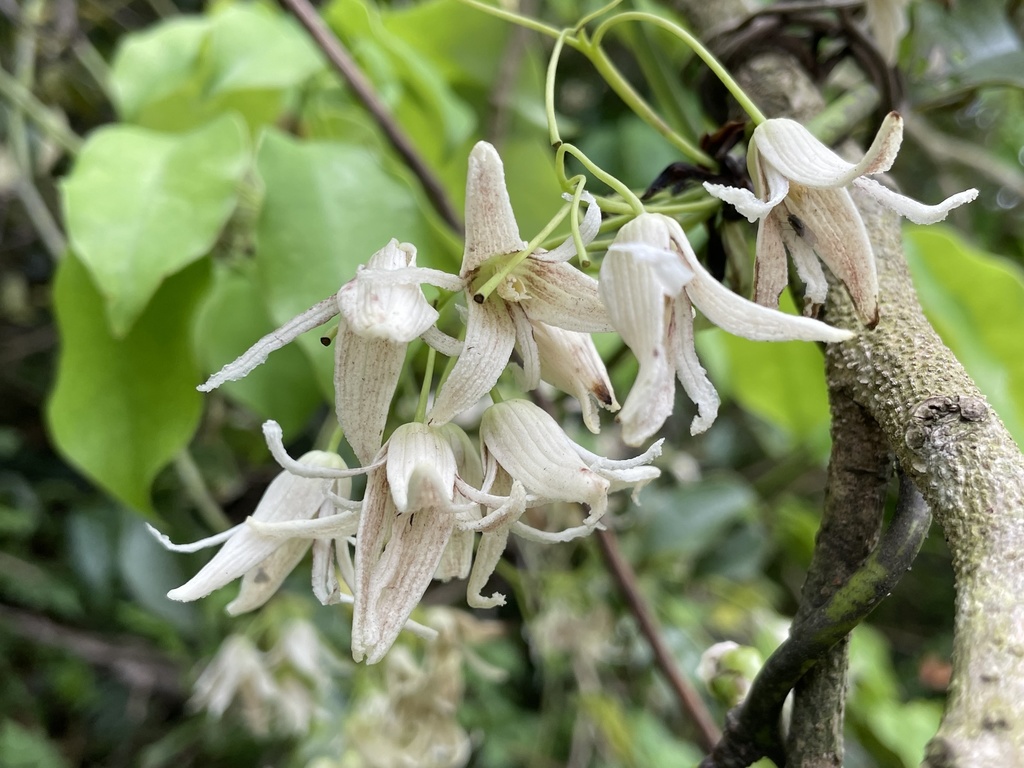
Stauntonia hexaphylla
Stauntonia hexaphylla or Stauntonia vine is a plant in the family Lardizabalaceae.
In Japan, it is distributed in Honshu, Shikoku, Kyushu, and Okinawa. Outside Japan it is found in South Korea. It grows wild in mountains and hills in warm regions and near the coast. Outside of its natural distribution, it is sometimes planted in gardens as shade shelves.
From the article Stauntonia hexaphylla on Wikipedia (CC BY-SA), quoted section by section
Description
Stauntonia hexaphylla is an evergreen woody vine. The bark ranges from pale brown to brownish brown and bears lenticels. On mature stems, the bark becomes shallowly fissured lengthwise and may peel away. Young branches are green and have conspicuous lenticels. The leaves are stalked and palmately compound. They usually have five leaflets, although leaves on young shoots may have three, while those on mature branches have five to seven. The leaflets are thick and leathery, dark green and glossy on the upper surface, and somewhat paler beneath. A distinctive network of veins is visible on the underside.
Flowers. Flowering occurs from April to May. The species is monoecious, with separate male and female flowers occurring on the same plant. The flowers are borne in racemes from the leaf axils. Female flowers are larger than male flowers and are fragrant. The outside of the flower is pale yellowish green, while the inner surface is dark reddish purple. Both male and female flowers lack true petals and instead have six sepals.
Fruit. The fruit ripens from September to October. It is elliptical, about 5 to 7 cm (2.0 to 2.8 in) long, and becomes dark reddish purple when ripe. The fruit resembles that of Akebia, but its skin is thinner and softer. Unlike the fruit of Akebia, it does not split open along the sutures of the carpels when ripe. …
At the table
Stauntonia hexaphylla is grown as an ornamental plant and can be cultivated as bonsai or trained over trellises to provide shade. Its fruit is edible. The plant has traditionally been valued as a fruit crop in Japan, where there is a long-standing tradition of presenting its fruit to the Imperial House of Japan. The fruit is smaller than that of many Akebia species. Although its pulp is sweet, the numerous seeds make it comparatively difficult to eat, limiting its commercial importance. Some growers continue to cultivate the plant, including for fruit presented to the Imperial Household, Ōmi Shrine, which enshrines Emperor Tenji, and Yasukuni Shrine. The stems and roots are also used in the Japanese crude drug known as yamokka (野木瓜), traditionally used as a diuretic.
== References ==
Wikipedia: “Uses”
Where it lives
Recorded sightings
—
geo-referenced records in GBIF, from museums, herbaria and field observers.
Drag the globe to turn it. Dots are where records exist, not a range map; darker means more records.
In the stacks
Searching the stacks…
Every page naming Stauntonia hexaphylla in the Biodiversity Heritage Library →
This page is assembled live from iNaturalist, GBIF, Wikipedia, the Source Library and the Internet Archive. It is not yet part of the hand-edited codex. iNaturalist taxon 460701.