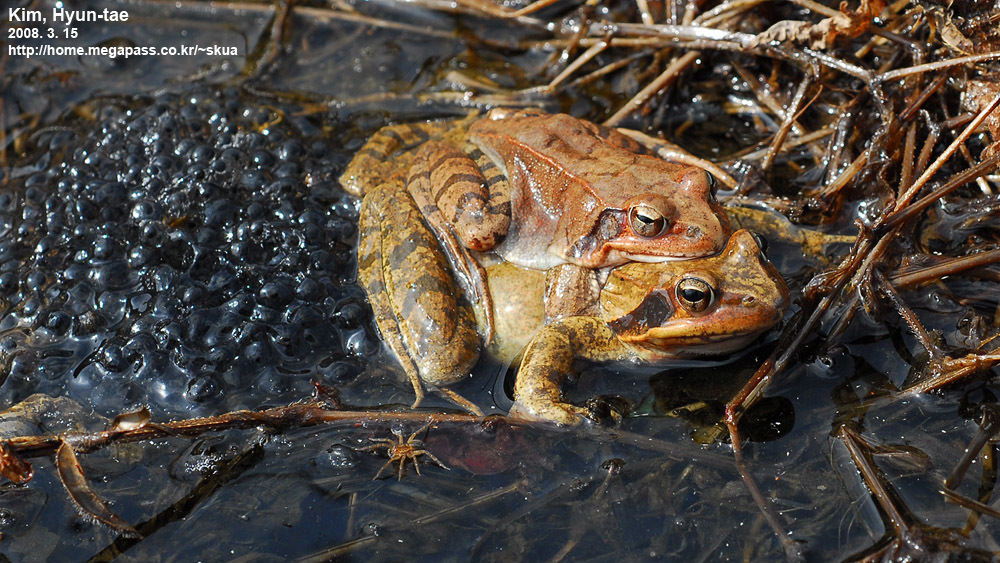
Ueno's Brown Frog
Rana uenoi
Rana uenoi is a species of true frog that was discovered in 2014 using mtDNA and comparative morphology etc. to distinguish it from its previously designated species, Dybowski's frog. It is found in wooded areas in the Korean Peninsula (it is very likely found in North Korea but the evidence is incomplete) and the nearby islands. It is also found on Tsushima Island, Japan.
From the article Rana uenoi on Wikipedia (CC BY-SA), quoted section by section
Description
Males are smaller than females and grow to around 5–6.2 cm (2.0–2.4 in) SVL, while females grow to around 6–7.6 cm (2.4–3.0 in) SVL. They are brown with striped legs and dark "temples" called tympana. They sometimes have black dots on their back. The abdomen is white and gets yellowish closer to the posterior end. Many small details distinguish R. uenoi from Dybowski's frog e.g. R. uenoi has longer hindlimbs.
Range & habitat
This frog is found in wooded areas in the Korean Peninsula (it is very likely found in North Korea but the evidence is incomplete) and the nearby islands. It is also found on Tsushima Island, Japan.
Wikipedia: “Range”
In human culture
Rana uenoi is named after Dr. Shun-ichi Uéno, a Japanese entomologist.
== References ==
Wikipedia: “Etymology”
Listen
Looking for field recordings…
Where it lives
Recorded sightings
—
geo-referenced records in GBIF, from museums, herbaria and field observers.
Drag the globe to turn it. Dots are where records exist, not a range map; darker means more records.
In the stacks
Searching the stacks…
Every page naming Rana uenoi in the Biodiversity Heritage Library →
This page is assembled live from iNaturalist, GBIF, Wikipedia, the Source Library and the Internet Archive. It is not yet part of the hand-edited codex. iNaturalist taxon 460621.