- Animals
- ›Chordates
- ›Vertebrates
- ›Mammals
- ›Therians
- ›Placental Mammals
- ›Primates, Rodents, and Allies
- ›Rodents
- ›Squirrels, Dormice, and Mountain Beavers
- ›Squirrels
- ›Typical and Flying Squirrels
- ›Typical Squirrels
- ›Sciurus
- ›Hesperosciurus
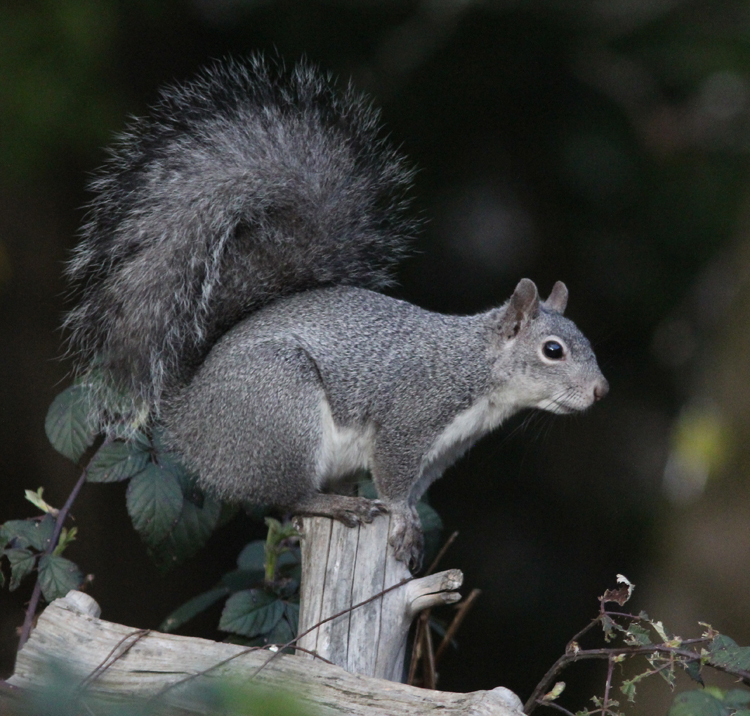
Western Gray Squirrel
Sciurus griseus
The western gray squirrel (Sciurus griseus) is a tree squirrel found along the western coast of the United States and Mexico. In some places, this species has also been known as the silver-gray squirrel, the California gray squirrel, the Oregon gray squirrel, the Columbian gray squirrel and the banner-tail. There are three geographical subspecies: S. g. griseus (central Washington to the western Sierra Nevada in central California); S. g. nigripes (from south of San Francisco Bay to San Luis Obispo County, California); and S. g. anthonyi (which ranges from San Luis Obispo to northern Baja California).
In some landscapes, the western gray squirrel has lost habitat or experienced local extinction due to competition with other squirrel species and other pressures on their population.
From the article Western gray squirrel on Wikipedia (CC BY-SA), quoted section by section
Description
The western gray squirrel was first described by George Ord in 1818 based on notes taken by Lewis and Clark at The Dalles in Wasco County, Oregon. Sciurus griseus is the largest tree squirrel in the Sierra Nevada and Central California range. It has plantigrade, pentadactyl feet with two phalanges. Compared with the eastern gray squirrel S. carolinensis or the fox squirrel S. niger (which have been introduced into its native range), these squirrels are shy, and will generally run up a tree and give a hoarse chirping call when disturbed. Weights vary from about .35 to 1 kilogram (0.77 to 2.20 lb), and length (including tail) from 43 to 61 centimetres (17 to 24 in). Western gray squirrels exhibit a unique form of coloring around their bodies. They have solid gray fur on most of their body, which is most prevalent on their backs and sides. They have four toes on their two front feet and five toes on their two back feet. Tree squirrels undergo a complete head-to-tail molt in the spring and a rump-to-head molt in the fall. Tail hair is replaced only in the spring. Nesting mothers will use their tail hair to line birthing nests. Western gray squirrels eat berries, nuts, a variety of seeds, and the eggs of small birds. The dental formula for S. griseus is 1.0.2.31.0.1.3 × 2 = 22.
Range & habitat
The Pacific Northwest is home to the western gray squirrel. They are the largest tree squirrel native to this region. They have been spotted at several human made locations in California, such as Bidwell Park or the campus to CSU Chico. Eastern gray squirrels occur along the Pacific coast from northern Washington state to the southern border of California, extending inland until the California-Nevada border at Truckee. Populations are known to exist in Mexico, including at the Laguna Hanson lake in the central Sierra de Juarez in Baja California, but the Mexican distribution of the species is poorly studied. In Washington, the species historically occurred in the Columbia River Gorge and both sides of the Cascade Mountains. In the present, eastern gray squirrels occur only in three disjunct populations; the first is located in Pierce County in the southern part of the Puget Trough; the second is in Klickitat County and eastern Skamania County in the Columbia River basin; and the third is in Chelan County and Okanogan County in the north-central portion of the state. The Pierce County population is concentrated in the Fort Lewis Military Reserve, which contains the largest remaining area of ponderosa pine forest in the Puget Through. …
Wikipedia: “Distribution and habitat”
What it does
Western gray squirrels forage mainly on the ground, but rarely move far from trees and tend to avoid open spaces. They use tree cover for access to escape routes, and can move rapidly through close canopy cover. However, they are less agile in trees than other tree squirrel species, and rarely make large leaps between tree branches. They are primarily diurnal and alternate between periods of activity and rest, growing less active in the later day. During windy or stormy conditions they typically remain close to their nests. When alarmed, western gray squirrels rapidly climb a tree and face their perceived threat while flagging their tails and making repeated "chuck" noises, typically rising in pitch as the alarm call is sustained. Western gray squirrels play an important ecological role in maintaining and rejuvenating oak woodlands. They are important dispersers of fungi, particularly hypogeous fungi with subterranean fruiting bodies. The squirrels eat large quantities of truffles and truffle-like fungi, and disperse their spores through their droppings. Many of these fungi are ectomycorrhizal symbiotes of trees, especially oaks, which they provide with nitrogen through symbiotic nitrogen-fixing bacteria. …
Wikipedia: “Ecology and behavior”
Listen
Looking for field recordings…
Where it lives
Recorded sightings
—
geo-referenced records in GBIF, from museums, herbaria and field observers.
Drag the globe to turn it. Dots are where records exist, not a range map; darker means more records.
In the stacks
Searching the stacks…
Every page naming Sciurus griseus in the Biodiversity Heritage Library →
This page is assembled live from iNaturalist, GBIF, Wikipedia, the Source Library and the Internet Archive. It is not yet part of the hand-edited codex. iNaturalist taxon 46023.