- Animals
- ›Chordates
- ›Vertebrates
- ›Mammals
- ›Therians
- ›Placental Mammals
- ›Primates, Rodents, and Allies
- ›Rodents
- ›Squirrels, Dormice, and Mountain Beavers
- ›Squirrels
- ›Typical and Flying Squirrels
- ›Typical Squirrels
- ›Sciurus
- ›Sciurus
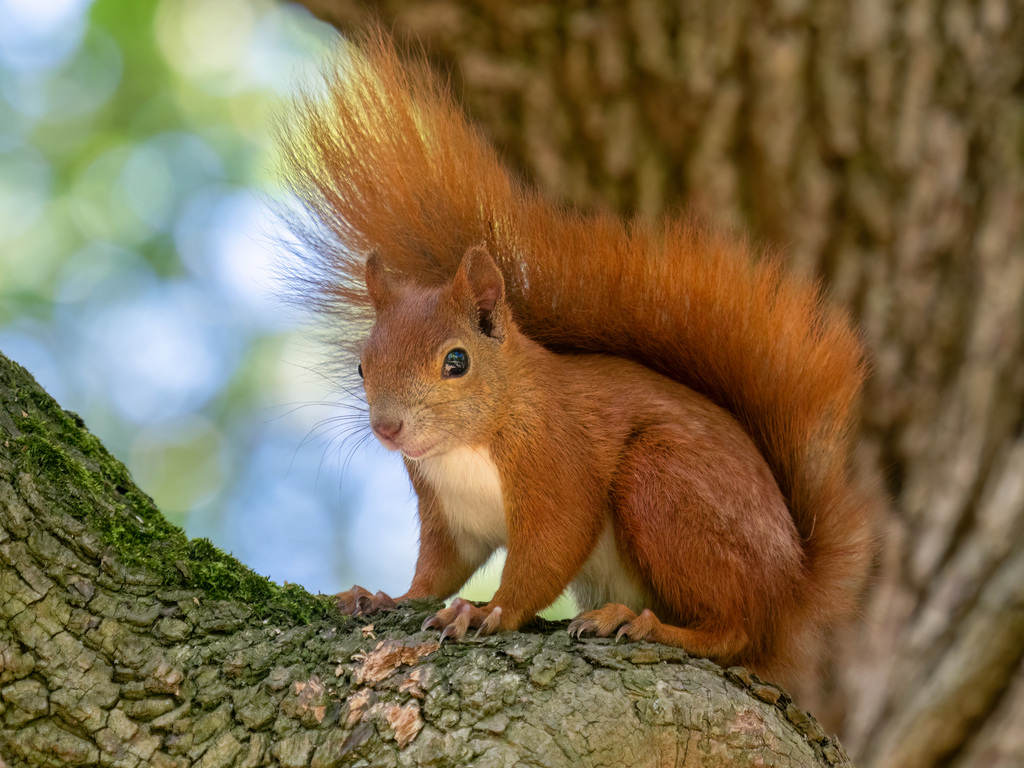
Eurasian Red Squirrel
Sciurus vulgaris
The red squirrel (Sciurus vulgaris), also called Eurasian red squirrel, is a species of tree squirrel in the genus Sciurus. It is an arboreal and primarily herbivorous rodent and common throughout Eurasia.
From the article Red squirrel on Wikipedia (CC BY-SA), quoted section by section
Description
The red squirrel has a typical head-and-body length of 19 to 23 cm (7.5 to 9.1 in), a tail length of 15 to 20 cm (5.9 to 7.9 in), and a mass of 250 to 340 g (8.8 to 12.0 oz). Males and females are the same size. The long tail helps the squirrel to balance and steer when jumping from tree to tree and running along branches, and may keep the animal warm during sleep. It is also used to signal during social interactions. The dorsal coat color of S. vulgaris is dark but otherwise highly variable. There are several coat colour morphs, ranging through red, reddish-brown, brown, bright chestnut, gray, black, and bluish. Polymorphism is common, although the particular proportions of coat colors vary between different areas. Red coats are most common in Great Britain; in other parts of Europe and Asia different coat colours coexist within populations, much like hair colour in some human populations. Melanism is common, particularly in continental, boreal, and montane populations. Dark coloration is rare in the British Isles. Populations dominated by a single color type are rare and mostly occur on islands. The underside of the squirrel is always white-cream in colour. …
Range & habitat
The red squirrel is found in both coniferous forest and temperate broadleaf woodlands. Red squirrel populations are densest in large areas of coniferous forest, with secondary densities in mixed forests, deciduous forests, and parklands. They can also be found in suburban areas and in conifer plantations. Red squirrels occupy boreal, coniferous woods in northern Europe and Siberia, preferring Scots pine, Norway spruce and Siberian pine. In western and southern Europe they are found in broad-leaved woods where the mixture of tree and shrub species provides a better year-round source of food. In most of the British Isles and in Italy, broad-leaved woodlands are now less suitable due to the better competitive feeding strategy of introduced grey squirrels. In Great Britain, Ireland and in Italy, red squirrel populations have decreased in recent years. This decline is associated with the introduction by humans of the eastern grey squirrel (Sciurus carolinensis) from North America. However, the population in Scotland is stabilising due to conservation efforts.
Wikipedia: “Distribution and habitat”
What it does
The red squirrel is diurnal; activity typically begins at sunrise, but continues after sunset. Between 60% and 80% of its active period may be spent foraging and feeding. Red squirrels do not hibernate. During the winter, however, they may remain within their nest for several days during severe weather. Movement on the ground alternates between series of leaps and alert postures, during which the squirrel sits upright with erect ears while sniffing the air. Movement in trees is rapid and agile, and squirrels may leap between distinct trees up to four meters apart. Climbing down trees is done headfirst, with frequent pauses.
Diet. The red squirrel eats mostly the seeds of trees, especially conifers, neatly stripping cones to get at the seeds within, alongside acorns and nuts. Other food sources include fruits and berries, fungi, lichens, young plant shoots, vegetables, garden flowers, and tree sap. More rarely, red squirrels may also eat invertebrates, bird eggs, or nestlings. A Swedish study shows that out of 600 stomach contents of red squirrels examined, only four contained remnants of birds or eggs. Excess food is put into caches called "middens", either buried or in nooks or holes in trees, and eaten when food is scarce. Caching occurs most frequently during the fall to create food stores for the winter. …
Wikipedia: “Ecology and behaviour”
In human culture
The red squirrel is the national mammal of Denmark. Red squirrels have historically been hunted both as a game animal and for their furs. The expression "squirrel pelt" is still widely understood there to be a reference to money. It has been suggested that the trade in red squirrel fur, highly prized in the medieval period and intensively traded, may have been responsible for the leprosy epidemic in medieval Europe. Within Great Britain, widespread leprosy is found early in East Anglia, to which many of the squirrel furs were traded, and the strain is the same as that found in modern red squirrels on Brownsea Island. Red squirrels are frequently valued as appealing wildlife in urban settings. However, they are also seen as a pest in orchards and gardens due to their habit of peeling off tree bark to feed on cambium. Intensive bark-stripping has caused economic damage to conifer plantations in Great Britain, particularly during high activity periods in summer. Full red squirrels also appear as heraldic charge, generally depicted upright and holding a nut.
Wikipedia: “Cultural significance”
Listen
Looking for field recordings…
Where it lives
Recorded sightings
—
geo-referenced records in GBIF, from museums, herbaria and field observers.
Drag the globe to turn it. Dots are where records exist, not a range map; darker means more records.
In the stacks
Searching the stacks…
Every page naming Sciurus vulgaris in the Biodiversity Heritage Library →
This page is assembled live from iNaturalist, GBIF, Wikipedia, the Source Library and the Internet Archive. It is not yet part of the hand-edited codex. iNaturalist taxon 46001.