- Animals
- ›Chordates
- ›Vertebrates
- ›Mammals
- ›Therians
- ›Placental Mammals
- ›Primates, Rodents, and Allies
- ›Rodents
- ›Squirrels, Dormice, and Mountain Beavers
- ›Squirrels
- ›Beautiful and Palm Squirrels
- ›Beautiful Squirrels
- ›Callosciurus
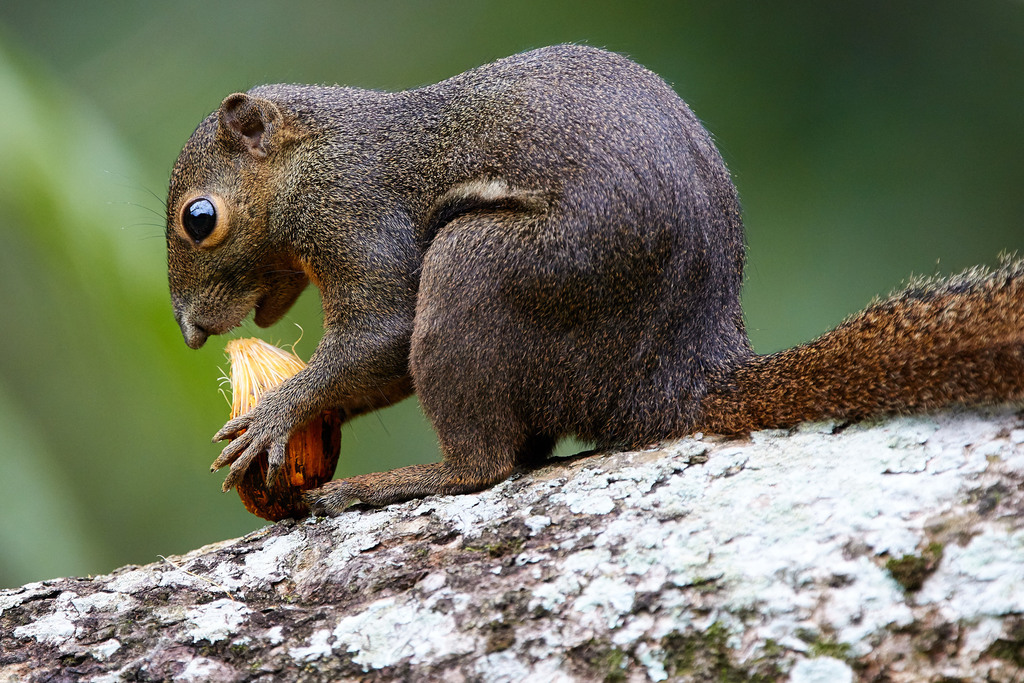
Plantain Squirrel
Callosciurus notatus
The plantain squirrel, oriental squirrel or tricoloured squirrel, Callosciurus notatus is a species of rodents in the family Sciuridae found in Indonesia, Malaysia, Singapore, and Thailand in a wide range of habitats: forests, mangroves, parks, gardens, and agricultural areas. Fruit farmers consider them to be pests.
From the article Plantain squirrel on Wikipedia (CC BY-SA), quoted section by section
Description
Its body is about 20–30 cm (8–12 in) long with a similar-sized tail. Its weight can vary from 160 to 259 g (5.6 to 9.1 oz). It is greyish/brown with a chestnut belly and a black and white stripe on the side. It is very quick and agile in trees, able to jump a few metres between trees, and rarely wanders on the ground. Like all rodents, it has two large upper and lower incisors. Its chestnut belly easily distinguishes it from the similar black-striped squirrel, which has a grey belly.
What it does
The plantain squirrel is diurnal. It is either solitary or social in small groups, wherein squirrels communicate with shrill chirps and chattering while showing off their tails. These high calls may be alarms responding to the presence of a predator. Different types of predators prompt different calls and elicit different responses in the squirrel. A snake alarm causes nearby squirrels to move towards the threat and mob it, while a raptor alarm causes the squirrels to freeze and take cover. Plantain squirrels breed year round, but most often from April to June. They are promiscuous, with multiple males (usually 5 to 7) competing for a female in estrus within her home range. Two to four of the males end up mating with the female, during which time they interact by barking and chasing one another. After 40 days of gestation, the female gives birth to 1–4 (2 on average) blind and hairless young, each weighing some 16 grams. The mother houses her litter in a spherical nest of twigs and leaves high up in a tree or bush. After six weeks, the young squirrels will usually leave the nest.
Wikipedia: “Behaviour”
Listen
Looking for field recordings…
Where it lives
Recorded sightings
—
geo-referenced records in GBIF, from museums, herbaria and field observers.
Drag the globe to turn it. Dots are where records exist, not a range map; darker means more records.
In the stacks
Searching the stacks…
Every page naming Callosciurus notatus in the Biodiversity Heritage Library →
This page is assembled live from iNaturalist, GBIF, Wikipedia, the Source Library and the Internet Archive. It is not yet part of the hand-edited codex. iNaturalist taxon 45945.