- Animals
- ›Chordates
- ›Vertebrates
- ›Mammals
- ›Therians
- ›Placental Mammals
- ›Primates, Rodents, and Allies
- ›Rodents
- ›Squirrels, Dormice, and Mountain Beavers
- ›Squirrels
- ›Beautiful and Palm Squirrels
- ›Palm Squirrels
- ›Funambulus
- ›Funambulus
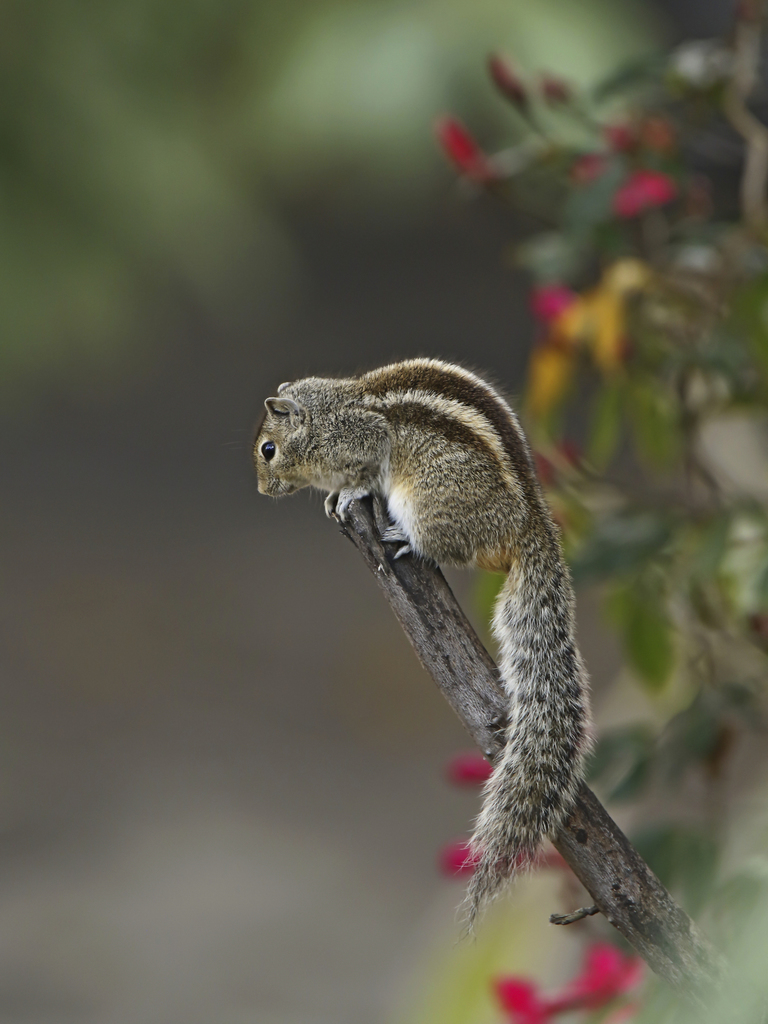
Three-striped Palm Squirrel
Funambulus palmarum
The Indian palm squirrel or three-striped palm squirrel (Funambulus palmarum) is a species of rodent in the family Sciuridae found naturally in India (south of the Vindhyas), Pakistan (eastern districts of Karachi), Bangladesh, and Sri Lanka. In the late 19th century, the palm squirrel was introduced to Madagascar, Réunion, Mayotte, Comoro Islands, Mauritius, and Seychelles. The closely related five-striped palm squirrel (F. pennantii) is found in northern India, southern Pakistan and its range partly overlaps with this species.
From the article Indian palm squirrel on Wikipedia (CC BY-SA), quoted section by section
Description
The palm squirrel is about the size of a large chipmunk, with a bushy tail slightly shorter than its body. The back is a grizzled, grey-brown colour with three conspicuous white stripes which run from head to tail. The two outer stripes run from the forelegs to the hind legs only. It has a creamy-white belly and a tail covered with interspersed, long, black and white hair. The ears are small and triangular. Juvenile squirrels have significantly lighter coloration, which gets progressively darker as they age. Albinism is rare, but exists in this species.
What it does
The Indian palm squirrel exhibits a variety of reproductive behaviors; some display cyclical periodicity activity while others show continuous reproductive activity. The gestation period is 34 days; breeding takes place in grass nests during the autumn. Litters of two or three are common, and average 2.75. The young are weaned after about 10 weeks and are sexually mature at 9 months. The adult weight is 100 grams. Little is known about their longevity, but one specimen lived 5.5 years in captivity.
Wikipedia: “Life cycle”
Listen
Looking for field recordings…
Where it lives
Recorded sightings
—
geo-referenced records in GBIF, from museums, herbaria and field observers.
Drag the globe to turn it. Dots are where records exist, not a range map; darker means more records.
In the stacks
Searching the stacks…
Every page naming Funambulus palmarum in the Biodiversity Heritage Library →
This page is assembled live from iNaturalist, GBIF, Wikipedia, the Source Library and the Internet Archive. It is not yet part of the hand-edited codex. iNaturalist taxon 45938.