- Animals
- ›Chordates
- ›Vertebrates
- ›Mammals
- ›Therians
- ›Placental Mammals
- ›Primates, Rodents, and Allies
- ›Rodents
- ›Mice, Rats, and Hamsters
- ›Muroids
- ›Hamsters, Voles, Lemmings, and Allies
- ›Voles, Lemmings, and Muskrats
- ›Muskrats
- ›Ondatra
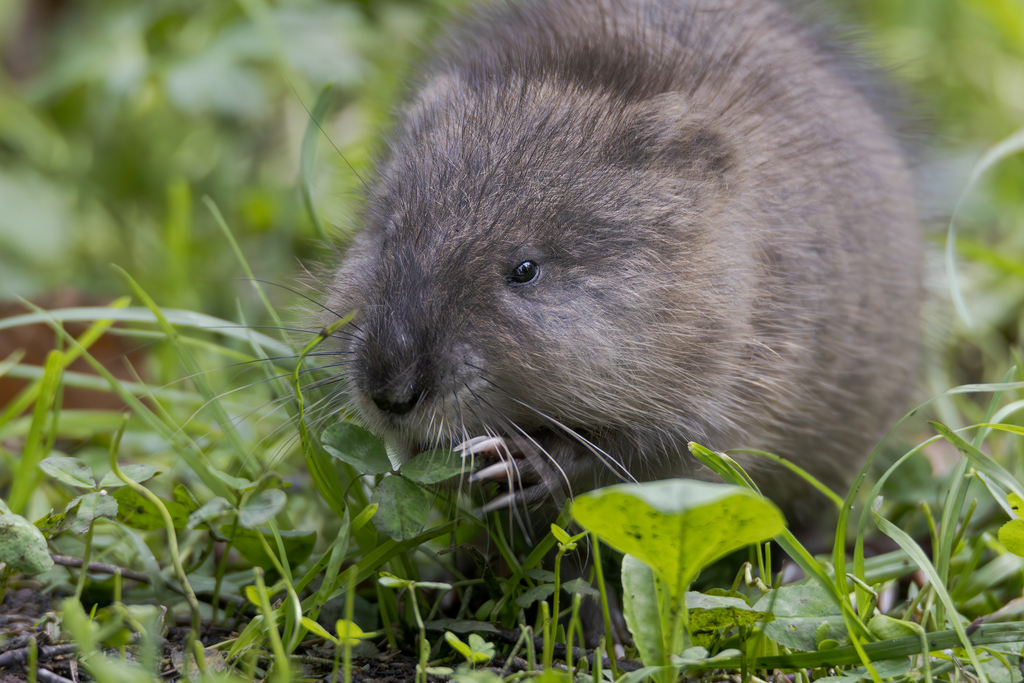
Muskrat
Ondatra zibethicus
The muskrat or common muskrat (Ondatra zibethicus) is a medium-sized semiaquatic rodent.
Adult muskrats weigh 0.6–2 kg (1+1⁄4–4+1⁄2 lb), with a body length (excluding the tail) of 20–35 cm (8–14 in). They are covered with short, thick fur of medium to dark brown color. Their long tails, covered with scales rather than hair, are laterally compressed and generate a small amount of thrust, with their webbed hind feet being the main means of propulsion and the unique tail mainly important in directional stability. Muskrats spend most of their time in the water and can swim underwater for 12 to 17 minutes. They live in families of a male and female pair and their young. They build nests to protect themselves from the cold and predators, often burrowed into the bank with an underwater entrance. Muskrats feed mostly on cattail and other aquatic vegetation but also eat small animals.
From the article Muskrat on Wikipedia (CC BY-SA), quoted section by section
Description
An adult muskrat is about 40–70 cm (16–28 in) long, half of that length being the tail, and weighs 0.6–2 kg (1+1⁄4–4+1⁄2 lb). That is about four times the weight of the brown rat (Rattus norvegicus), though an adult muskrat is only slightly longer. It is one of the most prominent and heaviest members of the family Cricetidae, which includes all voles, lemmings, and most mice native to the Americas, and hamsters in Eurasia. The muskrat is much smaller than a beaver (Castor canadensis), with which they often share a habitat. Muskrats are covered with short, thick fur, which is medium to dark brown or black, with the belly a bit lighter (countershaded); as the animal ages, it turns partly gray. The fur has two layers, which protect it from cold water. They have long tails covered with scales rather than hair. To aid in swimming, their tails are slightly flattened vertically, a shape that is unique to them. When they walk on land, their tails drag on the ground, which makes their tracks easy to recognize. Muskrats spend most of their time in water and are well suited to their semiaquatic life. They can swim underwater for 12 to 17 minutes. Their bodies, like those of seals and whales, are less sensitive to the buildup of carbon dioxide than those of most other mammals. They can close off their ears to keep water out. …
Range & habitat
Muskrats are found in most of Canada, the United States, and a small part of northern Mexico. They were introduced to Europe at the beginning of the 20th century and have become an invasive species in northwestern Europe. They primarily inhabit wetlands, areas in or near saline and freshwater wetlands, rivers, lakes, or ponds. They are not found in Florida, where the round-tailed muskrat, or Florida water rat (Neofiber alleni), fills their ecological niche. Their populations naturally cycle; in areas where they become abundant, they can remove much of the vegetation in wetlands. They are thought to play a major role in determining the vegetation of prairie wetlands in particular. They also selectively remove preferred plant species, thereby changing the abundance of plant species in many kinds of wetlands. Species commonly eaten include cattail and yellow water lily. Alligators are thought to be an important natural predator, and the absence of muskrats from Florida may, in part, be the result of alligator predation. While much wetland habitat has been eliminated due to human activity, new muskrat habitat has been created by the construction of canals or irrigation channels (e.g., acequias), and the muskrat remains widespread. They can live alongside streams that contain the sulfurous water that drains away from coal mines. …
Wikipedia: “Distribution and ecology”
At the table
Muskrats have sometimes been a food resource for North Americans, amongst others. Since the 19th century in southeastern Michigan, they have sometimes been eaten by some Catholics, e.g. on days that other meats are prohibited. Preparation typically involves the removal of the musk glands, situated in the tail but possibly contaminating the lower belly. Muskrat fur is warm, becoming prime in northern North America at the beginning of December. In the early 20th century, the trapping of the animal for its fur became an important industry there. During that era, the fur was specially trimmed and dyed to be sold widely in the US as "Hudson seal" fur. Muskrats were introduced at that time to Europe as a fur resource and spread throughout northern Europe and Asia. Royal Canadian Mounted Police winter hats are made from muskrat fur.
Wikipedia: “Uses”
In human culture
The specific name zibethicus means "musky", being the adjective of zibethus "civet musk; civet". The genus name comes from the Huron word for the animal, ondathra, and entered Neo-Latin as Ondatra via French. The muskrat's common name probably comes from a word of Algonquian (possibly Powhatan) origin, muscascus (literally "it is red", so called for its colorings), or from the Abenaki native word mòskwas, as seen in the archaic English name for the animal, musquash. Because of the association with the "musky" odor, which the muskrat uses to mark its territory, and its flattened tail, the name became altered to musk-beaver; later it became "muskrat" due to its resemblance to rats.
Wikipedia: “Etymology”
Listen
Looking for field recordings…
Where it lives
Recorded sightings
—
geo-referenced records in GBIF, from museums, herbaria and field observers.
Drag the globe to turn it. Dots are where records exist, not a range map; darker means more records.
In the old herbals & bestiaries

In the stacks
Searching the stacks…
Every page naming Ondatra zibethicus in the Biodiversity Heritage Library →
This page is assembled live from iNaturalist, GBIF, Wikipedia, the Source Library and the Internet Archive. It is not yet part of the hand-edited codex. iNaturalist taxon 45763.