- Animals
- ›Chordates
- ›Vertebrates
- ›Mammals
- ›Therians
- ›Placental Mammals
- ›Primates, Rodents, and Allies
- ›Rodents
- ›Mice, Rats, and Hamsters
- ›Muroids
- ›Old World Mice and Rats
- ›Murines
- ›Typical Old World Rats
- ›Bandicota
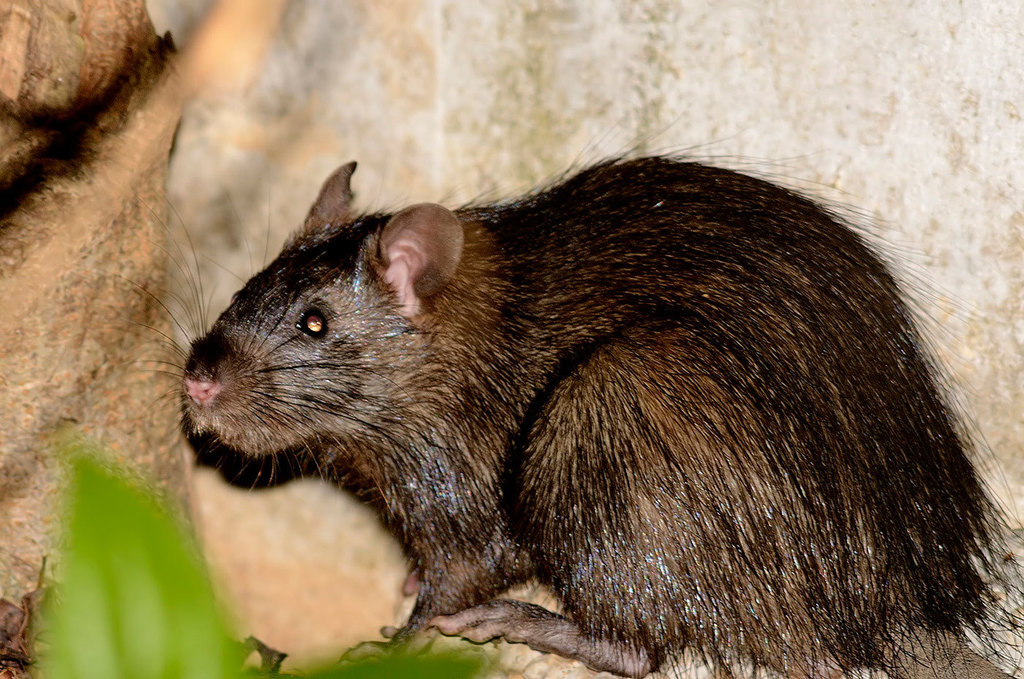
Greater Bandicoot-rat
Bandicota indica
The greater bandicoot rat or Indian bandicoot rat (Bandicota indica) is a species of rodent in the family Muridae found in Bangladesh, China, India, eastern Pakistan, Indonesia, Laos, Malaysia, Myanmar, Nepal, Sri Lanka, Taiwan, Thailand, and Vietnam.
It can grow to about 30–45 cm without including the tail which can grow to 28 cm. These should not be confused with marsupial bandicoots which inhabit Australia and neighbouring New Guinea, which were named after the bandicota rats.
From the article Greater bandicoot rat on Wikipedia (CC BY-SA), quoted section by section
Description
The greater bandicoot rat also called perichali (Tamil) has a dark gray-brown upper parts with a profusion of long, black hairs. Sides are gray with a few long, black hairs. Short, light gray fur occurs on the ventral surfaces. It has a dark and naked, scaly tail, and dark feet with light-colored claws. The young are much lighter in colour. In Sinhala, the bandicoot rat is known as maha uru-meeya - මහ ඌරු මීයා, and in Malayalam, it is known as panni-eli - പന്നിയെലി, thorappan തോരപ്പൻ. Both names directly translate to "pig-rat". These are one of several animals called chuchundra in the Nepali language.
What it does
A female has between 8 and 10 litters during her life. The young (8–14 rat pups per litter) are born blind and naked. Young reach sexual maturity around 50 to 60 days after birth. The lifespan of adults is around a year.
Wikipedia: “Reproduction”
Listen
Looking for field recordings…
Where it lives
Recorded sightings
—
geo-referenced records in GBIF, from museums, herbaria and field observers.
Drag the globe to turn it. Dots are where records exist, not a range map; darker means more records.
In the stacks
Searching the stacks…
Every page naming Bandicota indica in the Biodiversity Heritage Library →
This page is assembled live from iNaturalist, GBIF, Wikipedia, the Source Library and the Internet Archive. It is not yet part of the hand-edited codex. iNaturalist taxon 45664.