- Animals
- ›Chordates
- ›Vertebrates
- ›Mammals
- ›Therians
- ›Placental Mammals
- ›Primates, Rodents, and Allies
- ›Rodents
- ›Mice, Rats, and Hamsters
- ›Muroids
- ›Old World Mice and Rats
- ›Murines
- ›Australasian Mice and Rats
- ›Melomys
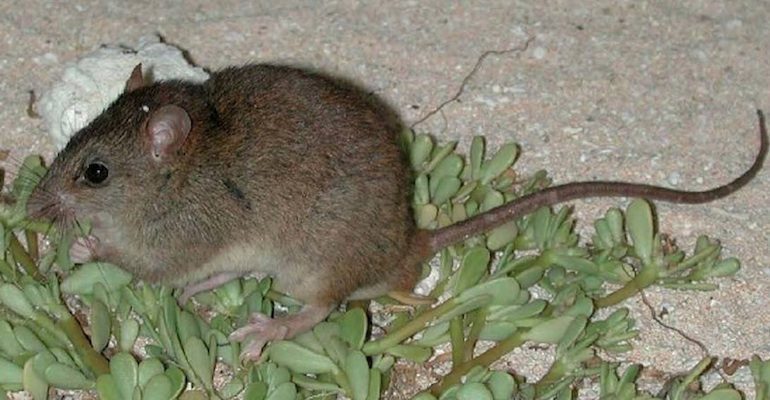
Bramble Cay Melomys
Melomys rubicola
The Bramble Cay melomys, or Bramble Cay mosaic-tailed rat (Melomys rubicola), is a recently extinct species of rodent in the family Muridae and subfamily Murinae. It was an endemic species of the isolated Bramble Cay, a low-lying vegetated coral cay with a habitable area of approximately 5 acres (2.0 ha) located at the northern tip of the Great Barrier Reef in Australia. Described by researchers as having last been seen in 2009 and declared extinct by the Queensland Government and University of Queensland researchers in 2016, it was formally declared extinct by the International Union for Conservation of Nature (IUCN) in May 2015 and the Australian government in February 2019. Having been the only mammal endemic to the reef, its extinction was described as the first extinction of a mammal species due to anthropogenic climate change.
From the article Bramble Cay melomys on Wikipedia (CC BY-SA), quoted section by section
Description
Melomys rubicola was relatively large for a rodent, with a body-length ranging from 14.8 to 16.5 centimetres (5+7⁄8 to 6+1⁄2 in) and a tail-length between 14.5 and 18.5 centimetres (5+3⁄4 and 7+1⁄4 in). Compared to other rats, it had a long tail, short ears, and large feet. Its weight was recorded as between 78 and 164 grams (2+3⁄4 and 5+3⁄4 oz). The tail was prehensile at the tip and covered with rough scales. The fur was reddish brown above and greyish brown below, with black guard hairs on its back. It was similar in appearance to the Cape York melomys, to which it was closely related. As with other species of melomys, it was described as having a Roman nose.
Range & habitat
Scientists are uncertain on how the animal reached Bramble Cay. Studies have theorized that it either reached Bramble Cay from the island of New Guinea by floating on driftwood, or that it reached the region when it was still above water at a time when Australia was connected to New Guinea by a land bridge, and then persisted into recent times. The Bramble Cay melomys was described in 2002 as Australia's most isolated mammal. The cay is located in the northeastern portion of the Torres Strait, approximately 50 kilometres (31 mi) from the mouth of the Fly River in Papua New Guinea. The cay is between 4 and 5 hectares (9+7⁄8 and 12+3⁄8 acres), but the rodent only occupied the vegetated portion of the island, measuring approximately 2 hectares (5 acres). The vegetation of the island comprises grasses and herbs, generally shorter than 0.4 metres (1 ft 4 in). Although 11 species of plants have been recorded on the island in the past, only three to five species have been recorded as present at the same time. Common species include Portulaca oleracea, Boerhavia albiflora, Cenchrus echinatus, and Amaranthus viridis. Three species were observed in 1994: Amaranthus viridis, Boerhavia tetrandra (genus Boerhavia), a type of spinach eaten by humans; and Lepturus repens. …
Wikipedia: “Distribution and ecology”
What it does
Little is known of the diet, but it is suggested that melomys rats were primarily herbivorous, feeding on leaves, seeds, fruits and flowers. They were scansorial, adapted to climbing rainforest trees to search for food. Melomys were important prey items for many rainforest predators, such as sooty owls and pythons. The melomys had a varied diet, feeding on plant matter, insects, and possibly bird eggs. The ability to survive in a limited habitat with scarce resources showcased the resilience of the Bramble Cay species.
Wikipedia: “Diet”
In human culture
First Dog on the Moon published a cartoon tribute to the Bramble Cay melomys, entitled "A moment of silence for the Bramble Cay melomys, another victim of climate change", on 20 February 2019, and another to remember the anniversary of its extinction. In August 2021, a group of artists from Erub Island created a series of works called Maizab Kaur Mukeis (the Meriam Mir name for the Bramble Cay melomys), consisting of sculptures of the animal made with ghost nets. The work was inspired by the news of its extinction, with the artists hoping to create awareness of the damage caused by the abandoned fishing nets to marine ecosystems. The work was selected as one of four Queensland finalists for the National Aboriginal and Torres Strait Islander Art Awards (NATSIAA).
Wikipedia: “In popular culture”
Listen
Looking for field recordings…
Where it lives
Recorded sightings
—
geo-referenced records in GBIF, from museums, herbaria and field observers.
Drag the globe to turn it. Dots are where records exist, not a range map; darker means more records.
In the stacks
Searching the stacks…
Every page naming Melomys rubicola in the Biodiversity Heritage Library →
This page is assembled live from iNaturalist, GBIF, Wikipedia, the Source Library and the Internet Archive. It is not yet part of the hand-edited codex. iNaturalist taxon 45294.