- Plants
- ›Vascular Plants
- ›flowering plants
- ›Dicots
- ›Heathers, Balsams, Primroses, and Allies
- ›camellia family
- ›Stewartia
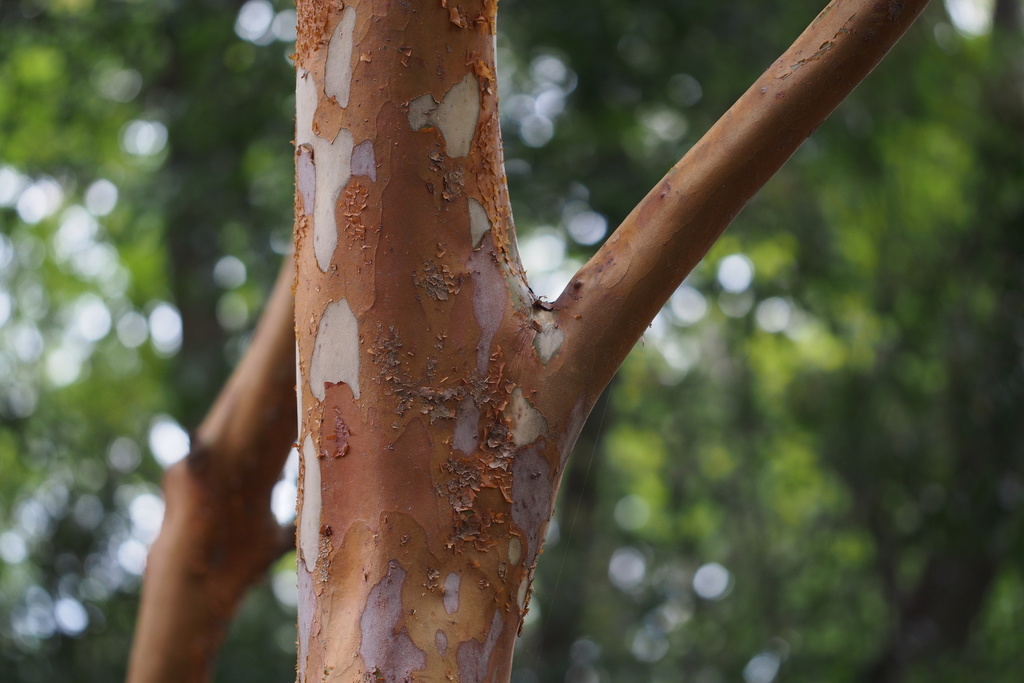
Tall Stewartia
Stewartia monadelpha
Stewartia monadelpha, known as tall stewartia or orangebark stewartia, is a deciduous shrub or multi-stemmed tree native to the temperate rainforests of Japan. Stewartia is a genus of flowering plants in the family Theaceae. The genus name Stewartia is in honor of the 18th century Scottish botanist, John Stuart.
From the article Stewartia monadelpha on Wikipedia (CC BY-SA), quoted section by section
Description
Its appearance varies from a sturdy shrub to a small tree with orange or cinnamon-brown colored bark. It typically grows to a height of 20–25 ft (6.1–7.6 m) but has been known to reach 80 ft (24 m). As the plant matures its form changes from a pyramidal crown to become more open with horizontal branches reaching outwards. The dark green leaves are elliptic and oblong in shape and have serrated edges, growing to approximately 2–4 in (51–102 mm) long, and turn red in the autumn. In June, small cupped flowers appear, growing 1–1.5 in (25–38 mm) wide the flowers are white with yellow stamens, similar in appearance to camellia flowers.
Range & habitat
Tall stewartia is endemic to Japan and primarily grows in cool, montane temperate rainforest zones; specifically, south-central Honshu, Kyushu and Shikoku islands. It is also cultivated in other countries as an ornamental plant.
Wikipedia: “Distribution and habitat”
What it does
This plant grows best in partial shade, but having an excellent heat tolerance, is able to grow well in full sunlight. In terms of soil, tall stewartia can tolerate well-drained clay, loam, sandy, and acidic soils.
== References ==
Wikipedia: “Ecology”
Where it lives
Recorded sightings
—
geo-referenced records in GBIF, from museums, herbaria and field observers.
Drag the globe to turn it. Dots are where records exist, not a range map; darker means more records.
In the stacks
Searching the stacks…
Every page naming Stewartia monadelpha in the Biodiversity Heritage Library →
This page is assembled live from iNaturalist, GBIF, Wikipedia, the Source Library and the Internet Archive. It is not yet part of the hand-edited codex. iNaturalist taxon 452251.