- Animals
- ›Chordates
- ›Vertebrates
- ›Mammals
- ›Therians
- ›Placental Mammals
- ›Primates, Rodents, and Allies
- ›Rodents
- ›Mice, Rats, and Hamsters
- ›Muroids
- ›Old World Mice and Rats
- ›Murines
- ›Typical Old World Rats
- ›Nesokia
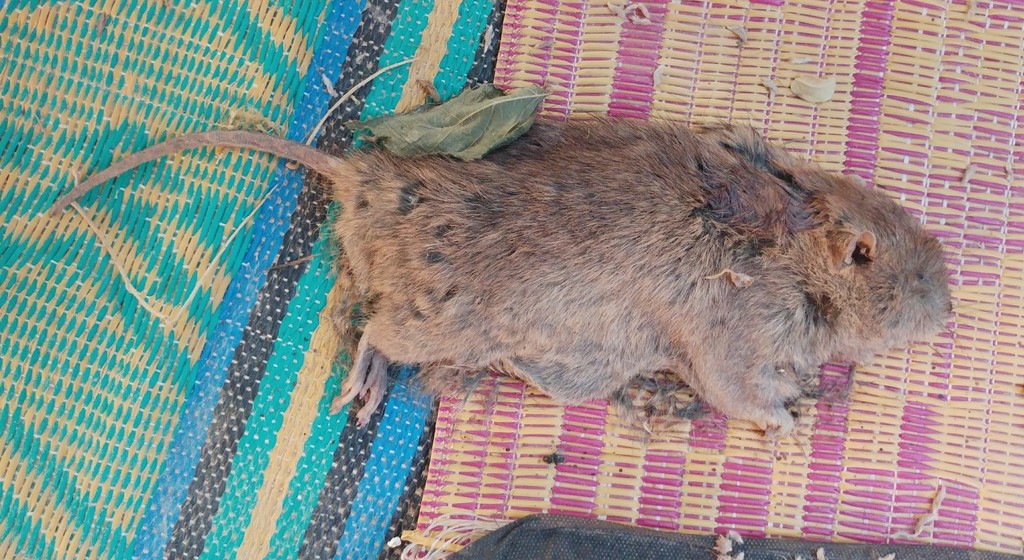
Short-tailed Bandicoot-rat
Nesokia indica
The short-tailed bandicoot rat (Nesokia indica) is a species of rodent in the family Muridae. Other common names include short-tailed mole-rat, Indian bandicoot, bandicoot-rat, flat-tooth rat and short-tailed nesokia....
From the article Short-tailed bandicoot rat on Wikipedia (CC BY-SA), quoted section by section
Description
The short-tailed bandicoot rat is generally brown on the upper parts and lighter on the underside, sometimes with a white patch on the throat. It has long, dense and soft hair in the winter, but the hair is short, sparse and stubbly in the summer. The broad feet and the tail are scantily haired. The forefeet have four functional digits and the hind feet have five, each with a strong, nearly straight claw. The body size varies between 182 and 388 g, and the length between 165 and 218 mm.
Wikipedia: “Characteristics”
Range & habitat
The short-tailed bandicoot rat lives in river valleys, by lake sides, in irrigated lands and oases in Asia and North Africa, from Xinjiang (China) in the east to Egypt in the west, to Uzbekistan in the north and to Bangladesh in the south.
Wikipedia: “Distribution”
What it does
The short-tailed bandicoot rat is common and can reach high numbers under favorable conditions. It prefers damp places and does considerable damage to agricultural crops by its burrowing activities. It feeds on grasses, grains, roots and cultivated fruit and vegetables. It makes tunnels in walls of irrigation canals and can cause leaks and flooding. It has many predators, including jackals, foxes, jungle cats, polecats, weasels, snakes and domestic cats and dogs.
Wikipedia: “Ecology”
Listen
Looking for field recordings…
Where it lives
Recorded sightings
—
geo-referenced records in GBIF, from museums, herbaria and field observers.
Drag the globe to turn it. Dots are where records exist, not a range map; darker means more records.
In the stacks
Searching the stacks…
Every page naming Nesokia indica in the Biodiversity Heritage Library →
This page is assembled live from iNaturalist, GBIF, Wikipedia, the Source Library and the Internet Archive. It is not yet part of the hand-edited codex. iNaturalist taxon 45193.