- Animals
- ›Chordates
- ›Vertebrates
- ›Mammals
- ›Therians
- ›Placental Mammals
- ›Primates, Rodents, and Allies
- ›Rodents
- ›Mice, Rats, and Hamsters
- ›Muroids
- ›Hamsters, Voles, Lemmings, and Allies
- ›South American Mice and Rats
- ›Rice Rats
- ›Holochilus
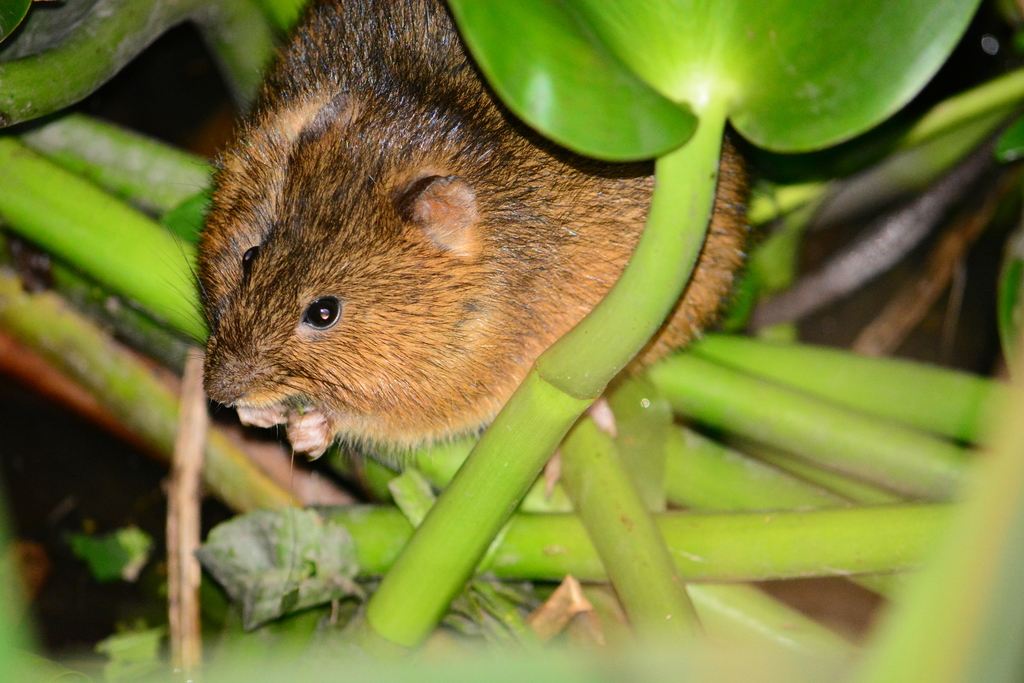
web-footed marsh rat
Holochilus brasiliensis
Holochilus brasiliensis, also known as the Brazilian marsh rat or web-footed marsh rat, is a species of semiaquatic rodent from South America. It is found in northeastern Argentina, southern and eastern Brazil and in eastern Uruguay.
From the article Holochilus brasiliensis on Wikipedia (CC BY-SA), quoted section by section
Description
This is a medium sized species compared with other members of the genus; the head-and-body length is between 167 and 211 mm (6.6 and 8.3 in) and the tail length is between 183 and 214 mm (7.2 and 8.4 in). The fur is luxuriant and dense. The dorsal colour is cinnamon, the flanks are a brighter orange and the underparts a paler orange, apart from a white throat and chest and some white in the unguinal area.
Range & habitat
H. brasiliensis is semiaquatic and occurs in eastern and southern Brazil, Uruguay, eastern Paraguay and northeastern Argentina in the Atlantic Forest Ecoregion. It is typically found in swampy grassland and woodland areas bordering rivers in the rainforest, both on the coastal plain and inland.
Wikipedia: “Distribution and habitat”
What it does
A nocturnal species, H. brasiliensis moves freely on land and in the water. It is seldom caught in live traps but is frequently caught by barn owls and mammalian carnivores. It feeds on tender shoots and mostly breeds after rains in spring and summer, with litters of three to six young having been recorded. It can be a pest in sugar cane and rice crops.
Wikipedia: “Ecology”
Listen
Looking for field recordings…
Where it lives
Recorded sightings
—
geo-referenced records in GBIF, from museums, herbaria and field observers.
Drag the globe to turn it. Dots are where records exist, not a range map; darker means more records.
In the stacks
Searching the stacks…
Every page naming Holochilus brasiliensis in the Biodiversity Heritage Library →
This page is assembled live from iNaturalist, GBIF, Wikipedia, the Source Library and the Internet Archive. It is not yet part of the hand-edited codex. iNaturalist taxon 45009.