- Animals
- ›Chordates
- ›Vertebrates
- ›Mammals
- ›Therians
- ›Placental Mammals
- ›Primates, Rodents, and Allies
- ›Rodents
- ›Mice, Rats, and Hamsters
- ›Muroids
- ›Old World Mice and Rats
- ›Crested Rats
- ›Lophiomys
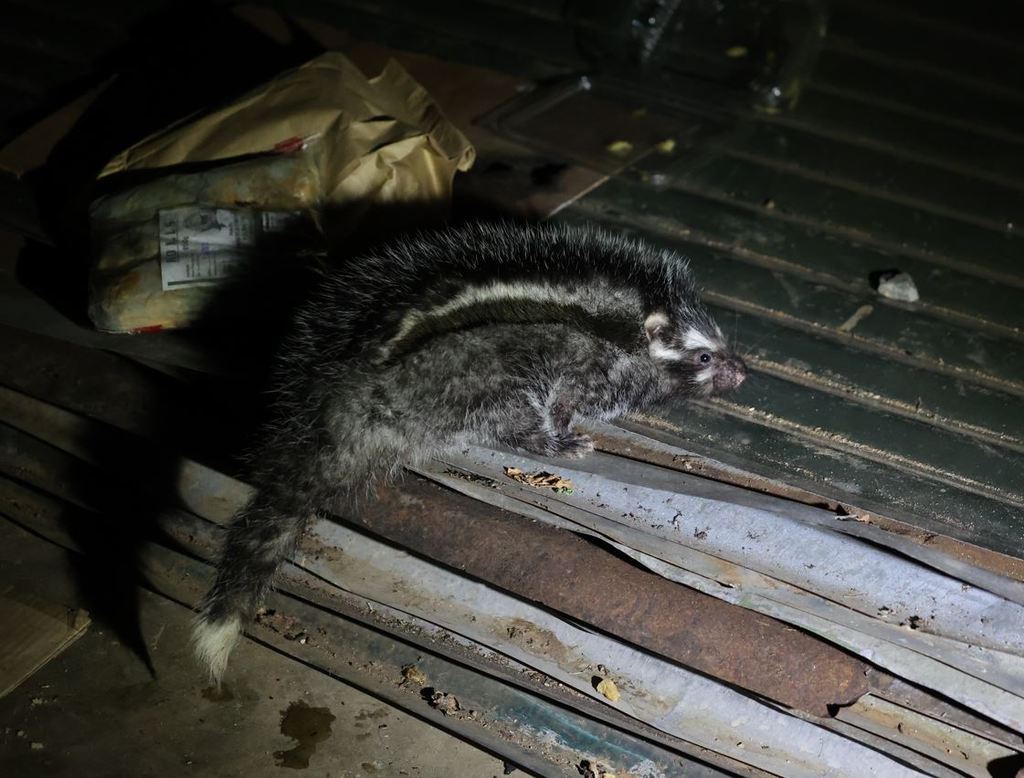
Maned Rat
Lophiomys imhausi
The maned rat or African crested rat (Lophiomys imhausi) is a large nocturnal, long-haired and bushy-tailed East African rodent that superficially resembles a porcupine. The world's only known poisonous rodent, the maned rat coats itself in toxins from plants to fend off predators.
From the article Maned rat on Wikipedia (CC BY-SA), quoted section by section
Description
The head and body length ranges from 18–30.5 centimetres (7.1–12.0 in) long, with the tail 14.5–20.5 centimetres (5.7–8.1 in) long; the typical weight is 590–920 g (21–32 oz). The coat consists of long, silver and black-tipped guard hairs over a dense, woolly, grey and white undercoat, with the face and limbs having short, black fur. A mane of longer, coarser black-and-white banded hairs extends from the top of the animal's head to just beyond the base of the tail. This mane is bordered by a broad, white-bordered strip of hairs covering an area of glandular skin. The forelimbs and hind limbs have short black fur. The forefeet are large and digit 1 of the forefeet does not have a claw, while digits 2-5 have a well developed claw. When the animal is threatened or excited, the mane erects and this strip parts, exposing the glandular area. The hairs in this area are, at the tips, like ordinary hair, but are otherwise spongy, fibrous, and absorbent with a honeycomb structure. The rat is known to deliberately smear these hairs with poison from the bark of the Acokanthera schimperi, the poison arrow tree, on which it chews, thus creating a defense mechanism that can sicken or even kill predators which attempt to bite it. It is the only rodent known to use and store toxins from a different species in nature to protect itself, with no known adverse effects to themselves. L. …
Range & habitat
The habitat of the maned rat ranges from nearly sea level in Ethiopia and Somalia, to more typically the drier, highland forests and woodlands of Somalia, Ethiopia, Sudan, Tanzania, Uganda, and Kenya. Fossil remains have been found as far north as Palestine, however. They are often found in rocky areas or in hollow tree trunks and holes along the tops of ravines, and have also been found nesting among rocks on cliff-faces.
Wikipedia: “Habitat”
What it does
Its diet in the wild consists largely of leaves, fruit, and other plant material, but it has been known to eat meat, cereals, root vegetables, and insects in captivity. Food is eaten by sitting on its haunches and using its forepaws to bring food items to its mouth. It is the only species in the super family Muroidea whose stomach is highly compartmentalised. The stomach contains five anatomically discrete sections that superficially resemble the sacculated configuration characteristic of ruminant artiodactyls. Because of its large size and weight, L. imhausi may be one of the few muroid rodents that has symbiotic microflora in the foregut which can metabolise cellulose by gastric fermentation.
Wikipedia: “Diet”
Listen
Looking for field recordings…
Where it lives
Recorded sightings
—
geo-referenced records in GBIF, from museums, herbaria and field observers.
Drag the globe to turn it. Dots are where records exist, not a range map; darker means more records.
In the stacks
Searching the stacks…
Every page naming Lophiomys imhausi in the Biodiversity Heritage Library →
This page is assembled live from iNaturalist, GBIF, Wikipedia, the Source Library and the Internet Archive. It is not yet part of the hand-edited codex. iNaturalist taxon 44950.