- Animals
- ›Chordates
- ›Vertebrates
- ›Mammals
- ›Therians
- ›Placental Mammals
- ›Primates, Rodents, and Allies
- ›Rodents
- ›Mice, Rats, and Hamsters
- ›Muroids
- ›Hamsters, Voles, Lemmings, and Allies
- ›Hamsters
- ›Mesocricetus
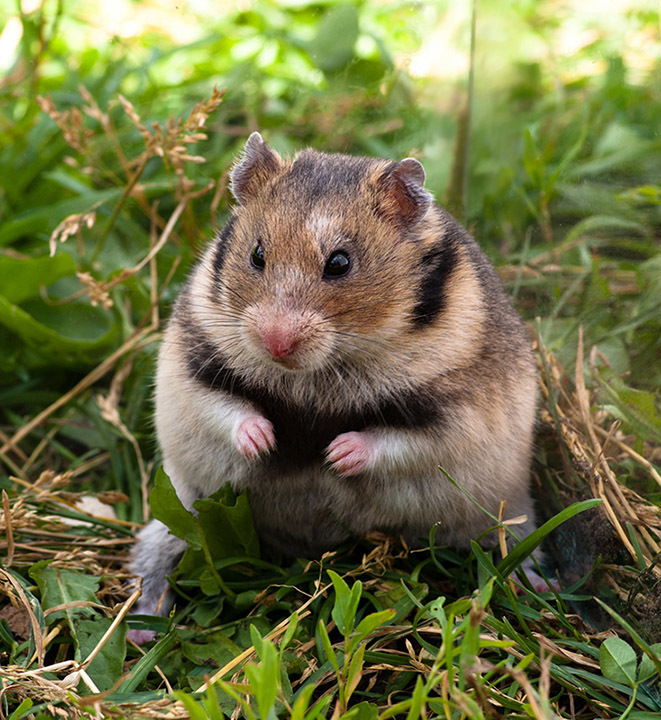
Brandt's hamster
Mesocricetus brandti
The Turkish hamster (Mesocricetus brandti), also referred to as Brandt's hamster, Azerbaijani hamster, or avurtlak, is a species of hamster native to Turkey, Azerbaijan and other surrounding nations. The Turkish hamster, first catalogued in 1878, is a fairly close relative of the Syrian or golden hamster, though far less is known about it, and it is rarely kept as a pet. The population of the Turkish hamster is said to be declining in the wild, yet this hamster is often used in laboratory testing. Turkish hamsters have lifespans of about two years and are solitary, nocturnal animals, which hibernate.
They are reported to be more aggressive than other members of the family Cricetidae. They are tan and dark, sandy brown in color. Like all hamsters, the Turkish hamster has cheek pouches that allow it to carry large amounts of food at one time.
From the article Turkish hamster on Wikipedia (CC BY-SA), quoted section by section
Range & habitat
Hamsters are found in the wild throughout Europe and Asia and are considered to be extremely adaptable, living in scrublands, sand dunes, desert steppes and farmlands. The land where the Turkish hamster lives is extremely dry and open, with fairly little vegetation aside from grasses. Turkish hamsters usually live between 1,000 and 2,200 meters above sea level. This hamster burrows in the ground for shelter, and its burrows can be 20 inches to 6 feet below the ground surface. These burrows are complex, consisting of several tunnels leading to separate cells for nesting, food, and waste. Turkish hamster burrows are well-enough equipped for the hamsters to hibernate for four to 10 months (though sources do differ on this point), sometimes sleeping for 30 days at a time, though usually waking weekly for a day or two of activity.
Wikipedia: “Habitat and behavior”
What it does
Turkish hamsters have fairly varied diets, subsisting primarily on grains and herbs. They do eat insects on occasion and store roots and leaves in their burrows for hibernation. As Turkish hamsters often live near and among farmlands, they often eat human crops and are considered a pest.
Wikipedia: “Diet”
Toxicity
The Turkish hamster is a rare species, but is the most widespread of the family Cricetidae. Its ability to live in a variety of environments means the Turkish hamster often lives on farmlands, and is viewed as and controlled as an agricultural pest. In 1996, the Turkish hamster was categorized as an animal with the lowest risk of extinction, but due to cases of direct poisoning by farmers, it is now near threatened. More data are needed to understand the population decline.
Wikipedia: “Population and endangerment”
Listen
Looking for field recordings…
Where it lives
Recorded sightings
—
geo-referenced records in GBIF, from museums, herbaria and field observers.
Drag the globe to turn it. Dots are where records exist, not a range map; darker means more records.
In the stacks
Searching the stacks…
Every page naming Mesocricetus brandti in the Biodiversity Heritage Library →
This page is assembled live from iNaturalist, GBIF, Wikipedia, the Source Library and the Internet Archive. It is not yet part of the hand-edited codex. iNaturalist taxon 44917.