- Animals
- ›Chordates
- ›Vertebrates
- ›Mammals
- ›Therians
- ›Placental Mammals
- ›Primates, Rodents, and Allies
- ›Rodents
- ›Mice, Rats, and Hamsters
- ›Muroids
- ›Hamsters, Voles, Lemmings, and Allies
- ›South American Mice and Rats
- ›Long-clawed Mice
- ›Geoxus
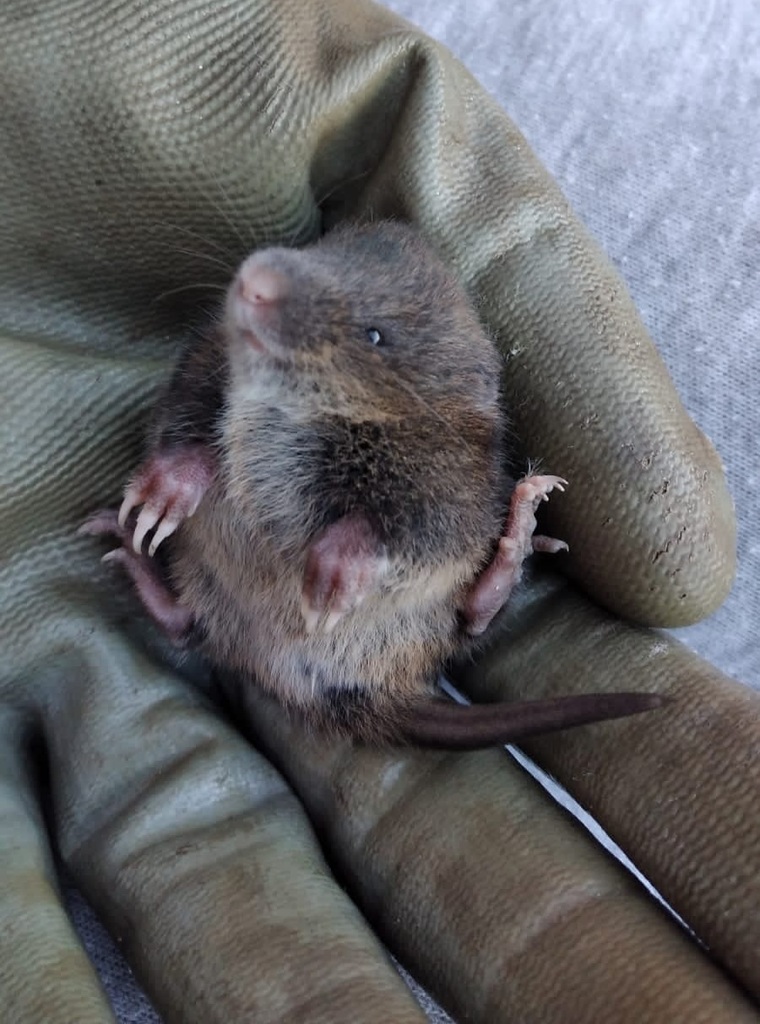
Valdivian Long-clawed Molemouse
Geoxus valdivianus
Geoxus valdivianus, also known as the long-clawed mole mouse or Valdivian long-clawed akodont, is a species of rodent in the tribe Abrotrichini of family Cricetidae found in the Valdivian temperate rain forests and Magellanic subpolar forests of Argentina and Chile. It is one of two species in the genus Geoxus.
From the article Geoxus valdivianus on Wikipedia (CC BY-SA), quoted section by section
Description
The long-clawed mole mouse is a small shrew-like mammal with a short tail and a total length of about 14 cm (5.5 in). The body is spindle-shaped, enabling this mouse to move and turn in confined spaces. The pelage is short and velvety, dark olive-brown to black, sometimes tinged with reddish brown. The snout is pointed, the eyes small and the ears tiny. The feet are large, the claws being larger than the digits.
Range & habitat
This species is endemic to the southern tip of South America. Its range extends from southern Argentina and central Chile, including Mocha Island and Chiloé Island, to the Strait of Magellan. Its habitat is the forests of Nothofagus, Saxegothaea and bamboo found in this region, as well as tussock grassland, marshes and wet meadows; its altitudinal range is from sea level to the tree line.
Wikipedia: “Distribution and habitat”
What it does
The long-clawed mole mouse digs a burrow and also moves about in surface runways near fallen logs and in dense undergrowth. It is mainly nocturnal, leaving its burrow briefly to feed on earthworms and other small invertebrates, supplemented by plant material.
Wikipedia: “Behaviour”
Listen
Looking for field recordings…
Where it lives
Recorded sightings
—
geo-referenced records in GBIF, from museums, herbaria and field observers.
Drag the globe to turn it. Dots are where records exist, not a range map; darker means more records.
In the stacks
Searching the stacks…
Every page naming Geoxus valdivianus in the Biodiversity Heritage Library →
This page is assembled live from iNaturalist, GBIF, Wikipedia, the Source Library and the Internet Archive. It is not yet part of the hand-edited codex. iNaturalist taxon 44812.