- Plants
- ›Vascular Plants
- ›flowering plants
- ›Dicots
- ›Roses, Elms, Figs, and Allies
- ›rose family
- ›brambles, roses, strawberries, and allies
- ›Brambles
- ›Rubus
- ›Cylactis
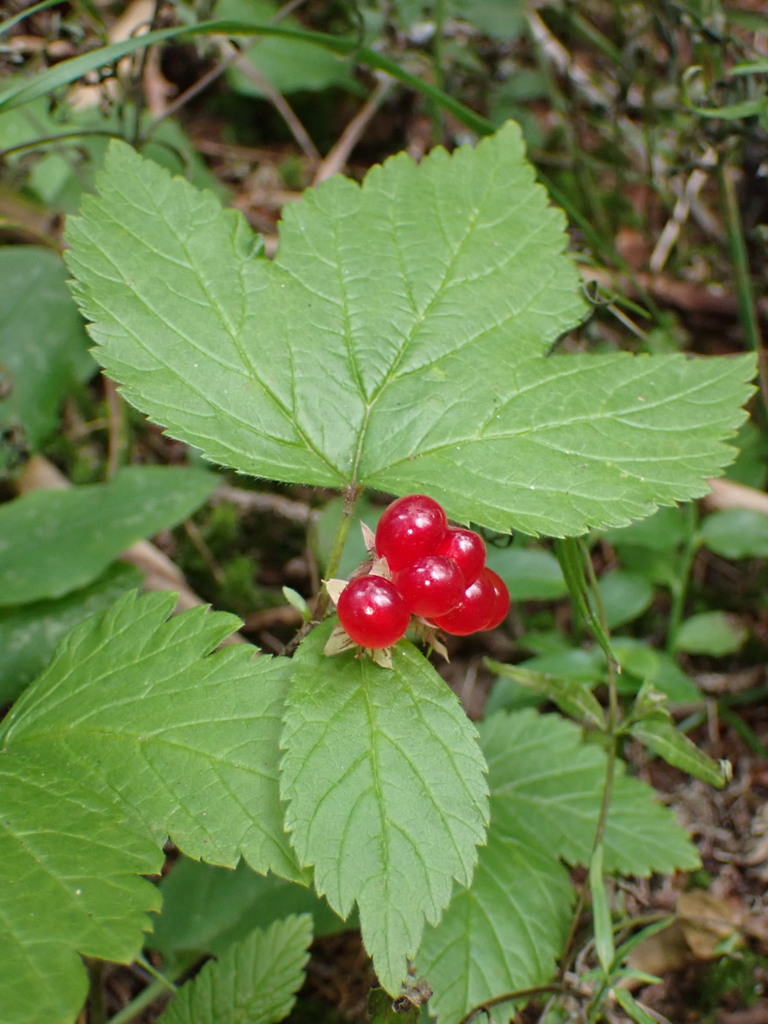
Stone Bramble
Rubus saxatilis
Rubus saxatilis or stone bramble is a species of bramble widespread across Europe and Asia from Iceland and Spain east as far as China. It has also been found in Greenland.
From the article Rubus saxatilis on Wikipedia (CC BY-SA), quoted section by section
Description
The stone bramble is a perennial plant with biennial stems which die after fruiting in their second year. It sends out long runners which root at the tip to form new plants. The stems are 20–60 centimetres (8–23+1⁄2 in) tall and rough with many small spines. The alternate leaves are stalked, usually compound and consisting of three oval leaflets with serrated margins, the terminal leaflet having a short stalk and the other two being slightly smaller. The inflorescence is a few-flowered corymb. The calyx of each flower has five sepals and the corolla is composed of five narrow white petals. There is a bunch of stamens and there are several pistils. The fruit is an aggregate of several red, fleshy drupes. It is red, 1–1.5 cm (3⁄8–5⁄8 in) in diameter, and contains large pips. Its fruit persists for an average of 17.6 days, and bears an average of 2 seeds per fruit. Fruits average 94% water (possibly the highest among European fleshy fruits) and their dry weight includes 29.8% carbohydrates and 1.4% lipids.
Range & habitat
It is widespread across Eurasia from Iceland and Spain east as far as China. It has also been found in Greenland. The stone bramble can form dense clumps, spreading by means of its runners. It can also spread by seed as its fruit are eaten by birds which deposit the seeds elsewhere in their droppings. It flourishes in damp woods and rough places and can grow vigorously in clearings created by felling trees.
Wikipedia: “Distribution and habitat”
At the table
The berries are edible raw or cooked, and have an acid flavor, but are agreeable to the palate. In Russian cuisine, they are eaten plain with sugar, honey, or milk, and can be used in preparation of kissel, kompot, juice, syrup, jams and jellies, and kvass.
Wikipedia: “Culinary”
In medicine
Many parts of the plant are astringent, owing largely to the presence of tannins. A decoction of the root was once used in India for the treatment of relaxed bowels and dysentery, and also in treating the spasmodic stage of whooping cough. A decoction of the leaves was used to treat dysentery and some types of bleeding.
Wikipedia: “Medicinal”
Where it lives
Recorded sightings
—
geo-referenced records in GBIF, from museums, herbaria and field observers.
Drag the globe to turn it. Dots are where records exist, not a range map; darker means more records.
In the old herbals & bestiaries


In the stacks
Searching the stacks…
Every page naming Rubus saxatilis in the Biodiversity Heritage Library →
This page is assembled live from iNaturalist, GBIF, Wikipedia, the Source Library and the Internet Archive. It is not yet part of the hand-edited codex. iNaturalist taxon 447878.