- Plants
- ›Vascular Plants
- ›flowering plants
- ›Dicots
- ›pinks, cactuses, and allies
- ›pink family
- ›Caryophylloideae
- ›Caryophylleae
- ›Dianthus
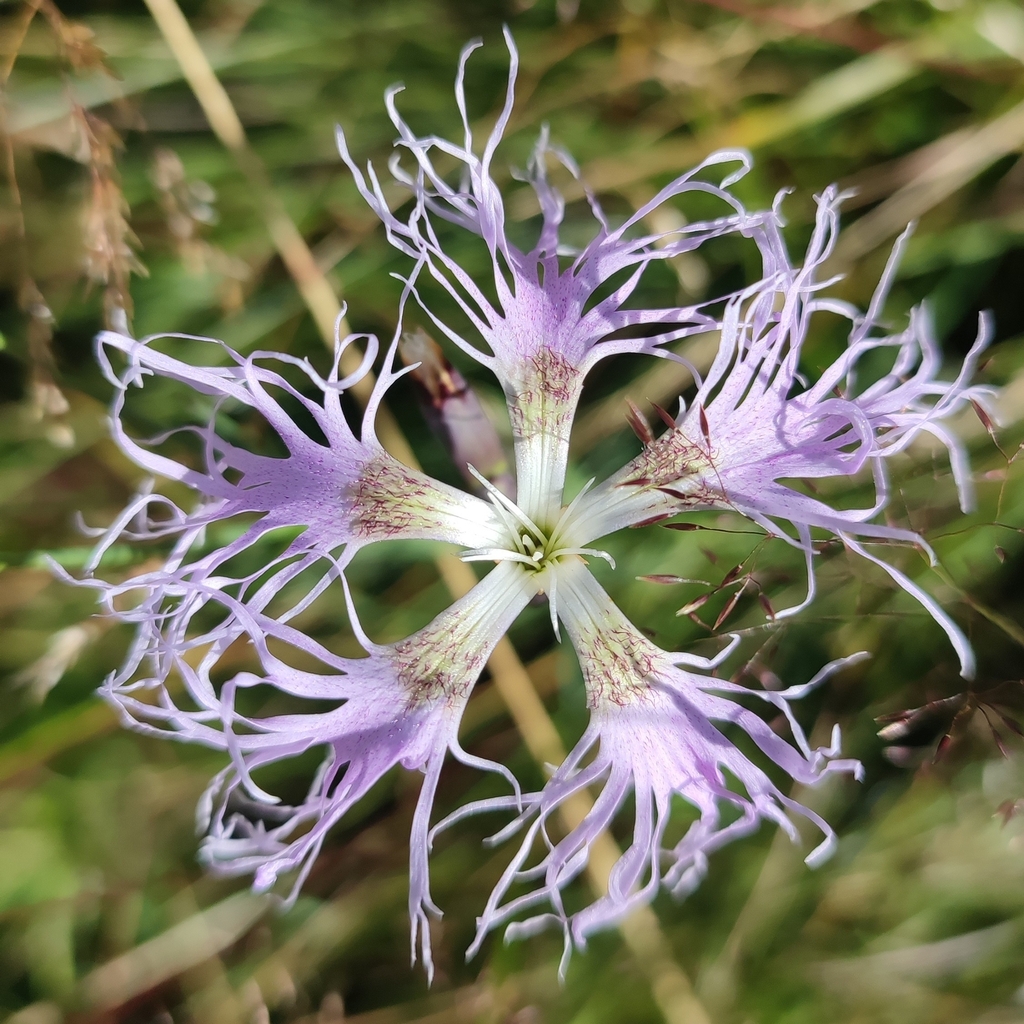
Fringed Pink
Dianthus superbus
Dianthus superbus, the fringed pink or large pink, is a species of Dianthus native to Europe and northern Asia, from France north to arctic Norway, and east to Japan; in the south of its range, it occurs at high altitudes, up to 2,400 m.
It is a herbaceous perennial plant growing to 80 cm tall. The leaves are green to greyish green, slender, up to 8 cm long. The flowers are sweetly scented, 3–5 cm in diameter, with five deeply cut fringed petals, pink to lavender with a greenish base; they are produced in branched clusters at the top of the stems from early to late summer.
From the article Dianthus superbus on Wikipedia (CC BY-SA), quoted section by section
At the table
Dianthus superbus is a popular garden plant and several cultivars and hybrids have been selected, with flower colour varying from white to red or purple, usually with a green centre. It thrives in ordinary to dry soil in full sun; partial shade is preferred in hot climates. It is self-sowing and can be propagated by seed, by division of the roots, layering of the stems or cuttings from growing shoots. Deadheading extends the blooming period. The flowers sit atop stems approximately 25–45 cm tall, while the gray-green linear leaves form a mat at the base of the plant 20–30 cm wide. Because D. superbus is low to the ground, those who want to enjoy its fragrance find planting it in groups desirable. The leaves are edible when young, and can be eaten when boiled. The flowers contain sweet nectar, and the foliage can be eaten or boiled to make a drink. The plant contains toxic saponins, but not enough to be harmful. It has historically been used in Chinese herbology as a contraceptive, diuretic, and anti-infective; its Chinese name is qúmài (瞿麦).
Wikipedia: “Cultivation and uses”
In human culture
The yamato nadeshiko (D. superbus longicalycinus) is metaphorically associated with traditional, idealized feminine beauty, in Japanese culture.
== References ==
Wikipedia: “Cultural significance”
Where it lives
Recorded sightings
—
geo-referenced records in GBIF, from museums, herbaria and field observers.
Drag the globe to turn it. Dots are where records exist, not a range map; darker means more records.
In the old herbals & bestiaries


In the stacks
Searching the stacks…
Every page naming Dianthus superbus in the Biodiversity Heritage Library →
This page is assembled live from iNaturalist, GBIF, Wikipedia, the Source Library and the Internet Archive. It is not yet part of the hand-edited codex. iNaturalist taxon 447244.