- Animals
- ›Chordates
- ›Vertebrates
- ›Mammals
- ›Therians
- ›Placental Mammals
- ›Primates, Rodents, and Allies
- ›Rodents
- ›Mice, Rats, and Hamsters
- ›Muroids
- ›Old World Mice and Rats
- ›Murines
- ›Typical Old World Rats
- ›Rattus
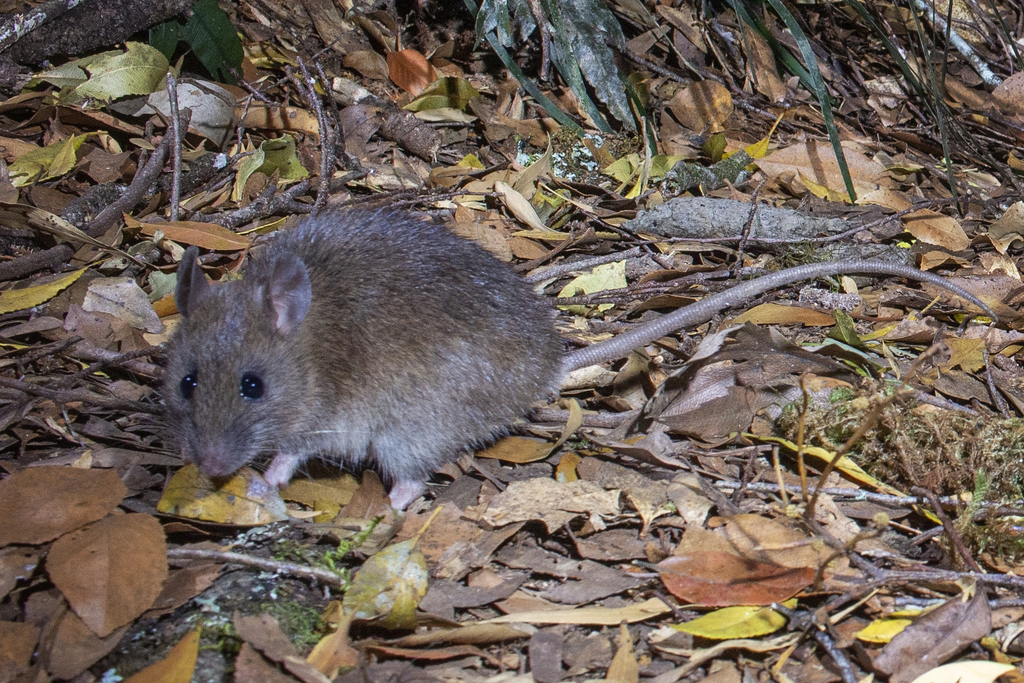
Australian Bush Rat
Rattus fuscipes
The bush rat or Australian bush rat (Rattus fuscipes) is a small Australian nocturnal animal. It is an omnivore and one of the most common indigenous species of rat on the continent, found in many heathland areas of Victoria and New South Wales.
From the article Bush rat on Wikipedia (CC BY-SA), quoted section by section
Description
While there are not many characteristics that readily distinguish the bush rat from other Rattus species, it is characterised by having small tympanic bullae and a straight incisive foramen. Adult bush rats are smaller than the Australian swamp rat (R. lutreolus) and in addition, the bush rat's foot pads are a pink colour, whereas the swamp rat's foot pads are dark brown. The hair at the foot is short and pale in colour, subspecies R. f. coracius is notably darker. The feet are pentadactyl and all digits are clawed. The tail is a pink shade of brown, almost free of hair, with scales that overlap and give an obvious ringed appearance. The bush rat exhibits sexual dimorphism: the males are larger than the females in the species. Their prominent eyes are large, and this distinguishes them from the narrower snouted Cape York species Rattus leucopus where their range overlaps. The species varies greatly in coloration and size. The length of the head and body combined is from 100 to 205 millimetres (3.9 to 8.1 in), the tail is 100 to 195 mm (3.9 to 7.7 in); these measurements are approximately the same in the individuals. The ventral side of the pelage is a light grey or cream colour, which grades with the rufous flank and darker brown of the upper-side; the overall colour is a greyish or reddish brown. …
Range & habitat
The bush rat is found primarily in the coastal regions of south and eastern Australia. While it is mainly found in the lowlands, the species is also found at higher altitudes in the Australian Alps. The coastal distribution extends to some offshore islands, including Kangaroo Island. The range of the southwestern subspecies R. f. fuscipes is through sclerophyll forest of a high rainfall region. Along the southern coast the subspecies R. f. greyii inhabits arid habitat, while subspecies assimilis is found from Victoria to Queensland. The habitat of R. fuscipes is terrestrial and favour wetter areas with dense undergrowth. The species constructs a shallow burrow that leads down into a nest chamber lined with grass and other vegetation.
Wikipedia: “Distribution and habitat”
What it does
The bush rat does not show much overlap in diet with other local rodent species. In the summer it consumes primarily fruit, arthropods, and seeds, but in the winter its main source of food is from a particular cyperaceous species. When found in the forest it consumes primarily fungi and various fibrous plant material. Bush rats have been observed feeding on nectar without damaging the blossoms, thus likely aiding in pollination.
Wikipedia: “Diet”
Listen
Looking for field recordings…
Where it lives
Recorded sightings
—
geo-referenced records in GBIF, from museums, herbaria and field observers.
Drag the globe to turn it. Dots are where records exist, not a range map; darker means more records.
In the stacks
Searching the stacks…
Every page naming Rattus fuscipes in the Biodiversity Heritage Library →
This page is assembled live from iNaturalist, GBIF, Wikipedia, the Source Library and the Internet Archive. It is not yet part of the hand-edited codex. iNaturalist taxon 44570.