- Animals
- ›Chordates
- ›Vertebrates
- ›Mammals
- ›Therians
- ›Placental Mammals
- ›Primates, Rodents, and Allies
- ›Rodents
- ›Ctenohystricans
- ›Hystricognaths
- ›Old World Porcupines
- ›Hystrix
- ›Hystrix
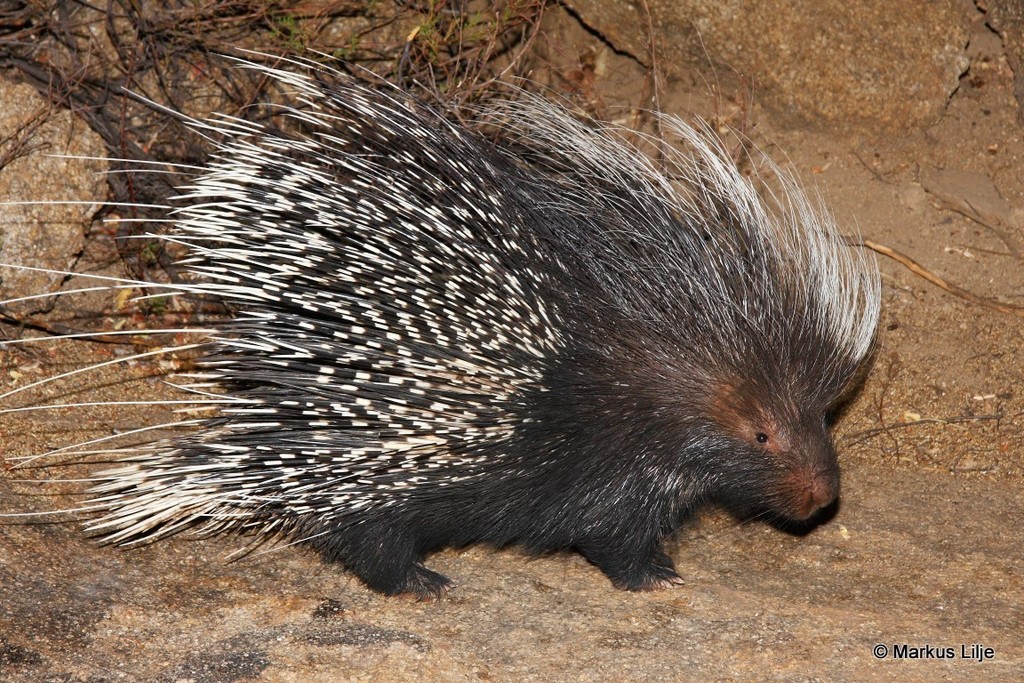
Cape Porcupine
Hystrix africaeaustralis
The Cape porcupine (Hystrix africaeaustralis), Cape crested porcupine or South African porcupine, is a species of Old World porcupine native to central and southern Africa.
From the article Cape porcupine on Wikipedia (CC BY-SA), quoted section by section
Description
Cape porcupines are one of the largest rodents in Africa and also one of the largest species of porcupine. Cape porcupines are amongst the largest living rodents in the world; a few other rodents appear to be larger in body mass such as the capybara and the Eurasian and North American beavers. They are similar in appearance to the slightly larger and closely related crested porcupine. They can most easily be distinguished from them by the presence of a band of short white spines along the midline of the rump. Indian porcupines are almost the same size on average as well, being slightly heavier on average than crested porcupines but slightly lighter than Cape porcupines. Cape porcupines measure 63 to 81 centimetres (25 to 32 inches) long from the head to the base of the tail, with the tail adding a further 11–20 centimetres (4.3–7.9 inches). They weigh from 10 to 24 kilograms (22 to 53 pounds), with exceptionally large specimens weighing up to 30 kg (66 lb); males and females are not significantly different in size. The average weight of males from Zimbabwe was 16.9 kg (37 lb) and while the average for females there was 18.4 kg (41 lb) while in the Orange river valley of South Africa males averaged 12.3 kg (27 lb) and females averaged 13 kg (29 lb). They are heavily-built animals, with stocky bodies, short limbs, and an inconspicuous tail. …
Range & habitat
Cape porcupines are found across the whole of southern and central Africa, to southern Kenya, Uganda, and Congo at the northern edge of their range. They inhabit a wide range of habitats, from sea level to 2,000 metres (6,600 ft), although they are only marginally present in dense forests and the driest of deserts, and are not found in swampland. There are no currently recognised subspecies.
Wikipedia: “Distribution and habitat”
What it does
Cape porcupines eat mostly plant material: fruits, roots, tubers, bulbs, and bark. They have a long small intestine and large caecum, employing hindgut fermentation to break down the tough materials in their food. They have also been reported to gnaw on carrion and bones. They are often considered pests by local farmers, because they can feed on crops and damage trees. However, their debarking of trees may also play a role in the maintenance of local savannah ecosystems, helping to prevent the development of denser forested environments. Cape porcupines are nocturnal and monogamous, typically living as mated pairs of adults, caring for any young together. Each pair may inhabit up to six burrows, jointly defending their shared territory, although they typically forage as individuals. Both sexes scent mark their territory, although males do so more frequently, and may play a more active role in its defence. The size of the home range varies depending on the local habitat and availability of food, but can range between at least 67 and 203 hectares (170 and 500 acres). When attacked, the porcupine freezes. If cornered, it turns vicious and charges to stab its attacker with its quills. Otherwise, the porcupine may retreat into its burrow, exposing only its quills and making it hard to dislodge.
Wikipedia: “Diet and behaviour”
Listen
Looking for field recordings…
Where it lives
Recorded sightings
—
geo-referenced records in GBIF, from museums, herbaria and field observers.
Drag the globe to turn it. Dots are where records exist, not a range map; darker means more records.
In the stacks
Searching the stacks…
Every page naming Hystrix africaeaustralis in the Biodiversity Heritage Library →
This page is assembled live from iNaturalist, GBIF, Wikipedia, the Source Library and the Internet Archive. It is not yet part of the hand-edited codex. iNaturalist taxon 44173.