- Plants
- ›Vascular Plants
- ›flowering plants
- ›Dicots
- ›pinks, cactuses, and allies
- ›Old World pitcher plants
- ›Nepenthes
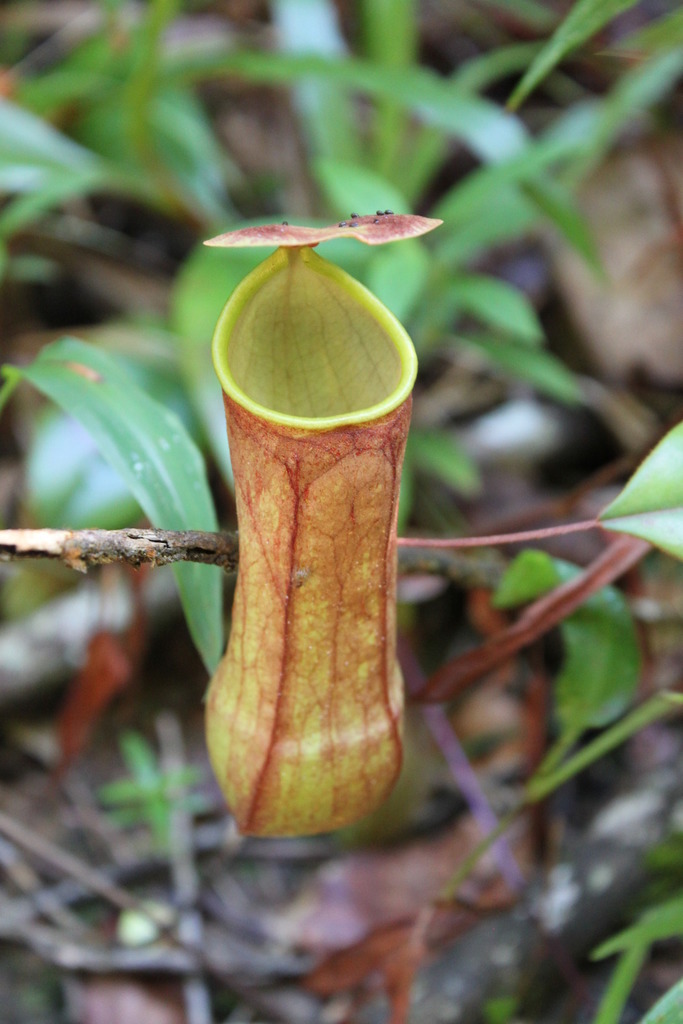
Sri Lankan pitcher plant
Nepenthes distillatoria
Nepenthes distillatoria (/nɪˈpɛnθiːz dɪˌstɪləˈtɔːri.ə/; from New Latin from Latin: destillo = to distill, -oria = adjectival ending; something from which a liquid is distilled, i.e., pitcher) is a tropical pitcher plant endemic to Sri Lanka. It was the second Nepenthes species to be described in print and the first to be formally named under the Linnaean system of taxonomy. It is therefore the type species of the genus.
From the article Nepenthes distillatoria on Wikipedia (CC BY-SA), quoted section by section
What it does
Nepenthes distillatoria is endemic to Sri Lanka and is the only Nepenthes species recorded from the island. It grows in waterlogged open scrub, along road embankments and other cleared areas, and in forest. N. distillatoria occurs from sea level to 700 m altitude. Due to its isolation, N. distillatoria has no known natural hybrids.
Wikipedia: “Ecology”
In human culture
Nepenthes distillatoria was the second Nepenthes species to be described in print, after N. madagascariensis. In 1677, Danish physician Thomas Bartholin made brief mention of it under the name Miranda herba, Latin for "marvelous herb". Three years later, Polish–Dutch merchant Jacob Breyne referred to this species as Bandura zingalensium, after a local name for the plant. Bandura subsequently became the most commonly used name for the tropical pitcher plants, until Linnaeus coined Nepenthes in 1737. Nepenthes distillatoria was again described in 1683, this time by Swedish physician and naturalist Herman Niklas Grim. Grim called it Planta mirabilis destillatoria, or the "miraculous distilling plant", and was the first to clearly illustrate a tropical pitcher plant. Three years later, in 1686, English naturalist John Ray quoted Grim as saying:
The root draws up moisture from the earth which with the help of the sun's rays rises up into the plant itself and then flows down through the stems and nerves of the leaves into the natural utensil to be stored there until used for human needs. [translated from Latin in Pitcher-Plants of Borneo] Linnaeus used Grim's original specific epithet when naming N. distillatoria in 1753.
Nepenthes distillatoria was again illustrated in Johannes Burmann's Thesaurus Zeylanicus of 1737. The drawing depicts the end of a flowering stem with pitchers. …
Wikipedia: “Botanical history”
Where it lives
Recorded sightings
—
geo-referenced records in GBIF, from museums, herbaria and field observers.
Drag the globe to turn it. Dots are where records exist, not a range map; darker means more records.
In the stacks
Searching the stacks…
Every page naming Nepenthes distillatoria in the Biodiversity Heritage Library →
This page is assembled live from iNaturalist, GBIF, Wikipedia, the Source Library and the Internet Archive. It is not yet part of the hand-edited codex. iNaturalist taxon 441210.