- Plants
- ›Vascular Plants
- ›flowering plants
- ›Dicots
- ›pinks, cactuses, and allies
- ›cacti
- ›globular cacti, moonlight cacti, torch cacti, and allies
- ›Cereeae
- ›Micranthocereus
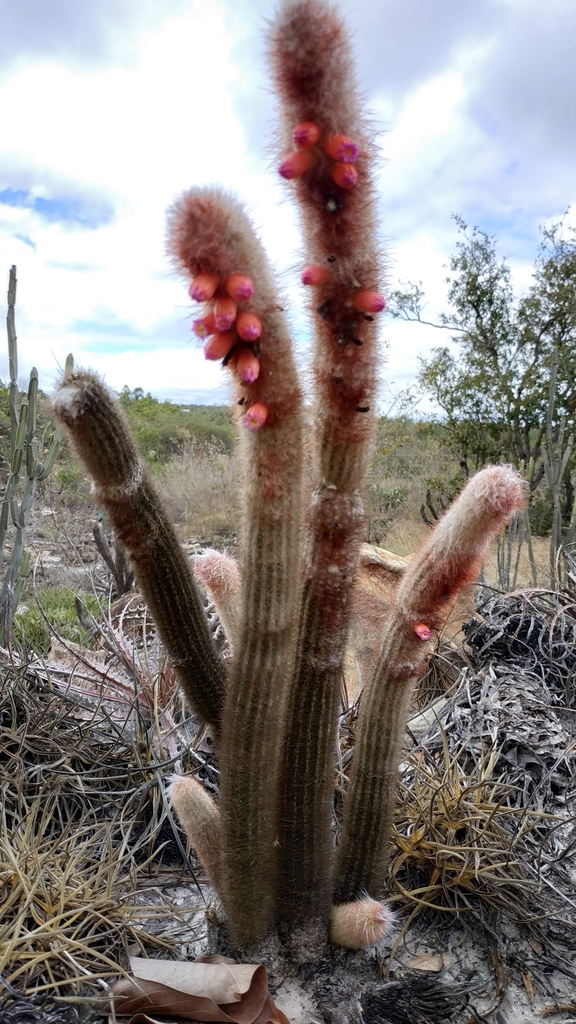
Micranthocereus violaciflorus
Viridicereus is a monotypic genus of flowering plant in the cactus family Cactaceae. Its only species is Viridicereus violaciflorus, endemic to southeast Brazil, previously known as Micranthocereus violaciflorus and Arrojadoa violaciflora.
From the article Viridicereus on Wikipedia (CC BY-SA), quoted section by section
Description
Viridicereus violaciflorus typically grows with minimal or no branching, reaching heights of 1 meter, and its shoots are almost entirely covered in fine spines. The shoots can have a diameter of up to 4 centimeters and feature 11 to 16 sharp-edged ribs. Oval areoles, covered in whitish to brownish hairs, are present. The plant has a central spine up to 2.5 centimeters long and up to 25 whitish to light brown radial spines, which are often attached to the shoots. The cephalium is made up of dense white to brown wool and reddish bristles. The tubular bluish-purple flowers are up to 2.3 centimeters long, and the urn-shaped fruits are greenish-red, measuring 1 to 1.1 centimeters in length and diameter.
Range & habitat
Viridicereus violaciflorus is found in the northern part of Minas Gerais, Brazil. Its natural habitats are subtropical or tropical dry shrubland and rocky areas. It is threatened by habitat loss.
Wikipedia: “Distribution”
Where it lives
Recorded sightings
—
geo-referenced records in GBIF, from museums, herbaria and field observers.
Drag the globe to turn it. Dots are where records exist, not a range map; darker means more records.
In the stacks
This page is assembled live from iNaturalist, GBIF, Wikipedia, the Source Library and the Internet Archive. It is not yet part of the hand-edited codex. iNaturalist taxon 440614.