- Animals
- ›Chordates
- ›Vertebrates
- ›Mammals
- ›Therians
- ›Placental Mammals
- ›Primates, Rodents, and Allies
- ›Rodents
- ›Ctenohystricans
- ›Hystricognaths
- ›Degus, Hutias, Tuco-tucos, and Allies
- ›Spiny Rats and Hutias
- ›Echimyines
- ›Terrestrial Spiny Rats and Allies
- ›Myocastor
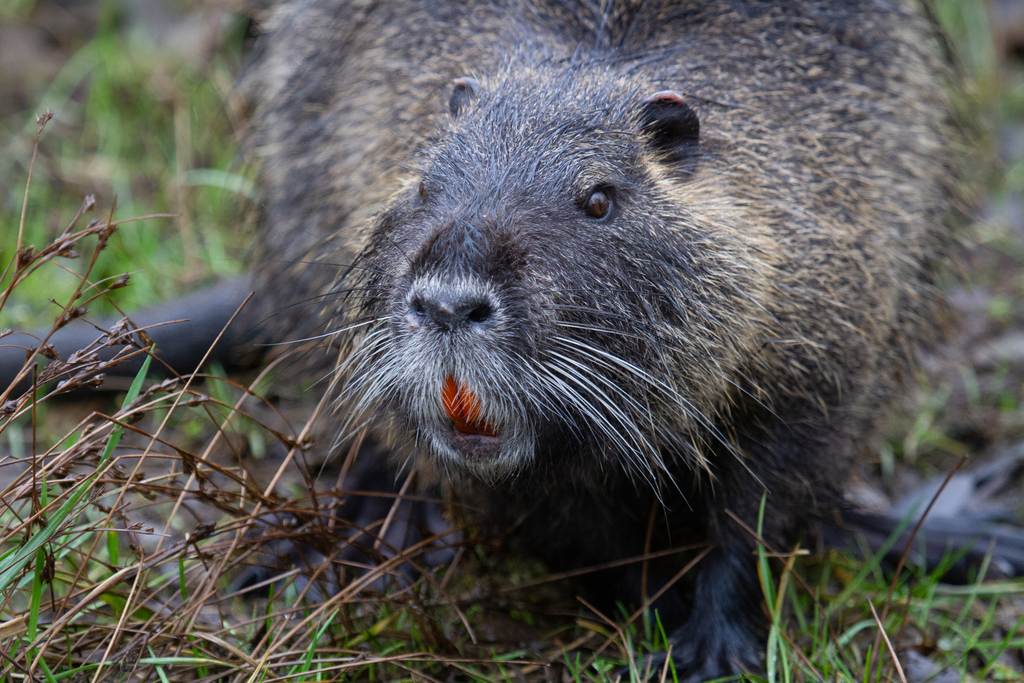
Coypu
Myocastor coypus
The coypu (from Spanish coipú, from Mapudungun koypu; Myocastor coypus), also known as the nutria, is a large, herbivorous, semiaquatic rodent. It has been classified for a long time as the only member of the family Myocastoridae. However, studies based on the comparison of DNA and protein sequences showed that Myocastor is nested within Echimyidae, the family of the spiny rats. Originally native to subtropical and temperate South America, it has since been introduced to North...
From the article Nutria on Wikipedia (CC BY-SA), quoted section by section
Description
The nutria somewhat resembles a very large rat, or a beaver with a small, long and skinny hairless tail. Adults are typically 4–9 kg (9–20 lb) in weight, and 40–60 cm (16–24 in) in body length, with a 30 to 45 cm (12 to 18 in) tail. It is possible for nutrias to weigh up to 16 to 17 kg (35 to 37 lb), although adults usually average 4.5 to 7 kg (10 to 15 lb). Nutrias have three sets of fur. The guard hairs on the outer coat are three inches long. They have coarse, darkish brown midlayer fur with soft dense grey under fur, also called the nutria. Three distinguishing features are a white patch on the muzzle, webbed hind feet, and large, bright orange-yellow incisors. They have approximately 20 teeth with four large incisors that grow during the entirety of their lives. The orange discoloration is due to pigment staining from the mineral iron in the tooth enamel. Nutrias have prominent four inch long whiskers on each side of their muzzle or cheek area. The mammary glands and teats of female nutrias are high on her flanks, to allow their young to feed while the female is in the water. There is no visible distinction between male and female nutria. Both are similar in coloring and weight. A nutria is often mistaken for a muskrat (Ondatra zibethicus), another widely dispersed, semiaquatic rodent that occupies the same wetland habitats. …
Wikipedia: “Appearance”
Range & habitat
Native to subtropical and temperate South America, its range includes Chile, Argentina, Uruguay, Paraguay and the southern parts of Brazil and Bolivia. It has been introduced to North America, Europe and Asia, primarily by fur ranchers. The distribution of nutrias outside South America tends to contract or expand with successive cold or mild winters. During cold winters, nutrias often suffer frostbite on their tails, leading to infection or death. As a result, populations of nutria often contract and even become locally or regionally extinct as in the Scandinavian countries and such U.S. states as Idaho, Montana, and Nebraska during the 1980s. During mild winters, their ranges tend to expand northward. For example, in recent years, range expansions have been noted in Washington and Oregon, as well as Delaware. Many nutrias have been introduced to Europe, and large populations of them were reported in 2020 across continental Europe. They also populated eastern areas of England, but were eradicated through wide-ranging trapping efforts in the 1980s. According to the U.S. Geological Survey, nutrias were first introduced to the United States in California, in 1899 by William Franklin Frakes. …
Wikipedia: “Distribution”
What it does
Besides breeding quickly, each nutria consumes large amounts of aquatic vegetation. An individual consumes about 25% of its body weight daily, and feeds year-round. Being one of the world's larger extant rodents, a mature, healthy nutria averages 5.4 kg (11 lb 14 oz) in weight, but they can reach as much as 10 kg (22 lb). They eat the base of the above-ground stems of plants, and often dig through soil for roots and rhizomes to eat. Nutrias eat parts and whole plants, and go after roots, rhizomes, tubers and black willow tree bark in the winter. Their creation of "eat-outs", areas where a majority of the above- and below-ground biomass has been removed, produces patches in the environment, which in turn disrupts the habitat for other animals and humans dependent on wetlands and marshes. Nutrias eat the following plant varieties: cattail, rushes, reeds, arrowheads, flatsedges, and cordgrasses. Commercial crops that nutrias also eat are lawn grasses, alfalfa, corn, rice, and sugarcane. Nutrias are found most commonly in freshwater marshes and wetlands, but also inhabit brackish marshes and rarely salt marshes. They either construct their own burrows, or occupy burrows abandoned by beaver, muskrats, or other animals. They are also capable of constructing floating rafts out of vegetation. Nutrias live in partially underwater dens. The main chamber is not submerged underground. …
Wikipedia: “Habitat and feeding”
At the table
In 1997 and 1998, Louisiana attempted to encourage the public to consume nutria meat. Nutria meat is leaner with a lower fat content and lower in cholesterol compared to ground beef. In an effort to encourage Louisianians to eat nutria, several recipes were distributed to locals and published on the internet. People in poor and rural Louisiana have trapped and consumed nutria meat for decades. A small number of game meat websites on the internet sell nutria meat for consumption. In Kyrgyzstan and Uzbekistan, nutrias (Russian and local languages Нутрия) are farmed on private plots and sold in local markets as a poor man's meat. As of 2016, however, the meat is used successfully in Moscow restaurant Krasnodar Bistro, as part of the growing Russian localvore movement and as a 'foodie' craze. It appears on the menu as a burger, hotdog, dumplings, or wrapped in cabbage leaves, with the flavour being somewhere between turkey and pork. A claimed environmentally sound solution is the use of nutria meat to make dog food treats. Marsh Dog, a US company based in Baton Rouge, Louisiana, received a grant from the Barataria-Terrebonne National Estuary Program to establish a company that uses nutria meat for dog food products. In 2012, the Louisiana Wildlife Federation recognized Marsh Dog with "Business Conservationist of the Year" award for finding a use for this eco-sustainable protein.
Wikipedia: “Food products”
In human culture
The genus name Myocastor derives from the two Ancient Greek words μῦς (mûs) 'rat, mouse', and κάστωρ (kástōr) 'beaver'. Therefore, the name Myocastor literally means 'mouse-beaver'. Two names are commonly used in English for Myocastor coypus. The name nutria (from the Spanish word nutria 'otter') is generally used in North America, Asia, and throughout countries of the former Soviet Union; however, in most Spanish-speaking countries, the word nutria refers primarily to the otter. To avoid this ambiguity, the name coypu or coipo (derived from Mapudungun) is used in South America, Britain and other parts of Europe. In France, the nutria is known as a ragondin. In Dutch, it is known as beverrat 'beaver-rat'. In German, it is known as Nutria, Biberratte 'beaver-rat', or Sumpfbiber 'swamp-beaver'. In Italy, the popular name is, as in North America and Asia, nutria, but it is also called castorino 'little beaver', by which its fur is known in Italy. In Swedish, the animal is known as sumpbäver 'marsh/swamp-beaver'. In Brazil, the animal is known as ratão-do-banhado 'big swamp-rat', nútria, or caxingui (the last from Tupi).
Wikipedia: “Etymology”
Listen
Looking for field recordings…
Where it lives
Recorded sightings
—
geo-referenced records in GBIF, from museums, herbaria and field observers.
Drag the globe to turn it. Dots are where records exist, not a range map; darker means more records.
In the stacks
Searching the stacks…
Every page naming Myocastor coypus in the Biodiversity Heritage Library →
This page is assembled live from iNaturalist, GBIF, Wikipedia, the Source Library and the Internet Archive. It is not yet part of the hand-edited codex. iNaturalist taxon 43997.