- Animals
- ›Chordates
- ›Vertebrates
- ›Mammals
- ›Therians
- ›Placental Mammals
- ›Primates, Rodents, and Allies
- ›Rodents
- ›Ctenohystricans
- ›Hystricognaths
- ›Degus, Hutias, Tuco-tucos, and Allies
- ›Spiny Rats and Hutias
- ›Echimyines
- ›Terrestrial Spiny Rats and Allies
- ›Proechimys
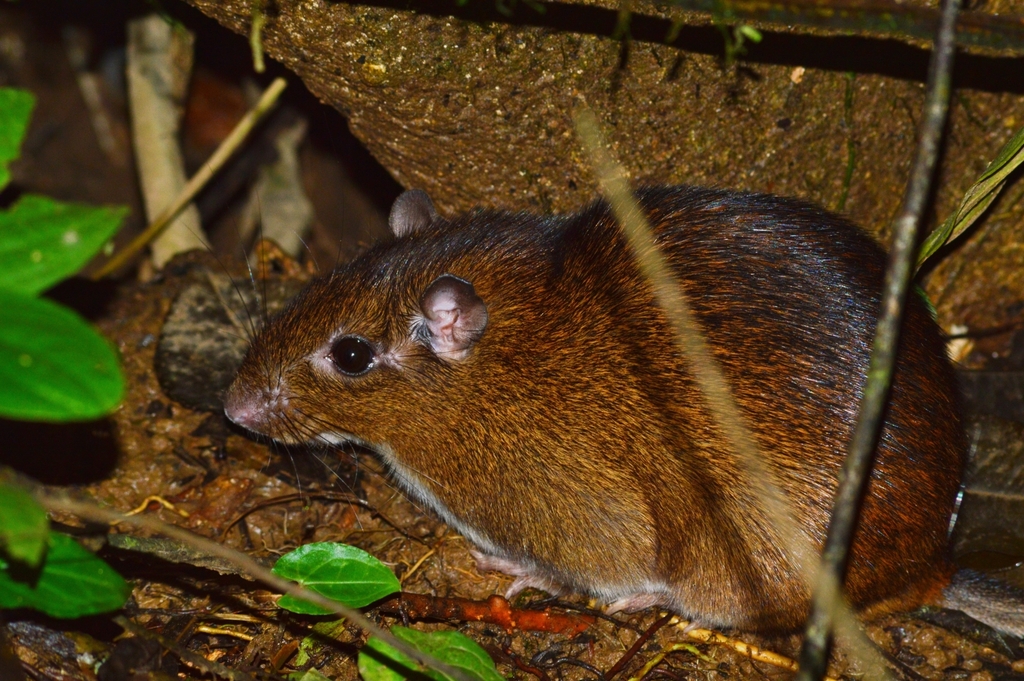
Tome's Spiny Rat
Proechimys semispinosus
Tome's spiny rat (Proechimys semispinosus), also known as Tomes' spiny rat or the Central American spiny rat, is a species of spiny rat distributed from Honduras to Ecuador. The IUCN has assessed its conservation status as being of "least concern".
From the article Tome's spiny rat on Wikipedia (CC BY-SA), quoted section by section
Description
Tome's spiny rat is a large rat with a head-and-body length of between 220 and 280 mm (8.7 and 11.0 in) and a tail length of between 175 and 192 mm (6.9 and 7.6 in). The head is long and slender, with prominent eyes and narrow erect ears. At night, the eyes reflect a reddish eyeshine. The feet are long with strong nails. The pelage is sleek with spines mixed in with the dorsal fur, though these are not very obvious in the field. The upper parts are reddish-brown while the underparts are white. The tail is almost hairless and is reddish-brown above and white below. About 20% of animals encountered have no tail. This rat could be confused with the armored rat (Hoplomys gymnurus) which is much the same size, but the armored rat has a longer snout and smaller eyes, which are less reflective at night. Other terrestrial rats are considerably smaller and mostly have tails that are longer than their head-and-body lengths. Its karyotype has 2n = 30 and FN = 50-54.
Range & habitat
The range of Tome's spiny rat extends from southeastern Honduras to southwestern Ecuador and possibly to northern Peru. It generally keeps below 800 m (2,620 ft) but in Ecuador may be found a little higher. It is a common species in evergreen and deciduous forest, favouring riparian corridors and low-lying areas. It is a tolerant and adaptable species, and the International Union for Conservation of Nature has assessed its conservation status as being of "least concern".
Wikipedia: “Distribution”
What it does
Tome's spiny rat is a nocturnal, mainly ground-dwelling rat. During the day it may hide in a burrow or under a fallen tree, in a hollow log or in dense vegetation. At night it moves slowly and often sits stationary beside a tree buttress or log. It may freeze if caught in the open. It feeds on fruits and seeds, fungi, plant material and insects, carrying larger objects to a safe place before consuming them. The females can breed four times a year, producing litters of up to five precocial young. The reproductive rate seems to be limited by the availability of food. On a group of small islands in Panama, each of which had its own range of tree species which fruited at different seasons, there were few births on each islet at times of fruit shortage and many at times of fruit abundance; the seasonal effects were even more marked when the spiny rat was the only frugivorous mammal on the island.
Wikipedia: “Ecology”
Listen
Looking for field recordings…
Where it lives
Recorded sightings
—
geo-referenced records in GBIF, from museums, herbaria and field observers.
Drag the globe to turn it. Dots are where records exist, not a range map; darker means more records.
In the stacks
Searching the stacks…
Every page naming Proechimys semispinosus in the Biodiversity Heritage Library →
This page is assembled live from iNaturalist, GBIF, Wikipedia, the Source Library and the Internet Archive. It is not yet part of the hand-edited codex. iNaturalist taxon 43943.