- Plants
- ›Vascular Plants
- ›flowering plants
- ›Dicots
- ›pinks, cactuses, and allies
- ›cacti
- ›globular cacti, moonlight cacti, torch cacti, and allies
- ›Notocacteae
- ›Eulychnia
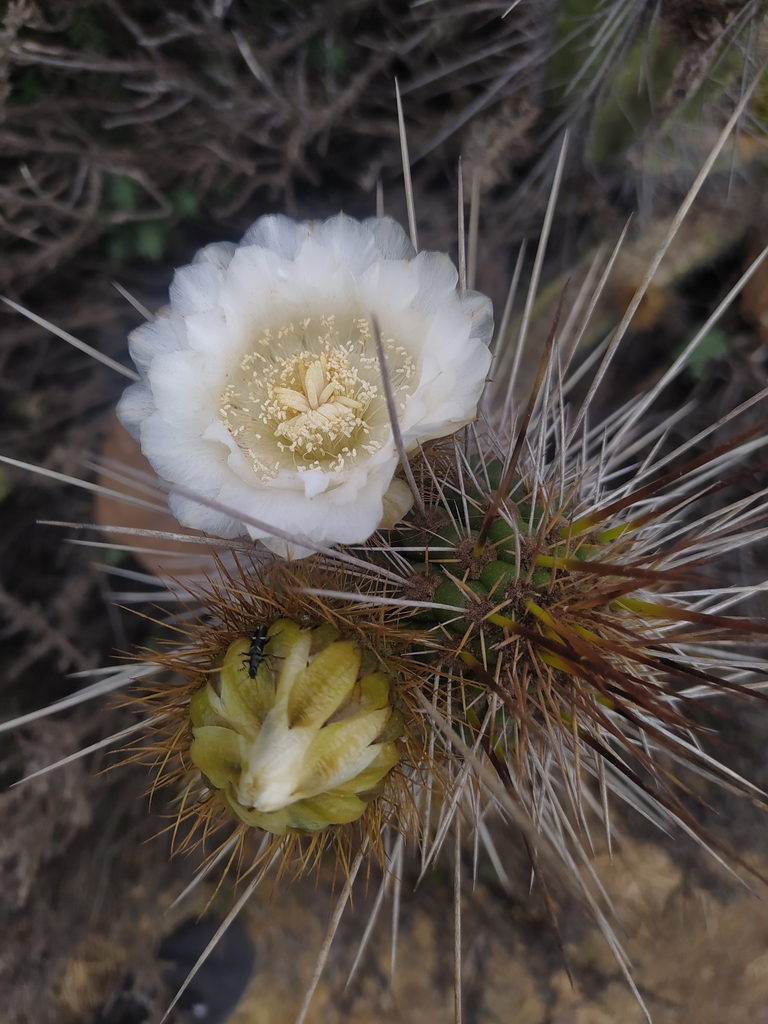
Eulychnia castanea
Eulychnia castanea is a species of Eulychnia found in Chile.
From the article Eulychnia castanea on Wikipedia (CC BY-SA), quoted section by section
Description
This cactus has a grass-green epidermis and creeps from the base, forming thickets several meters in diameter, though the plants themselves are relatively short, around 50 cm in height. The stems are typically 1 to 2 meters long, lying prostrate at the base, and are 6 to 8 cm thick. Each stem usually bears 9 to 12 ribs, occasionally 8 or 13, which are over 1 cm wide and about 1 cm high with blunt, deeply notched edges. Winged grooves descend from these notches towards the furrows between the ribs. Rounded areoles, about 5 mm in diameter, extend from the tubercles to the notches and are covered in dark gray or blackish-gray felt, spaced about 1 cm apart. The spines vary from brown to yellowish-brown, sometimes with lighter or darker banding, and are straight. There are 6 to 10 radial spines, 0.5 to 2 cm long, which are needle-like when shorter and awl-shaped when longer, oriented laterally. Additionally, one to two robust central spines, 3 to 10 cm long, are awl-shaped and overlap, often accompanied by smaller central spines. Flowers emerge laterally on the stems, measuring 5 to 5.5 cm long with a 4 to 5 cm opening. They emit a faint fragrance, opening fully at midday and partially closing at night. The white petals are about 2.5 cm long and 1.2 cm wide, spatulate in shape with rounded ends, forming a bowl-like structure where lower petals are less extended than upper ones. …
Range & habitat
This species is native to the coastal regions of northern Chile, specifically along the coastline from Los Molles in the Valparaíso region north to the Talinay mountain range in the Coquimbo region. It thrives in desert and dry scrub biomes, preferring coastal environments such as flat rocky surfaces, north-facing slopes, marine terraces, and ravines, typically found at elevations from sea level up to around 500 meters. The soils it grows in are chemically diverse, with pH levels between 6.5 and 8, indicating an adaptability to both slightly acidic and alkaline conditions. Living within the extremely arid Atacama Desert, a region known for prolonged droughts of 6 to 10 months and minimal rainfall (100-300 mm annually, primarily in winter), this species relies heavily on coastal fog as a crucial source of moisture. Its remarkable adaptations allow it to withstand high temperatures reaching up to 50°C. In its natural habitat, it forms specialized plant communities alongside other endemic species like Puya venusta, Vasconcellea chilensis, Myrcianthes coquimbensis, and Eulychnia breviflora, all adapted to the harsh conditions of the coastal desert
Wikipedia: “Distribution”
Where it lives
Recorded sightings
—
geo-referenced records in GBIF, from museums, herbaria and field observers.
Drag the globe to turn it. Dots are where records exist, not a range map; darker means more records.
In the stacks
Searching the stacks…
Every page naming Eulychnia castanea in the Biodiversity Heritage Library →
This page is assembled live from iNaturalist, GBIF, Wikipedia, the Source Library and the Internet Archive. It is not yet part of the hand-edited codex. iNaturalist taxon 438761.