- Plants
- ›Vascular Plants
- ›flowering plants
- ›Dicots
- ›pinks, cactuses, and allies
- ›cacti
- ›globular cacti, moonlight cacti, torch cacti, and allies
- ›Cereeae
- ›Cereus
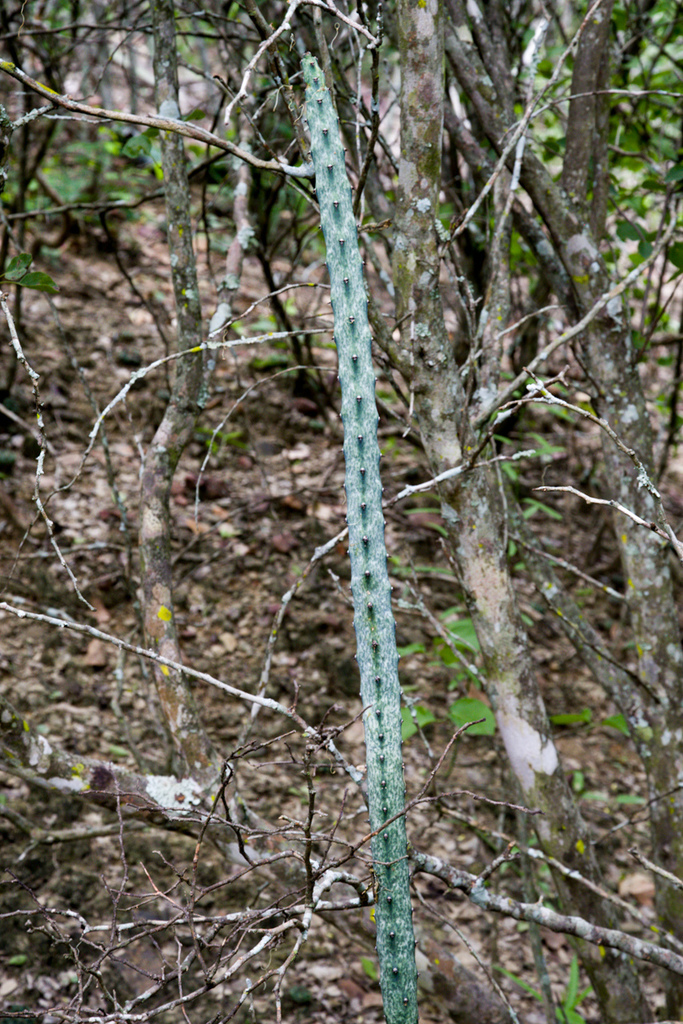
Cereus spegazzinii
Cereus spegazzinii is a species of cactus found in Argentina, Bolivia, Brazil and Paraguay.
From the article Cereus spegazzinii on Wikipedia (CC BY-SA), quoted section by section
Description
Cereus spegazzinii is a cactus that grows and branches abundantly. It is erect, sloping or almost creeping, with many cylindrical stems, of blue-green color often of glossy marble color. They grow up to 2 m in length and have a diameter of up to 6.5 cm. It has three to five ribs with very wide areoles. The first with two to three spines, and later with six blackish spines, and up to 1.5 cm in length. The flowers are white are 10 to 13 cm long and have a diameter of 7 to 9 cm. The fruits are pink ellipsoids.
Range & habitat
Cereus spegazzinii is distributed in Brazil in Mato Grosso do Sul, in Paraguay, in Bolivia and in northern Argentina at altitudes of up to 1400 meters. The plant was first described and published in 1899 by Frédéric Albert Constantin Weber. Nomenclature synonyms are Piptanthocereus spegazzinii (F.A.C.Weber) Riccob. (1909) and Monvillea spegazzinii (F.A.C.Weber) Britton & Rose (1920). The species is classified as Least Concern (LC) in the IUCN Red List of Threatened Species.
Wikipedia: “Distribution”
Where it lives
Recorded sightings
—
geo-referenced records in GBIF, from museums, herbaria and field observers.
Drag the globe to turn it. Dots are where records exist, not a range map; darker means more records.
In the stacks
Searching the stacks…
Every page naming Cereus spegazzinii in the Biodiversity Heritage Library →
This page is assembled live from iNaturalist, GBIF, Wikipedia, the Source Library and the Internet Archive. It is not yet part of the hand-edited codex. iNaturalist taxon 438224.