- Plants
- ›Vascular Plants
- ›flowering plants
- ›Dicots
- ›beeches, oaks, walnuts, and allies
- ›walnut family
- ›Carya
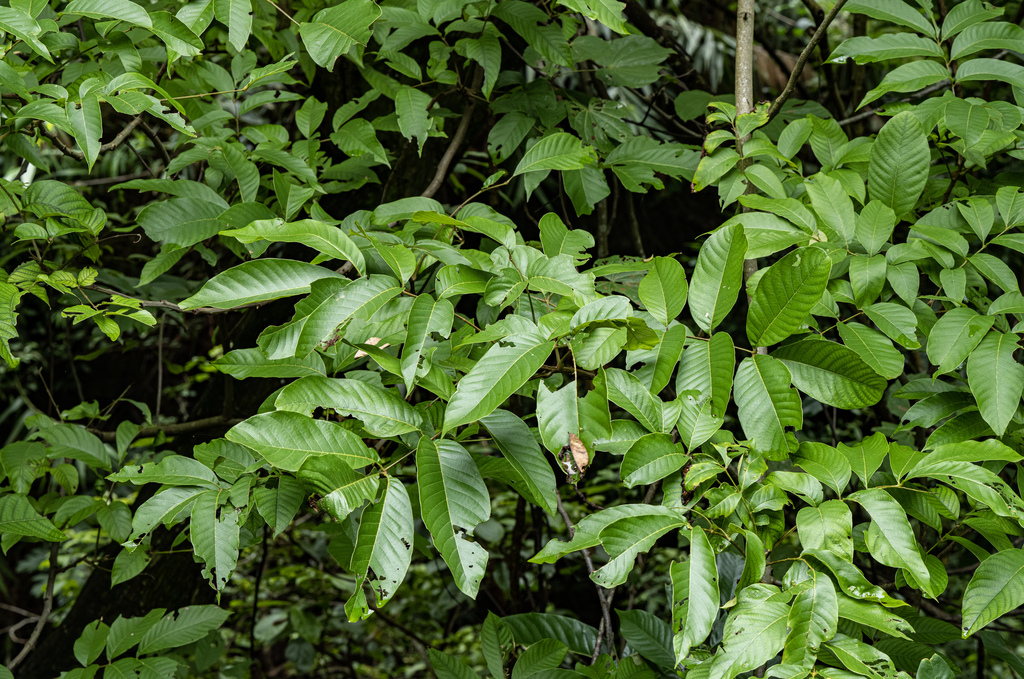
beaked hickory
Carya sinensis
Carya sinensis (syn. Annamocarya sinensis) is a species of tree native to southwestern China (Guangxi, Guizhou, Yunnan) and northern Vietnam, in the hickory genus Carya. It is sometimes called Chinese hickory or beaked hickory. It is closely related to Carya kweichowensis.
It is a medium-sized to large evergreen tree growing to 30 m (98 ft) tall. The leaves are 30–50 cm (12–20 in) long, and pinnate with 7–11 leaflets. The leaflets have an entire margin, which distinguishes it from other Carya, where the leaflets have a serrated margin. The flowers are catkins produced in spring, with the male catkins in clusters of five to eight together (single in other Carya). The fruit is a nut 6–8 cm (2.4–3.1 in) long and 4–6 cm (1.6–2.4 in) broad, with a prominent, acute beak at the apex.
Where it lives
Recorded sightings
—
geo-referenced records in GBIF, from museums, herbaria and field observers.
Drag the globe to turn it. Dots are where records exist, not a range map; darker means more records.
In the stacks
Searching the stacks…
Every page naming Carya sinensis in the Biodiversity Heritage Library →
This page is assembled live from iNaturalist, GBIF, Wikipedia, the Source Library and the Internet Archive. It is not yet part of the hand-edited codex. iNaturalist taxon 438183.