- Animals
- ›Chordates
- ›Vertebrates
- ›Mammals
- ›Therians
- ›Placental Mammals
- ›Primates, Rodents, and Allies
- ›Rodents
- ›Ctenohystricans
- ›Hystricognaths
- ›Cavies, Agoutis, and Pacas
- ›Cavies
- ›Capybaras and Rock Cavies
- ›Kerodon
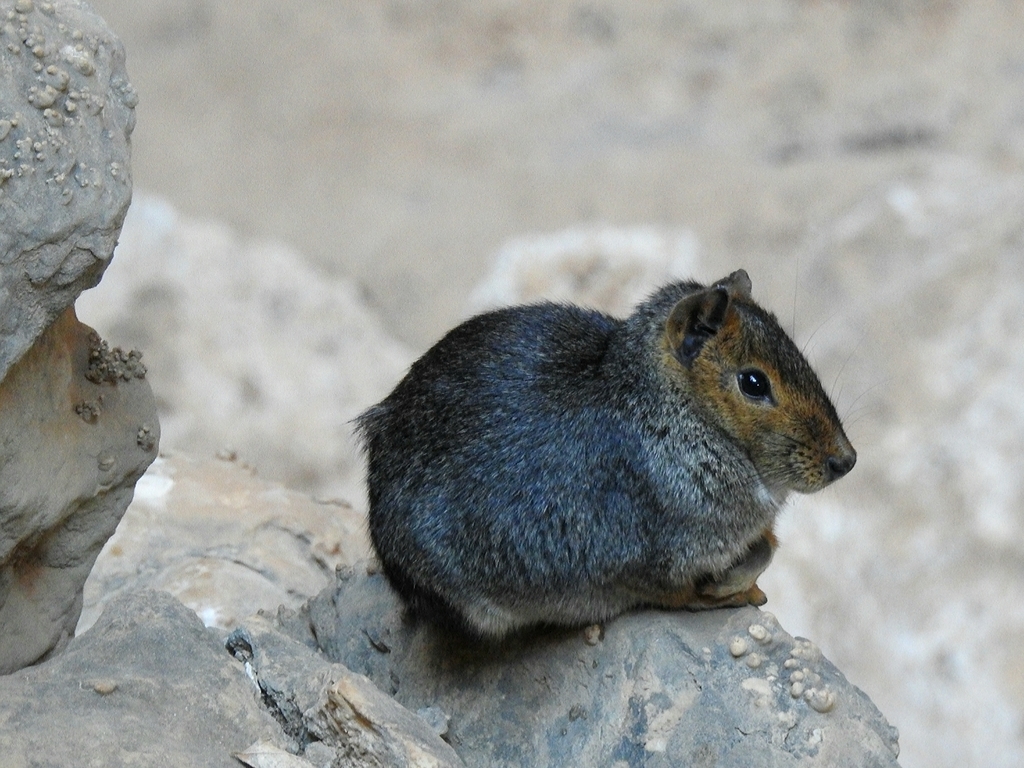
Rock Cavy
Kerodon rupestris
The rock cavy or mocó (Kerodon rupestris) is a species of cavy that is endemic to eastern Brazil. It has also been introduced to the Atlantic island of Fernando de Noronha.
The rock cavy is called mocó in Brazilian Portuguese, and koriko pexerumen in the Xukuru language of Pernambuco, Brazil.
From the article Rock cavy on Wikipedia (CC BY-SA), quoted section by section
Description
The rock cavy is a fairly large rodent weighing up to 1 kg (2.2 lb). Like other cavy species, their tails are vestigial or absent. Their backs are grey-brown and their bellies tan to light brown. In appearance and habit, they closely resemble the unrelated African rock hyraxes (an example of convergent evolution). They are herbivorous, feeding on seeds and leaves of the scrubby vegetation that grows in their territories. This vegetation consists of tender leaves and certain species of creeper.
Range & habitat
Rock cavies are found in dry, rocky areas with low, scrubby vegetation, and they prefer to reside close to stony mountainsides and hills. They are native to eastern Brazil, from eastern Piauí state to Minas Gerais state, and have been introduced to the island of Fernando de Noronha, off the eastern coast of Brazil.
Wikipedia: “Distribution and habitat”
What it does
Rock cavies usually shelter in crevices. They may be seen resting at all times of day, but are crepuscular – active mostly at dawn and dusk. They are able to climb, which makes reaching leaves, seeds, and occasional fruits easier. Rock cavies live in groups, centered around rock-sheltered dens. Each rock cavy group has an alpha or dominant male and several females. The males are territorial, defending rock pile shelters against other adult males. The rock piles are chosen to impress the females; once a female chooses a rock pile, she indirectly chooses its guardian as her mate. They can sometimes display homosexual behavior, with males courting other males. Some paedophilic behavior has also been displayed, with adult males courting juvenile males. Studies show that rock cavies have a direct link between their retina and the mediodorsal nucleus in the thalamus, which may provide them with strong visual recognition, emotional learning, and/or enhanced object-reward associative memory. This may partly explain why they are found living in large groups.
Reproduction. Females weigh 700-800 g and give birth to only one or two young, but several litters per year are common. The gestation period averages 75 days. …
Wikipedia: “Behavior”
Listen
Looking for field recordings…
Where it lives
Recorded sightings
—
geo-referenced records in GBIF, from museums, herbaria and field observers.
Drag the globe to turn it. Dots are where records exist, not a range map; darker means more records.
In the stacks
Searching the stacks…
Every page naming Kerodon rupestris in the Biodiversity Heritage Library →
This page is assembled live from iNaturalist, GBIF, Wikipedia, the Source Library and the Internet Archive. It is not yet part of the hand-edited codex. iNaturalist taxon 43808.