 NL·0322
Herbarium of the Nature Library
- Name
- Castor canadensis
- Family
- Castoridae
- Native to
- Most of North America from Alaska and Canada to northern Mexico; introduced to Tierra del Fuego and Finland
- Habitat
- Rivers and streams, Wetlands, Boreal forest, Temperate forest
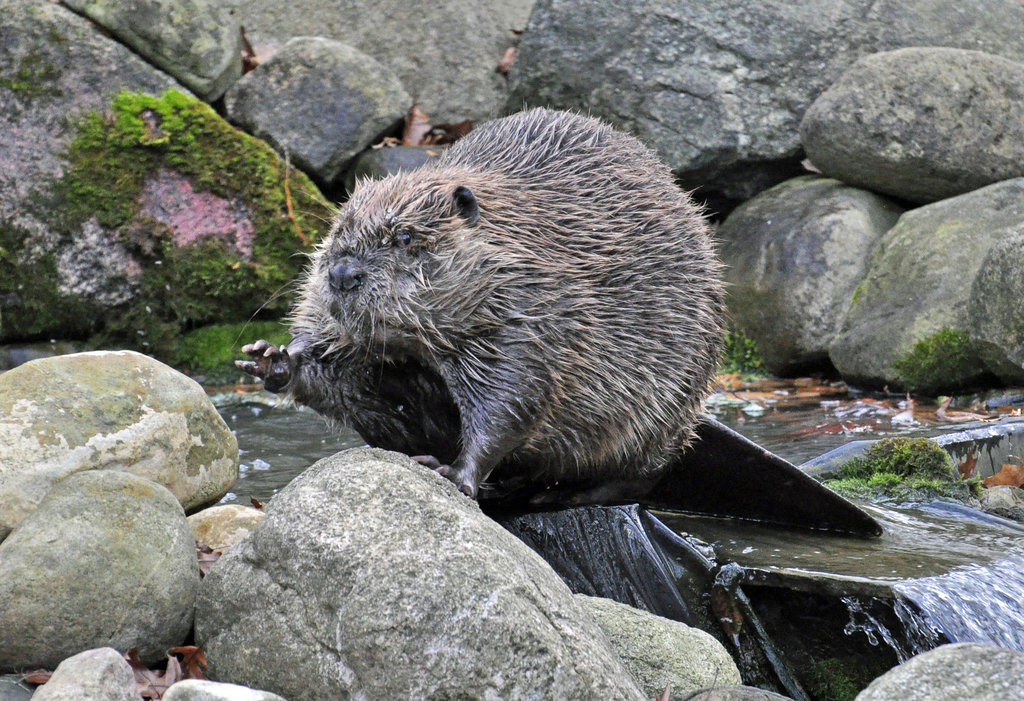
North American beaver
Castor canadensis
Also calledAmisk (Cree) · Amik (Ojibwe) · Tsá (Dene Sųłiné) · Castor (French/Spanish)
North America's largest rodent and one of its most important ecosystem engineers. Beaver dams turn streams into ponds and wetlands that store water, trap sediment and shelter fish, amphibians and birds.
The North American beaver is one of two extant beaver species, along with the Eurasian beaver. It is native to North America and has been introduced in South America (Patagonia) and Europe. The North American beaver is one of the national symbols of Canada and the official state mammal of Oregon and New York. North American beavers are widespread across the continental United States, Canada, southern Alaska, and some parts of northern Mexico. Wikipedia
What it can do
- iFells trees with self-sharpening incisors whose front enamel is strengthened with iron, giving it an orange colour
- iiBuilds dams of logs, mud and stone and repairs leaks it hears or feels flowing
- iiiStays underwater for up to ~15 minutes, with ears and nostrils that close and clear membranes over the eyes
- ivCreates wetlands that raise water tables and act as firebreaks during wildfires
In the field
Field marks
- aLarge brown rodent with a flat, scaly, paddle-shaped tail
- bOrange front teeth
- cSwims low with only the head showing
- dDams, lodges and gnawed tree stumps nearby
- Voice
- Slaps its tail loudly on the water when alarmed
- Not to be confused with
- Muskrat is much smaller with a thin tail. Nutria has white whiskers and a round, rat-like tail. Otters swim with a long tapering tail.
- Where to see it
- Algonquin Provincial Park (Ontario); Grand Teton and Rocky Mountain national parks
- When
- Resident; most active at dawn and dusk
Listen
Looking for field recordings…
Life & habits
- Diet
- Herbivore: bark, cambium, twigs and leaves of willow, aspen and other trees; aquatic plants
- Habitat
- Streams, rivers, ponds and lakes bordered by trees
- Size
- 11–32 kg; 0.9–1.2 m including the flat tail
- Lifespan
- 10–15 years in the wild
Families live in a domed lodge with underwater entrances and store branches in the pond mud as a winter food cache. A tail slap on the water warns the colony of danger.
In the medicine cabinet
| Tradition | Use |
|---|---|
| Medieval and early-modern European medicine | Castoreum, the scent-gland secretion of beavers, was prescribed for headaches, fevers and 'hysteria' |
| Indigenous North American medicine | Castoreum used in remedies for pain and as a scent lure |
Weight of evidence
Traditional. Long historical use; little or no modern clinical evidence.
Active compounds
salicylic acid derivatives (from willow bark in the diet), castoreum phenolics
Where it lives
Recorded sightings
—
geo-referenced records in GBIF, from museums, herbaria and field observers.
Native range
Most of North America from Alaska and Canada to northern Mexico; introduced to Tierra del Fuego and Finland
Drag the globe to turn it. Dots are where records exist, not a range map; darker means more records.
In the old herbals & bestiaries
Woodcuts and engravings matched from the Source Library’s scanned books by name. Plates marked “relative” show a close kin rather than this exact species. Click a plate to read the page it came from, with translation.

Ortus sanitatis
1491 · p.532

Books on Marine Fishes
Guillaume Rondelet · 1554 · p.877

Introductory Book
Michael Scot · 1350 · p.113

Garden of Health
1507 · p.431

History of Animals, Book II: On Oviparous Quadrupeds
Conrad Gessner · 1586 · p.721

Commentaries on the Six Books of Dioscorides
Pietro Andrea Mattioli · 1560 · p.317
In the stacks
Searching the stacks…
Every page naming Castor canadensis in the Biodiversity Heritage Library →
Marginalia
Demand for beaver-felt hats drove the fur trade that mapped much of Canada; the Hudson's Bay Company (1670) priced goods in 'made beaver' pelts. In Anishinaabe tradition, Amik is among the animals that dive to bring up mud to make the world.
Curiosity
A beaver dam in Wood Buffalo National Park, Canada, is about 850 m long and can be seen in satellite images.
Kinship

Photographs: iNaturalist contributors under the licences shown. Records: GBIF.org. Historical plates: Source Library (CC BY-SA 4.0; originals public domain). Summary text: Nature Library editors and Wikipedia (CC BY-SA). Medicinal and edibility notes are historical and educational, not advice. iNaturalist taxon 43794.