- Plants
- ›Vascular Plants
- ›flowering plants
- ›monocots
- ›Aroids, Water Plantains, Seagrass, and allies
- ›posidonia family
- ›Posidonia
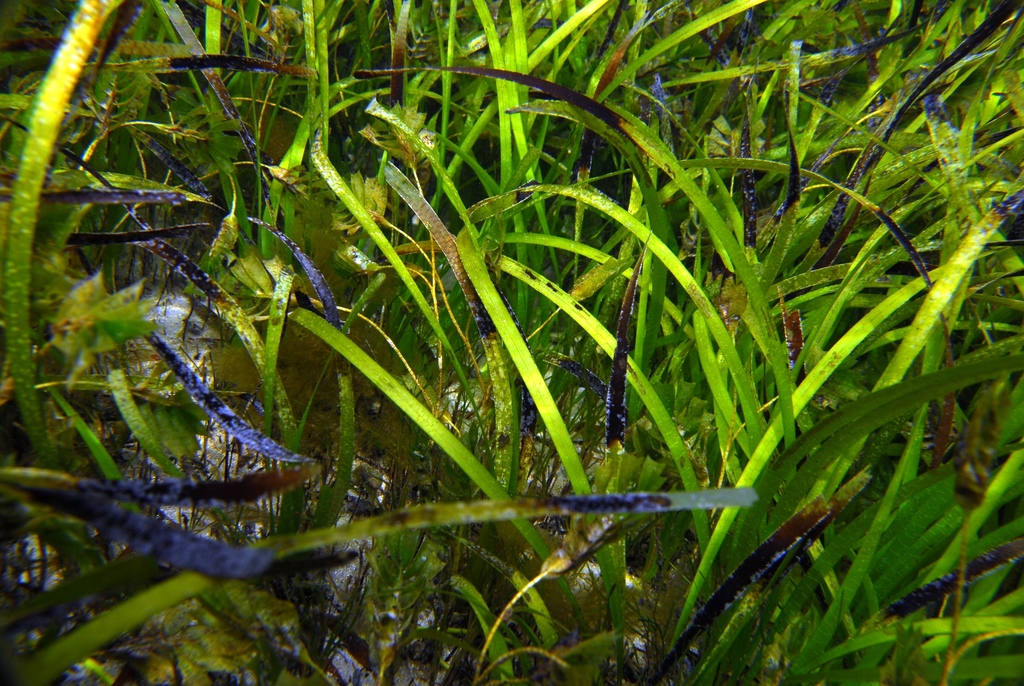
fibre-ball weed
Posidonia australis
Posidonia australis, also known as fibre-ball weed or ribbon weed, is a species of seagrass that occurs in the southern waters of Australia. It forms large meadows important to environmental conservation. Balls of decomposing detritus from the foliage are found along nearby shore-lines.
In 2022, a single stand in Shark Bay was reported by scientists to not only be the largest plant in the world, but the largest organism by square size.
From the article Posidonia australis on Wikipedia (CC BY-SA), quoted section by section
Description
Posidonia australis is a flowering plant occurring in dense meadows, or along channels, in white sand. It is found at depths from 1–15 m (3–49 ft). Subsurface rhizomes and roots provide stability in the sands it occupies. Erect rhizomes and leaves reduce the accumulation of silt. The leaves are ribbon-like and 11–20 mm (0.43–0.79 in) wide. They are bright green, perhaps becoming browned with age. The terminus of the leaf is rounded or absent through damage. They are arranged in groups with older leaves on the outside, longer and different in form from the younger leaves they surround. The species is monoecious. The flowers appear on small spikes on leafless stems, two bracts on each spike. The plant pollinates by hydrophily, by dispersing in the water. Posidonia australis reproduction usually occurs through sexual or asexual methods but, under extreme conditions, by pseudovivipary. A 2013 study showed that P. australis can sequester carbon 35 times more efficiently than rainforests. In 2022, a study by the School of Biological Sciences and Oceans Institute at The University of Western Australia showed that a single plant of this species can grow vegetatively by using rhizomes to cover an extensive area, similar to buffalo grass. …
Range & habitat
This species is found in waters around the southern coast of Australia. In Western Australia it occurs in the Shark Bay region, around islands of the Houtman Abrolhos, and southward along the coast of the Swan Coastal Plain. The species is recorded at the edge of the Esperance Plains, the Archipelago of the Recherche, at the southern coast of the southwest region. The range extends to the east to coastal areas of New South Wales, South Australia, Tasmania, and Victoria. A sign of a nearby occurrence of Posidonia is the presence of masses of decomposing leaves on beaches, forming fibrous balls.
Wikipedia: “Distribution”
Where it lives
Recorded sightings
—
geo-referenced records in GBIF, from museums, herbaria and field observers.
Drag the globe to turn it. Dots are where records exist, not a range map; darker means more records.
In the stacks
Searching the stacks…
Every page naming Posidonia australis in the Biodiversity Heritage Library →
This page is assembled live from iNaturalist, GBIF, Wikipedia, the Source Library and the Internet Archive. It is not yet part of the hand-edited codex. iNaturalist taxon 436908.