- Plants
- ›Vascular Plants
- ›flowering plants
- ›monocots
- ›Agaves, Orchids, Irises, and Allies
- ›agave and allies
- ›Dragon tree subfamily
- ›dragon trees and mother-in-law's tongues
- ›Dracaena
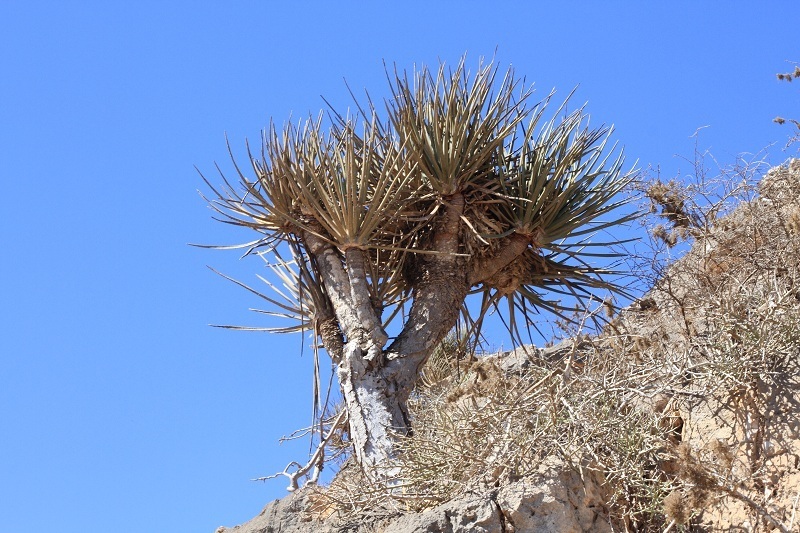
Arabian Dragon Tree
Dracaena serrulata
Dracaena serrulata, also called the Arabian or Yemen dragon tree, is a distinctive tree reaching around 5m tall with a single trunk. It is found in the dry escarpment mountains of southwestern Arabia in Oman, South Yemen and Saudi Arabia.
From the article Dracaena serrulata on Wikipedia (CC BY-SA), quoted section by section
Range & habitat
Dracaena serrulata is restricted largely to the highest, dry plateaus at the back of monsoon mountains, an area which monsoon rains do not reach. Dracaena serrulata grows commonly in association with such species as Vachellia etbaica and Grewia erythraea.
Wikipedia: “Habitat”
At the table
The stiff leaves of the Dracaena serrulata were an important source of fibre and rope. The large, stiff and spike-tipped leaves were cut or pulled from the trunk, and beaten with heavy clubs to loosen and crack open the rigid outer casing of the leaf. Then the leaves were taken to water and left to soak in it for some weeks. Once thoroughly softened, the leaves were removed from the water and piled up in heaps on a hard, flat surface, and then beaten and thrashed with switches to loosen the fibre into separate strands. Once the separate fibres had been unravelled, they were twisted and rubbed on the thigh or between the fingers to produce threads, which could then be double or trebled, rolled and twisted again, or plaited according to the thickness of rope desired. These threads were traditionally said to make the strongest of all the cordage produced in Oman. The ropes made from the Dracaena serrulata were popularly used as camel tackle, baggage ropes and rope-pulleys used to lower the heavy sacks of frankincense down precipices or across areas where baggage camels had difficulty penetrating. …
Wikipedia: “Uses”
Where it lives
Recorded sightings
—
geo-referenced records in GBIF, from museums, herbaria and field observers.
Drag the globe to turn it. Dots are where records exist, not a range map; darker means more records.
In the stacks
Searching the stacks…
Every page naming Dracaena serrulata in the Biodiversity Heritage Library →
This page is assembled live from iNaturalist, GBIF, Wikipedia, the Source Library and the Internet Archive. It is not yet part of the hand-edited codex. iNaturalist taxon 436237.