- Animals
- ›Chordates
- ›Vertebrates
- ›Mammals
- ›Therians
- ›Placental Mammals
- ›Primates, Rodents, and Allies
- ›Primates
- ›Monkeys, Apes, and Tarsiers
- ›Monkeys and Apes
- ›Apes and Old World Monkeys
- ›Apes
- ›Gibbons
- ›Hylobates
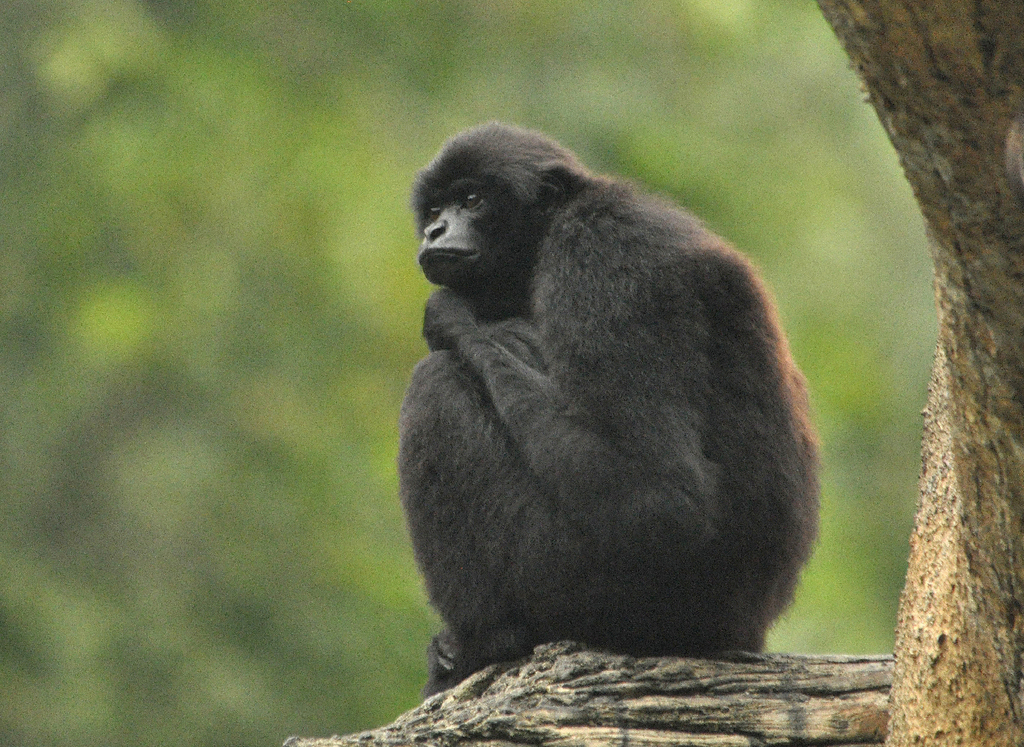
Kloss’s Gibbon
Hylobates klossii
Kloss's gibbon (Hylobates klossii), also known as the Mentawai gibbon, the bilou or dwarf siamang, is an endangered primate in the gibbon family, Hylobatidae. It is identifiable in that it is all black, resembling the siamang with its black fur, but is considerably smaller and lacks the siamang's distinctive throat pouch. Kloss's gibbon reaches a size 17 to 25 inches (43 to 64 cm) and weigh at most 13 pounds (5.9 kg). As is the case for all gibbons, they have long arms and no tail. Males and females are difficult to distinguish.
From the article Kloss's gibbon on Wikipedia (CC BY-SA), quoted section by section
Range & habitat
Kloss's gibbon exclusively lives on the Mentawai Islands that lie to the west of Sumatra. The Mentawai Islands consist four main islands that are part of an island archipelago. These islands are hearths of biodiversity, and are the homes of many endemic species. It is a diurnal inhabitant of the rain forest that hangs in the trees from its long arms and rarely comes to the ground. Because Kloss's gibbon rarely comes out of the canopy, these gibbons use tree limbs to cross obstacles like bodies of water. Like all species of gibbons it lives together in pairs that stake out a territory from approximately 49 to 74 acres (20 to 30 ha) of size. This area is defended vehemently against other gibbons. Its diet consists mainly of fruits, occasionally also eating different plant parts, bird eggs, insects and small vertebrates.
Wikipedia: “Habitat”
What it does
The reproductive cycle of Kloss's gibbon is similar to that of other gibbons. Every two to three years the female may give birth to a single young (with a gestation period of seven months). The young is weaned in the middle of its second year, and is fully mature in about seven years. Their life expectancy is about 25 years in the wild, and up to 40 years in captivity. Kloss's gibbons are monogamous, and male Kloss's gibbons use territory to attract and court possible mates. Territories are often contested and Kloss's gibbons defend their territories with aggression and threats. During courtship, males and females defend territory together, and mating only occurs after the females deems the male capable of defending a suitable territory.
Wikipedia: “Reproduction”
Listen
Looking for field recordings…
Where it lives
Recorded sightings
—
geo-referenced records in GBIF, from museums, herbaria and field observers.
Drag the globe to turn it. Dots are where records exist, not a range map; darker means more records.
In the stacks
Searching the stacks…
Every page naming Hylobates klossii in the Biodiversity Heritage Library →
This page is assembled live from iNaturalist, GBIF, Wikipedia, the Source Library and the Internet Archive. It is not yet part of the hand-edited codex. iNaturalist taxon 43589.