- Plants
- ›Vascular Plants
- ›flowering plants
- ›monocots
- ›Aroids, Water Plantains, Seagrass, and allies
- ›aponogeton family
- ›Aponogeton
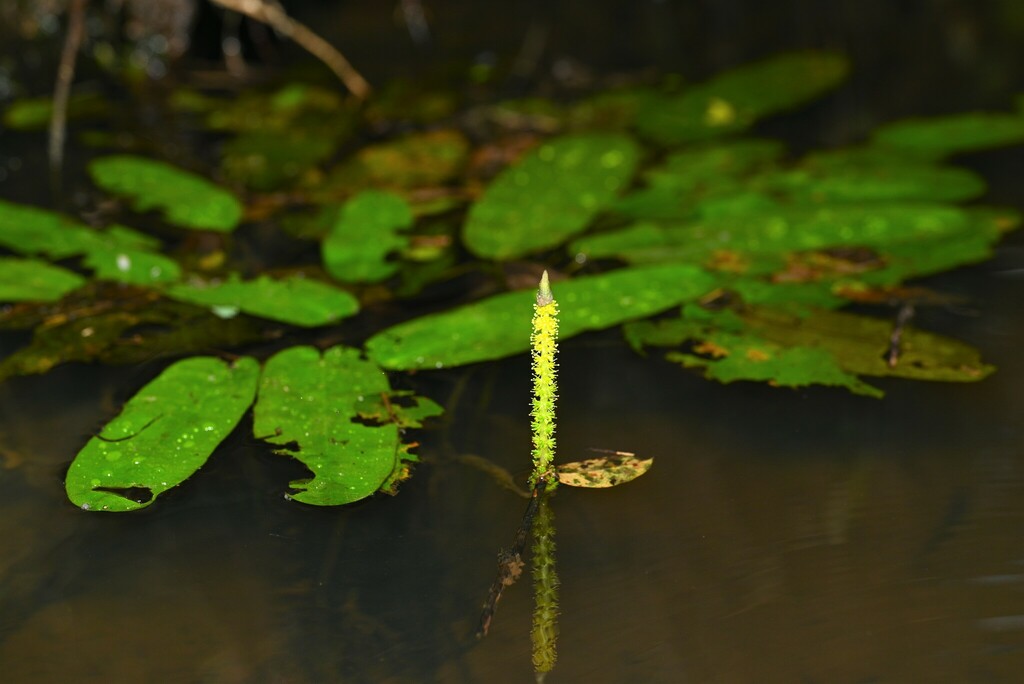
Aponogeton lakhonensis
Aponogeton lakhonensis is a species of an aquatic plant in the Aponogetonaceae family. This species with a yellow-flowered single spike rising above the water, is found in ricefields, ponds and slow-moving streams of tropical and sub-tropical Asia. An outlier population occurs in Sulawesi, the main area of occurrence is from Thailand to China and Assam in India. It is more closely related to tropical Australian species of Aponogeton than it is to other Southeast Asian species. In Thailand the whole plant is eaten is salads, whereas Cambodians prefer the leaves alone served with fish sauce.
From the article Aponogeton lakhonensis on Wikipedia (CC BY-SA), quoted section by section
Description
The species has an obovoid or elongated rhizome, up to 2 cm in length, with a filament remnant of the sheath often present. The petiole in submerged leaves is some 9 to 15 cm long, in floating leaves it is up to 40–60 cm in length. The narrowly ovate to linear leaf-blade is some 4–6 by 1–2 cm in size, herbaceous (soft, not woody/stiff), with some 7 to 9 primary veins at the base, cordate or rounded base, entire margin, either rounded apex or with a blunt tip. Pedunculate inflorescences, up to about 5 cm in size. Bisexual flowers, 2 yellow and slightly obovate perianth segments some 2 mm long; 6 stamens with broadened filaments toward the base; the carpels are slightly united near their base, with 4 to 6 ovules per carpel. Ovoid fruit with a short terminal beak, some 2–3 mm. Flowering in China occurs from April to October. Flowering time in Thailand is at least in March, May and September–October. Distinguishing characteristics of this taxa include: inflorescence with one spike; persistent tepals up to about 3 mm, yellow and obovate; not stoloniferous; 4–8 ovules; double testa; widened filament; short lateral beak on fruit; leaves are mainly submerged, not floating, submerged leaves some 25–6 cm in size, floating leaves up to 17 by 4 cm; petiole of submerged leaves some 7–35 cm long; ovaries some 1–1.75 mm; fruit is up to 3 by 2 mm, the beak is short, terminal or lateral; with s …
Range & habitat
This species is native to an area from Southeast Asia to China and Assam, and also in Sulawesi. Countries and regions in which it occurs indigenously are: Indonesia (Sulawesi); Thailand; Cambodia; China (Fujian, Guangdong, Guangxi, Hainan, Jiangxi, Yunnan, Zhejiang {Longquan}); Taiwan; Laos; Myanmar; and India (Assam, Meghalaya, Nagaland).
Wikipedia: “Distribution”
What it does
The taxa is found in paddy fields, ponds and streams. It is more or less abundant at specific sites of slow-flowing watercourses, paddy fields, streams and ponds. It has been found up to 800m above sea level.
Wikipedia: “Habitat and ecology”
At the table
Near the city of Lampang, Thailand, the whole plant is eaten in salads. The leaves of this species are eaten in Cambodia, they are served raw with fish sauce.
Wikipedia: “Uses”
In human culture
The species was named in 1910 by the French botanist Aimée Antoinette Camus (1879–1965). She specialised in orchids and oaks, her father was a botanist (Edmond Gustave Camus, 1852–1915), while the painter Blanche-Augustine Camus (1882–1968) was her sister. She published the description of the species in the publication Notulae Systematicae: Herbier du Muséum de Paris: Phanérogramie.
Wikipedia: “History”
Where it lives
Recorded sightings
—
geo-referenced records in GBIF, from museums, herbaria and field observers.
Drag the globe to turn it. Dots are where records exist, not a range map; darker means more records.
In the stacks
Searching the stacks…
Every page naming Aponogeton lakhonensis in the Biodiversity Heritage Library →
This page is assembled live from iNaturalist, GBIF, Wikipedia, the Source Library and the Internet Archive. It is not yet part of the hand-edited codex. iNaturalist taxon 435804.