- Animals
- ›Chordates
- ›Vertebrates
- ›Mammals
- ›Therians
- ›Placental Mammals
- ›Primates, Rodents, and Allies
- ›Primates
- ›Monkeys, Apes, and Tarsiers
- ›Monkeys and Apes
- ›Apes and Old World Monkeys
- ›Old World Monkeys
- ›Cercopithecines
- ›Guenons, Vervet Monkeys, and Talapoins
- ›Chlorocebus
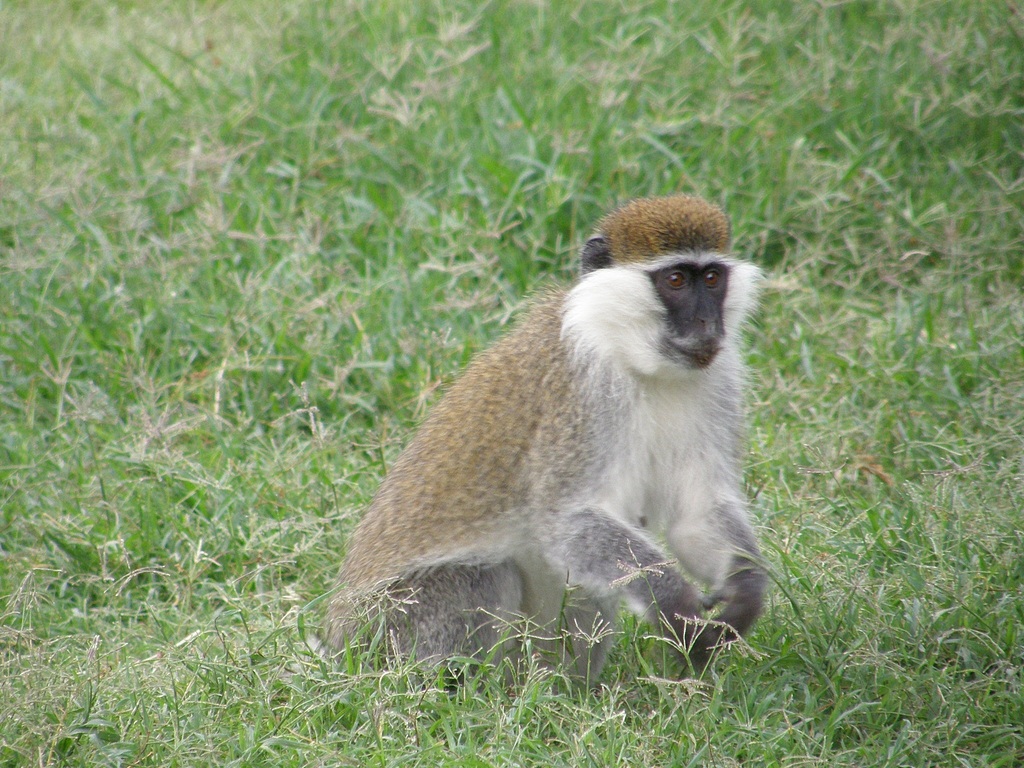
Grivet Monkey
Chlorocebus aethiops
The grivet (Chlorocebus aethiops) is an Old World monkey with long white tufts of hair along the sides of its face. Some authorities consider this and all of the members of the genus Chlorocebus to be a single species, Cercopithecus aethiops. As here defined, the grivet is restricted to Ethiopia, Sudan, Djibouti, and Eritrea. In the southern part of its range, it comes into contact with the closely related vervet monkey (C. pygerythrus) and Bale Mountains vervet (C. djamdjamensis). Hybridization between them is possible, and may present a threat to the vulnerable Bale Mountains vervet. Unlike that species, the grivet is common and rated as least concern by the IUCN.
From the article Grivet on Wikipedia (CC BY-SA), quoted section by section
Range & habitat
The main habitat of the grivet is savanna woodlands. Its range is Sudan east of the White Nile, Eritrea, and Ethiopia east to the Rift Valley. It is also found in Djibouti. The grivet needs to live around a source of water, especially during the dry season. It is able to adapt to many environments.
Wikipedia: “Habitat and distribution”
What it does
The grivet is most active in the morning and early evening. It stays on the ground most of the day to eat, and at night it sleeps in trees. The grivet spends a lot of time grooming, playing, climbing, and play fighting; all of these things help to ensure its survival. Its eating habits consist of eating mostly fruits, vegetables, and sometimes small mammals, insects, and birds, making it an omnivore. It also scavenges for human food. It must drink water daily, especially in the dry seasons. It is one of few species that has multiple-male groups that are of moderate size. In the hierarchy of males, an individual shows his dominance by putting his tail in a stiff, upright position and strolling past lower-ranked males. They travel in packs, and usually move on all fours or quadrupedally, except when using both hands for carrying, when they manage to walk and run quite comfortably on two legs. Groups can range from five to over 70. Females will have a limited number of mates, while males may have several. Swelling of the female's vulva alerts males as to when she is in estrus. Giving birth to one baby at a time is common, and gestation usually lasts 2-3 months. When the baby is born, the mother cleans the infant and bites off the umbilical cord. Young have pink faces and black hair. Around two months are needed for them to get their adult coats. …
Wikipedia: “Behavior”
Listen
Looking for field recordings…
Where it lives
Recorded sightings
—
geo-referenced records in GBIF, from museums, herbaria and field observers.
Drag the globe to turn it. Dots are where records exist, not a range map; darker means more records.
In the stacks
Searching the stacks…
Every page naming Chlorocebus aethiops in the Biodiversity Heritage Library →
This page is assembled live from iNaturalist, GBIF, Wikipedia, the Source Library and the Internet Archive. It is not yet part of the hand-edited codex. iNaturalist taxon 43523.