- Animals
- ›Chordates
- ›Vertebrates
- ›Mammals
- ›Therians
- ›Placental Mammals
- ›Primates, Rodents, and Allies
- ›Primates
- ›Monkeys, Apes, and Tarsiers
- ›Monkeys and Apes
- ›Apes and Old World Monkeys
- ›Old World Monkeys
- ›Colobines
- ›Langurs, Surilis, and Lutungs
- ›Presbytis
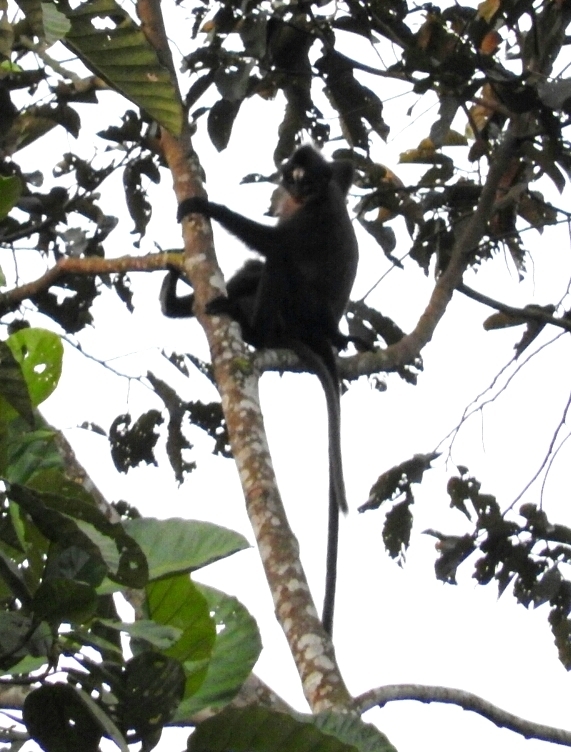
White-fronted Surili
Presbytis frontata
The white-fronted surili (Presbytis frontata) is a species of primate in the family Cercopithecidae, the Old World monkeys. It is endemic to the large international island of Borneo, in Indonesia, Malaysia, and possibly Brunei.
Its body is mainly grey-brown, with a distinct white spot on the forehead. Its chin and lower cheeks are greyish. Its natural habitat is subtropical or tropical dry forests. It is threatened by habitat loss.
From the article White-fronted surili on Wikipedia (CC BY-SA), quoted section by section
Range & habitat
This species is diurnal and arboreal. It is also primarily a folivorous species, but also consumes fruits and seeds. This species prefers to eat immature leaves to more mature ones. The group sizes range from 10 to 15 individuals. P. frontata can be found in tall lowland and hill dipterocarp forests, not above 300 meters. This species has also been observed in riverine and hill forest.
Wikipedia: “Ecology and habitat”
What it does
The white-fronted surili moves through the forest quadrupedally. This species also moves through the forest by leaping. In the population, solitary males have been observed in this species. For communication, the males use loud calls to demarcate the group's territory. There is also tactile communication, which is social grooming. This is when one individuals groom another to reinforce the bonds between individuals. For reproduction, they only give birth to a single offspring.
Wikipedia: “Social behaviour and communication”
Listen
Looking for field recordings…
Where it lives
Recorded sightings
—
geo-referenced records in GBIF, from museums, herbaria and field observers.
Drag the globe to turn it. Dots are where records exist, not a range map; darker means more records.
In the stacks
Searching the stacks…
Every page naming Presbytis frontata in the Biodiversity Heritage Library →
This page is assembled live from iNaturalist, GBIF, Wikipedia, the Source Library and the Internet Archive. It is not yet part of the hand-edited codex. iNaturalist taxon 43503.