- Animals
- ›Chordates
- ›Vertebrates
- ›Mammals
- ›Therians
- ›Placental Mammals
- ›Primates, Rodents, and Allies
- ›Primates
- ›Monkeys, Apes, and Tarsiers
- ›Monkeys and Apes
- ›Apes and Old World Monkeys
- ›Old World Monkeys
- ›Cercopithecines
- ›Guenons, Vervet Monkeys, and Talapoins
- ›Cercopithecus
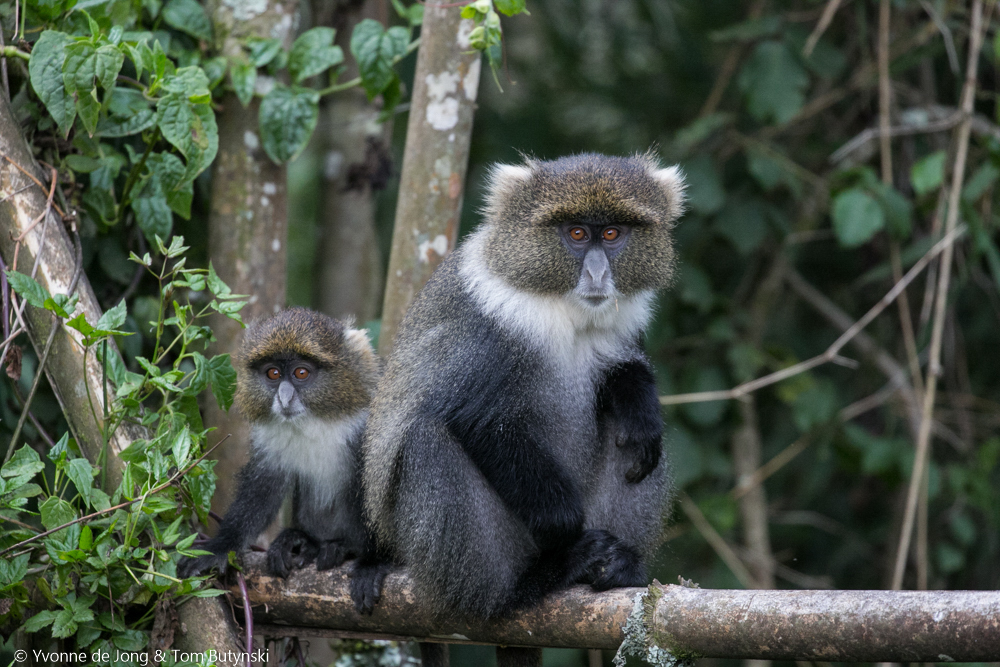
Blue Monkey
Cercopithecus mitis
The blue monkey or diademed monkey (Cercopithecus mitis) is a species of Old World monkey native to Central and East Africa, ranging from the upper Congo River basin east to the East African Rift and south to northern Angola and Zambia and populations further south down to South Africa. The taxonomy of this species has been disputed and Sykes' monkey, the silver monkey and the golden monkey are often regarded as subspecies.
From the article Blue monkey on Wikipedia (CC BY-SA), quoted section by section
Description
Like other mammals with the name "blue" (blue tick hound, blue wildebeest), the blue monkey often has a slaty-grey cast that can look blue to observers. It is mainly olive or grey apart from the face (which is dark with a pale or yellowish patch on the forehead – the "diadem" from which the species derives its common name), the blackish cap, feet, and front legs, and the mantle, which is brown, olive, or grey depending on the subspecies. Typical sizes range from 50 to 65 cm (20 to 26 in) in length, (not including the tail, which is almost as long as the rest of the animal), with females weighing a little over 4 kg (8.8 lb) and males up to 8 kg (18 lb).
Range & habitat
The blue monkey is found in evergreen forests and montane bamboo forests, and lives largely in the forest canopy, coming to the ground infrequently. It is very dependent on humid, shady areas with plenty of water. It eats mainly fruit and leaves, but will take some slower-moving invertebrates. It prefers to live in tall trees, which provide both food and shelter, and is, therefore, like almost all guenons, suffering from the loss of its natural habitat. Where pine plantations replace natural forest, the monkey may be treated as a threat by foresters, since it sometimes strips bark from exotic trees in a search for food or moisture. It is also hunted for bushmeat and as payback for crop-raiding.
Wikipedia: “Habitat”
What it does
Blue monkeys primarily eat fruits, including figs. They also eat insects, leaves, twigs, and flowers. "They are primarily frugivores, with 50% of their diet consisting of fruit, with leaves or insects being the main source of protein, with the rest of the diet being made up of seeds, flowers and fungi. [....] They eat a variety of plants but concentrate on a few species, which means their population density is generally dependent on plant species richness and diversity." Rarely, they eat vertebrates, such as lizards, birds, and small mammals including bushbabies.
Wikipedia: “Diet”
Listen
Looking for field recordings…
Where it lives
Recorded sightings
—
geo-referenced records in GBIF, from museums, herbaria and field observers.
Drag the globe to turn it. Dots are where records exist, not a range map; darker means more records.
In the stacks
Searching the stacks…
Every page naming Cercopithecus mitis in the Biodiversity Heritage Library →
This page is assembled live from iNaturalist, GBIF, Wikipedia, the Source Library and the Internet Archive. It is not yet part of the hand-edited codex. iNaturalist taxon 43486.